Our team was at the Asia Retail Congress in Mumbai this February. The agenda, much in line with the National Retail Foundation's (NRF) 2024 retail summit, was to discuss how Indian retailers can use emerging trends and technologies to create distinctive, revenue-driving customer experiences. The general understanding at the event was that AI and other emerging tech is just a piece of the customer experience puzzle.
There is a growing demand for all-encompassing, unified retail experiences that combine convenience and engagement. Everyone from the retailers to the tech infrastructure itself plays a critical role in building these experiences. It might be time for Indian retailers to focus on all of these areas and re-examine their role in the “aam aadmi’s” shopping journey/average shopper’s customer journey.
Here’s what has the attention of some of India’s biggest retail heads in 2024.
The shift towards unified commerce
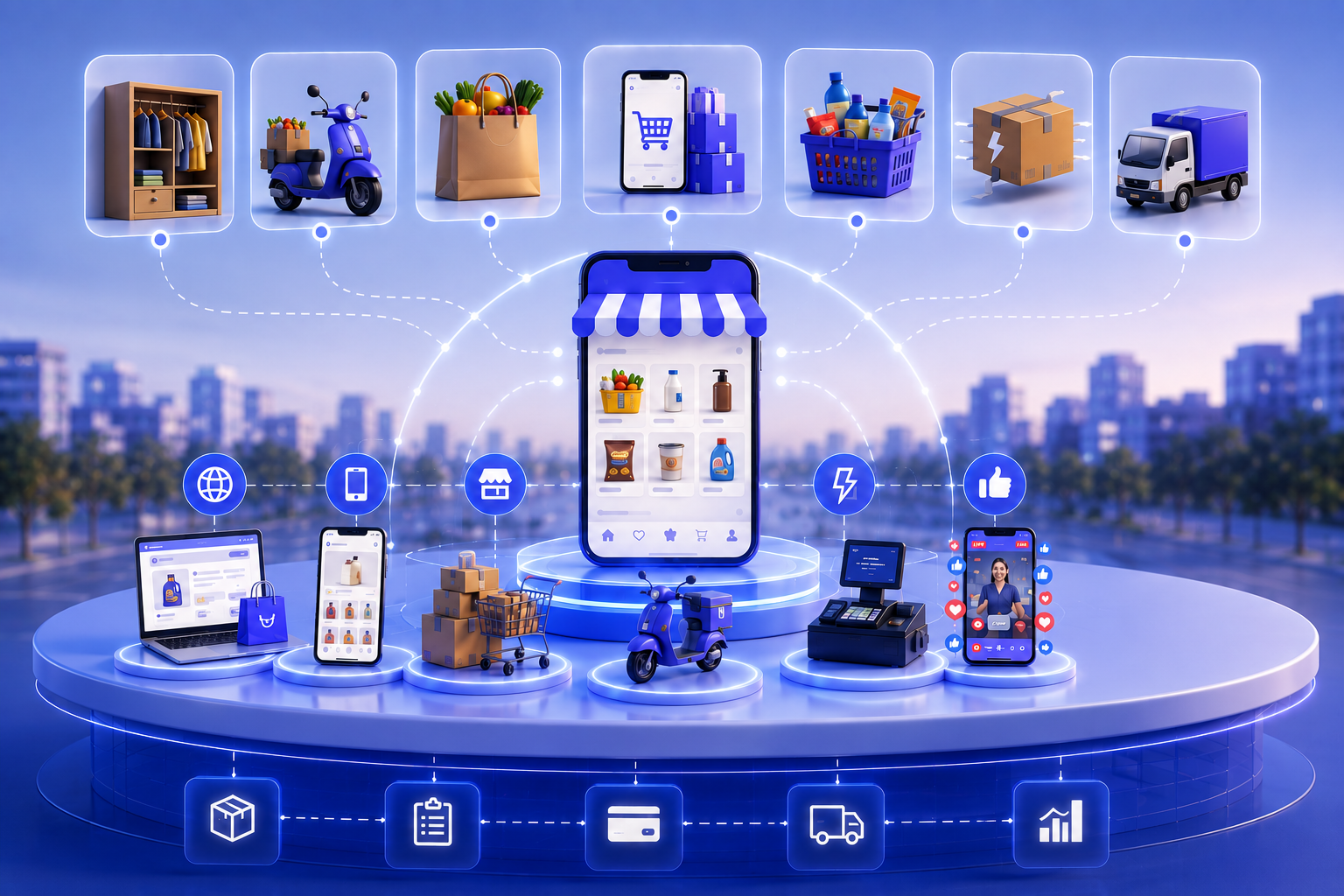
Several talking heads at the event showed interest in fast-tracking the adoption of unified commerce, a concept that goes beyond the coordination of multiple sales channels. In unified commerce, every touchpoint across a customer’s online and offline shopping journeys connects seamlessly, crafting a convenient and enjoyable experience.
To achieve this, businesses will have to invest in tech infrastructure that allows for a real-time exchange of data between several endpoints. The infrastructure would support customer facilities like,
The need for more streamlined social strategies
Social commerce strategies can help a brand meet several goals like boosting customer acquisition, increasing brand awareness and visibility and increasing customer loyalty. However, strategies that aim to achieve all of this at once tend to fail.
This is simply because successful social media campaigns require extensive yet precise planning guided by a clear objective. For instance, brand awareness campaigns tend to be bigger, using widely popular faces to establish a strong and trustworthy brand image. On the contrary, a successful acquisition campaign might require the brand to partner with smaller, more relatable ‘micro-influencers’ that can drive traffic to local stores.
Understanding how audiences respond to different types of social media content can help brands create highly focused and effective campaigns that actually drive results.
Attendees at the event observed that most social media campaigns being run by Indian retailers focused solely on driving online sales through their brand websites and marketplaces. While it can be an effective strategy for online-only or online-first brands, those with an established physical presence might be missing out by not using social media to drive customer traffic to their local stores.
Abhijeet Anand, founder of specialty coffee chain abCoffee discussed a recent successful social media campaign at the event. The campaign helped drive traffic to his Mumbai stores that were doing most of their business through Zomato.
The campaign advertised speed dating events across several of abCoffee’s Mumbai stores ahead of Valentine’s Day. This led to several of the brand’s online customers visiting its stores and interacting with the brand first-hand.
Renewed focus on mobile-first approach
A report from 2023 shows that Indian shoppers spent a total of 12.8 billion hours on shopping apps during the year, next only to China. This represents a significant increase as compared to 2020 and shows the growing preference for mobile shopping across the country.
Brands can capitalize on this by placing a renewed emphasis on mobile shopping experiences and moving beyond traditional mobile optimization measures. They can,
- Prioritize WhatsApp promotions over SMS and email marketing campaigns for better conversions.
- Adopt accelerated mobile pages (AMPs) that load instantly under most network conditions
- Host their remote/home shopping catalogs on instantly accessible microsites
- Invest in web applications that allow easy mobile access without the need to install anything
The advent of conversational commerce
Several of the world’s leading retailers like Walmart and Amazon have rapidly incorporated GenAI into their digital and physical shopping journeys. These advanced AI and NLP-powered features are being used to solve complex product discovery problems through conversational commerce.
Conversational or ‘Human-by-design’ commerce is the ideology/practice of making shopping experiences as intuitive and seamless as possible. This includes using AI-based functionality like semantic search to make shopping experiences more ‘human’.
With standard search, users need to search for specific products to build a cart that serves their use case. Semantic search allows for a use-case based approach where AI understands the user’s input and returns a list of products they might need.
For instance, a semantic search for ‘Cricket match party’ might return a cart with a TV, speakers, snacks, beverages and other things you’d need for a watch party.
GenAI-powered chatbots and search bars can allow Indian retailers to offer convenient and distinctive search experiences that boost their online conversions.
The launch of Open Network for Digital Commerce (ONDC)
The ONDC initiative helmed by the Indian government was rolled out in 2023 to promote more open and democratic commerce supported by open ecommerce networks.
ONDC can be thought of as a set of open protocols connecting various buyer apps— online marketplaces where customers can shop, to seller apps where retailers can onboard and manage their business.
It represents a significant pivot in the Indian marketplace in terms of :
- Level Playing Field: Thanks to its open network, ONDC enables smaller retailers to compete on equal footing with large players, increasing their visibility and reach.
- Enhanced Consumer Choice: By aggregating offerings from various sellers across platforms, it enriches consumer choice, allowing customers to easily compare products and prices across sellers and platforms.
- Accessibility and Inclusion: ONDC aims to make digital commerce accessible to rural and semi-urban areas with low ecommerce penetration. This inclusivity can unlock the potential of a large customer base that was previously untapped due to the digital divide.
Several major seller apps like Paytm, Meesho, Magicpin and Craftsvilla are already a part of the ONDC network with major more planning to join the list in 2024. Joining the ONDC network can prove to be a smart, future-forward decision for both retailers and ecommerce service providers.
Fynd has recently joined the ONDC network with both buyer and seller apps and as a Technology Solution Provider (TSP)! Retailers on the Fynd Commerce Platform can now sell on all ONDC marketplaces via our ONDC Seller integration.
The general discourse at the Asia Retail Congress suggested that 2024 is expected to be a transformative year in Indian retail. Apart from the rapid adoption of pioneering GenAI technologies, the Indian marketplace is witnessing a shift in both consumer behavior and the ecommerce infrastructure that connects businesses to customers.
The growing demand for distinctive shopping experiences and the roll-out of equal opportunity initiatives like ONDC serve to open the playing field for retailers looking to capture a rapidly evolving market.
%252520(1).webp)