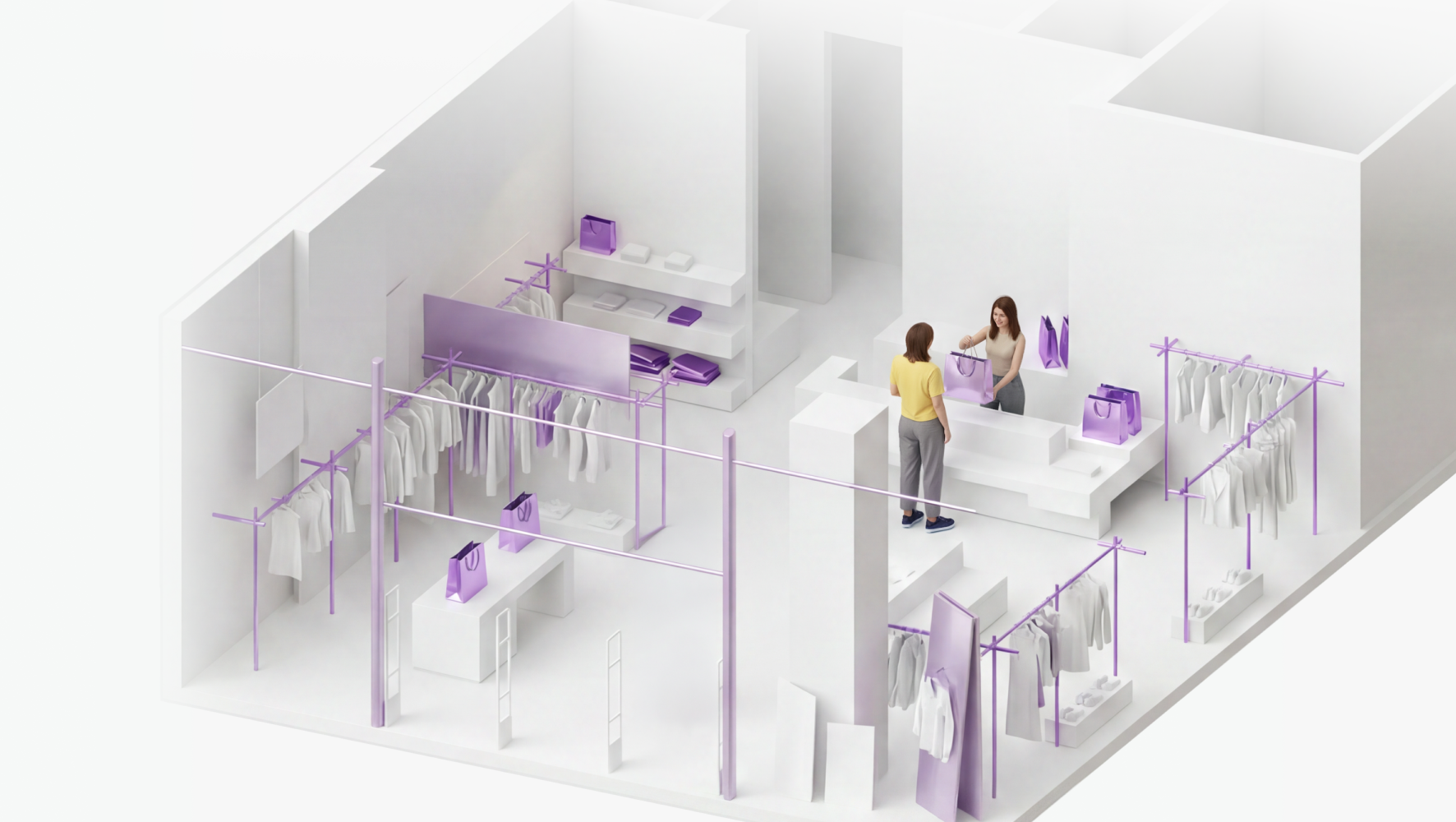
Isometric render of a retail store checkout, with staff assisting a customer amid clothing racks and shopping bags
Special ProjectCustomer Experience SensingRetail

Retail Jarvis.

Predictive, non-intrusive, always-on CX sensing. Reads operational reality and customer behaviour without asking a single question. 4 scores, 1 feedback loop. Anchor demo on Store 5943.

Building · Anchor demo on Store 5943, Mumbai Infinity MaladRoadmap · Production rollout, non-biometric by design
StatusBuild

Build

stage · anchor demo on Store 5943

4

core outputs · Readiness, CX, Friction, Churn

4

engine stages · Readiness → Journey → Behaviour → AI

Status

In Build. Anchor demo on Store 5943. Production rollout next.

Building

Foundation

Cornerstone in.

11-page cornerstone working note shipped 26-Nov-2025 (rev 16-Dec-2025). First principles, offline and online signal inventories, four core outputs, actions and feedback loops. The build proceeds against this spec.
Building

Anchor demo

Jarvis console · Store 5943.

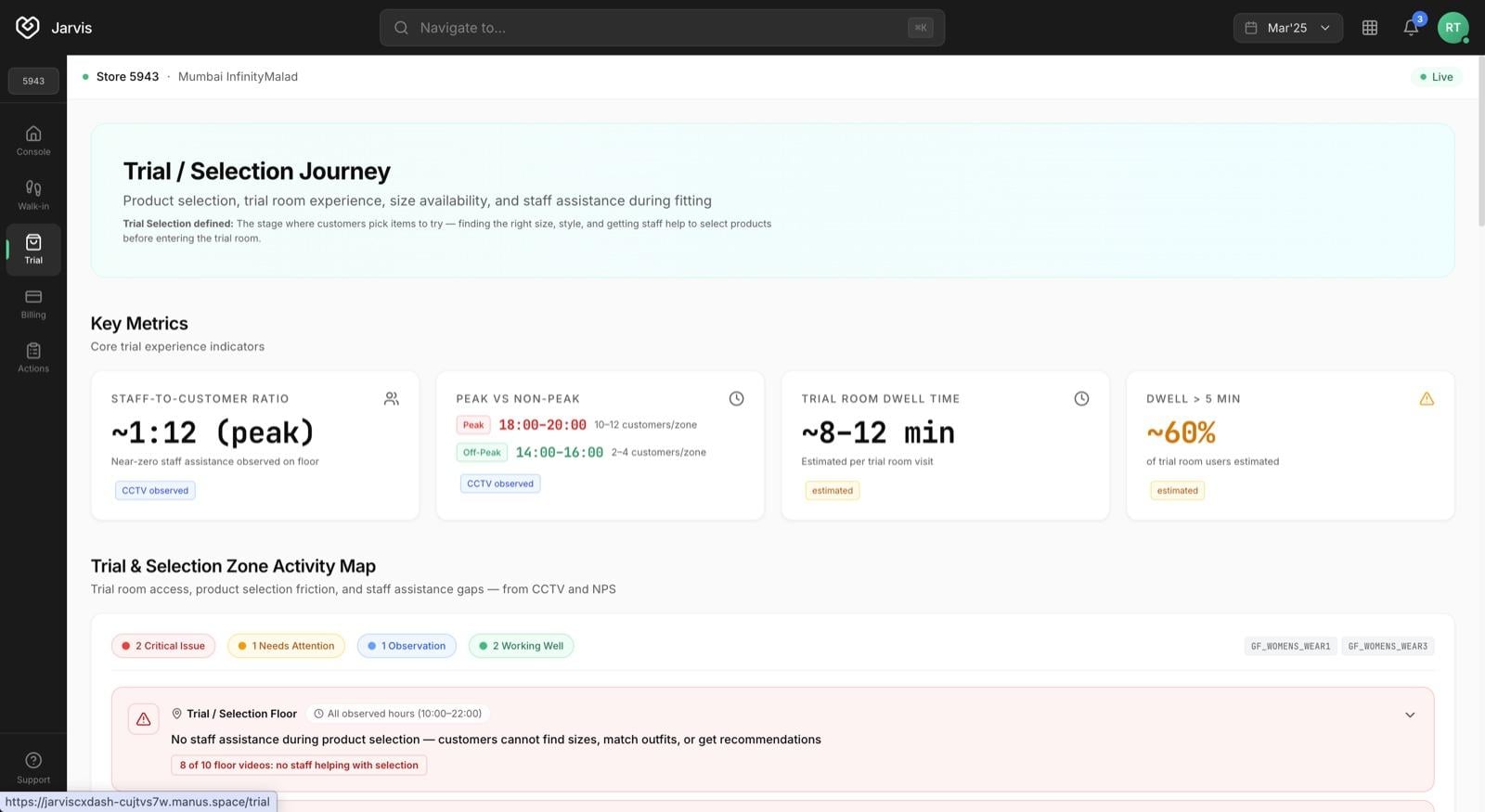
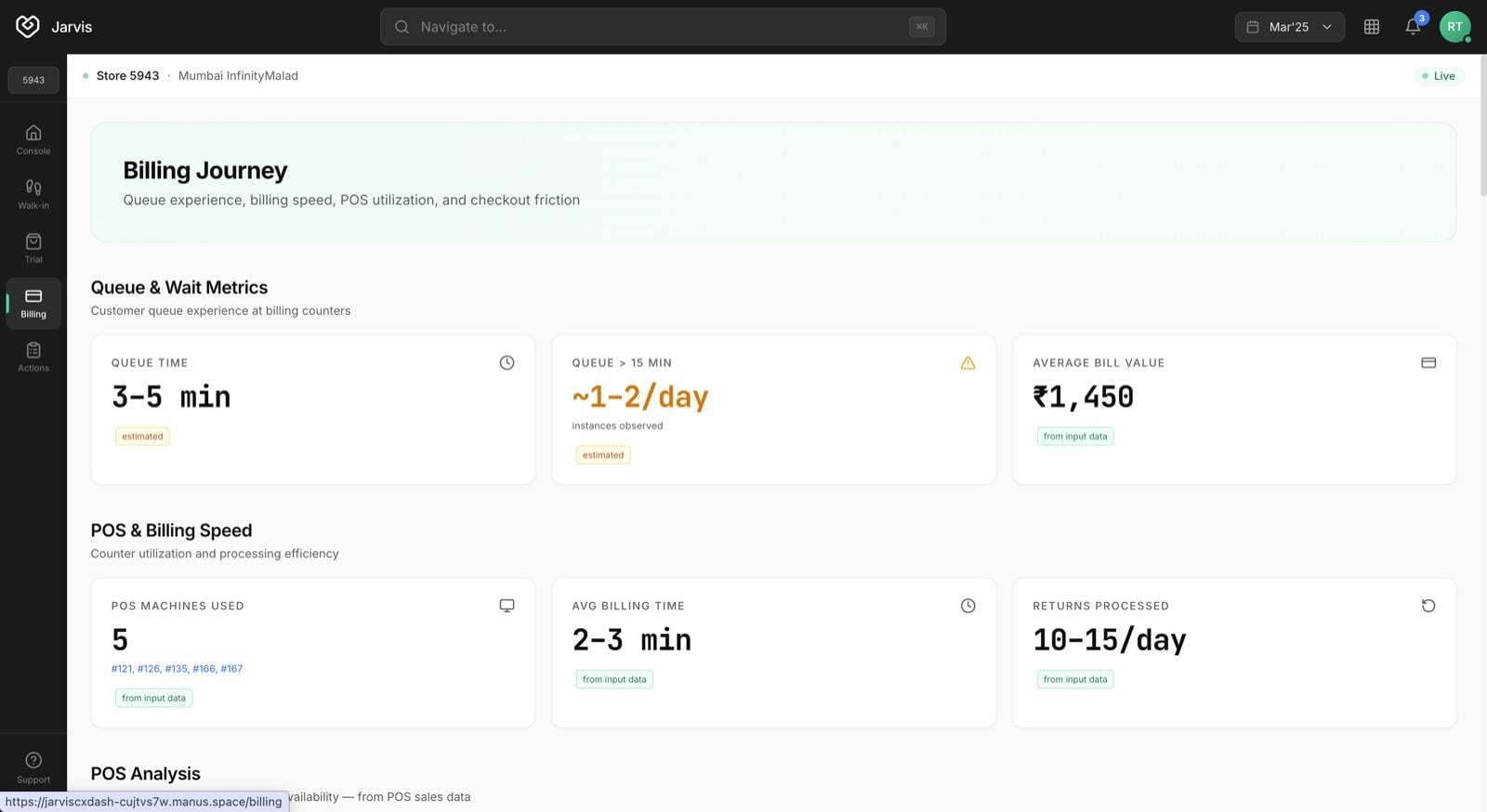
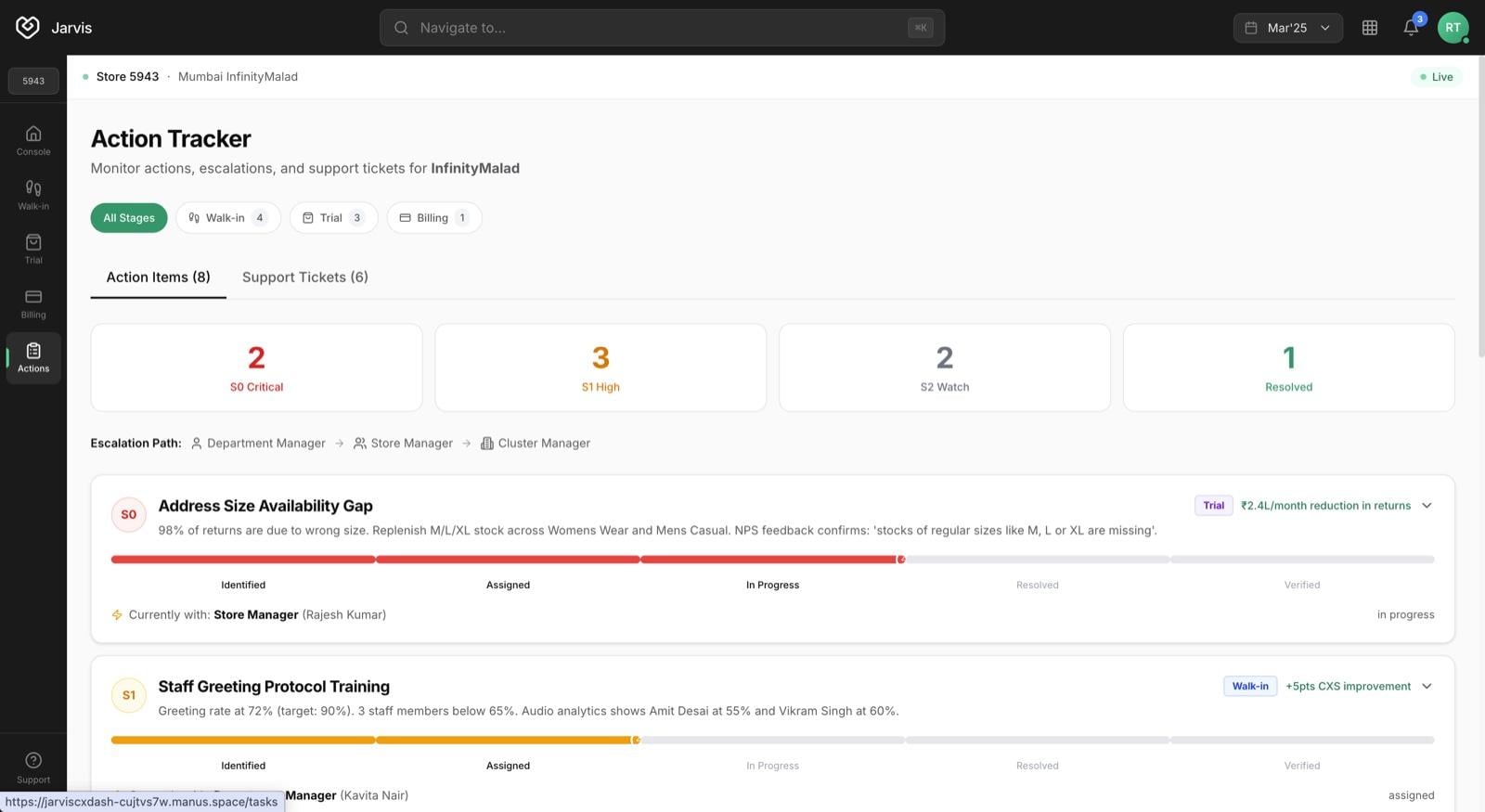
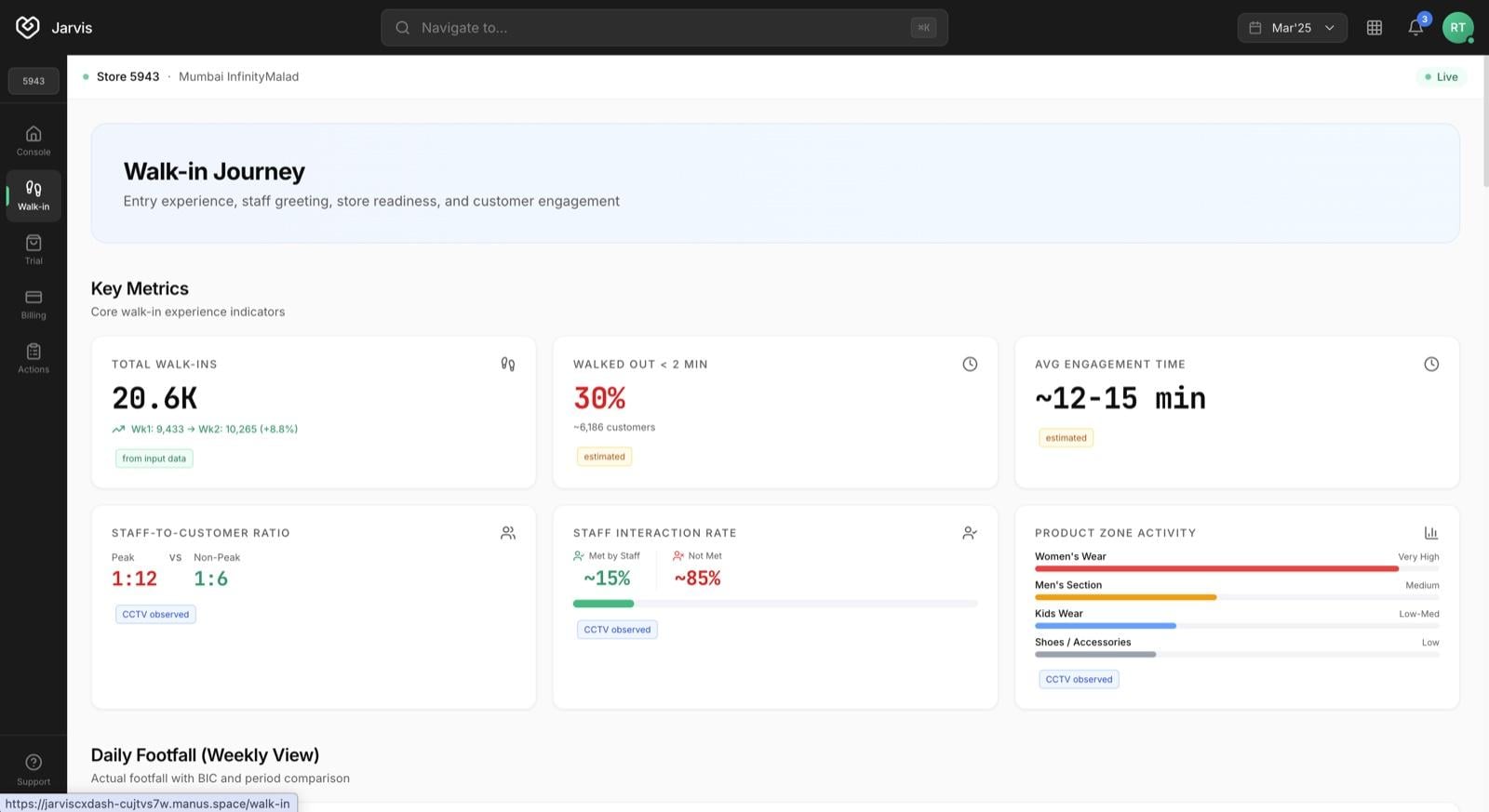
Five operator surfaces being built on Store 5943 (Mumbai Infinity Malad): Customer Journey Funnel, Walk-in, Trial/Selection, Billing, Action Tracker. CCTV-observed and POS-input metrics; estimated where instrumentation is pending.

Roadmap

Production rollout

Multi-store · non-biometric by design.

Production rollout across additional formats. Silhouette/posture CV only (non-biometric) per cornerstone Section 2C. Product to be re-housed under Impetus as Impetus Jarvis.

First principles

Customer experience cannot be understood by asking customers.

It must be observed. The cornerstone working note states four principles before any signal, score, or action is defined. Every downstream choice in the system rests on these.

Principle 01

Start with operational reality.

Temperature, lighting, cleanliness, product availability, navigability, staff readiness, app stability, search performance, delivery completeness, competitor pricing. If readiness is wrong, every downstream customer signal is distorted.

Principle 02

Behaviour reveals truth.

Customers communicate through actions long before words — continuing to browse or exiting, putting items back, abandoning a queue, retrying payment or dropping off. These signals are richer than any form-based feedback.

Principle 03

Build bottom-up.

Order matters: Readiness, Journey, Behaviour, Inference. Measure the environment first, capture what happened, observe the response, then infer experience quality and predict risk. Inverting the order produces assumptions, not insight.

Principle 04

Include external context.

Customer expectations are shaped before they enter a store or open the app. Competitor pricing, local promotions, social sentiment, and seasonal factors must be part of the model, or behaviour is interpreted out of context.

Architecture

One sensing engine. Three sides.

Signals enter on the left (offline, online, external). The Experience Sensing Engine runs four stages and emits four core KPIs. Playbooks on the right route each KPI to the team that can act. Operational changes feed new signals back to the engine for continuous learning.

Left · Signals

Three signal families.

Offline store (RFQM, AOV, footfall, queue, path, putback, switching), online/digital (RFQM, AOV, micro-journeys, NLP sentiment, channel switching), and external/market (competitor pricing, local promotions, environment, seasonality).

Centre · Sensing engine

Four stages, in order.

Readiness Measurement (store, digital, external context), Journey Capture (offline, digital, fulfilment), Behavioural Analytics (dwell, paths, queue, funnel), AI Inference (experience quality, friction locations, churn risk).

Right · Playbooks & actions

Four owners, by KPI.

Store Operations (readiness, staffing, assortment), Digital & Product (search, performance, payments), Fulfilment & Logistics (SLA, substitutions, reliability), CRM & Marketing (retention, outreach, recovery).

Retail Jarvis architecture — Signals to Experience Sensing Engine to Playbooks and Actions, with four core KPIs

Four stages, end to end. Signals (Offline Store, Online/Digital, External/Market) → Experience Sensing Engine (Readiness Measurement, Journey Capture, Behavioural Analytics, AI Inference) → Core KPIs (Store Readiness, Customer Experience, Friction Index, Churn Risk) → Playbooks (Store Ops, Digital & Product, Fulfilment & Logistics, CRM & Marketing). Operational changes feed new signals back — scores update.

Anchor demo

Five operator surfaces in build on the anchor store.

Jarvis console being built against a single anchor store, Store 5943 (Mumbai Infinity Malad). Each surface answers one operational question: where does the funnel break, what happens at the door, what happens in the trial room, what happens at the till, what does the manager fix.
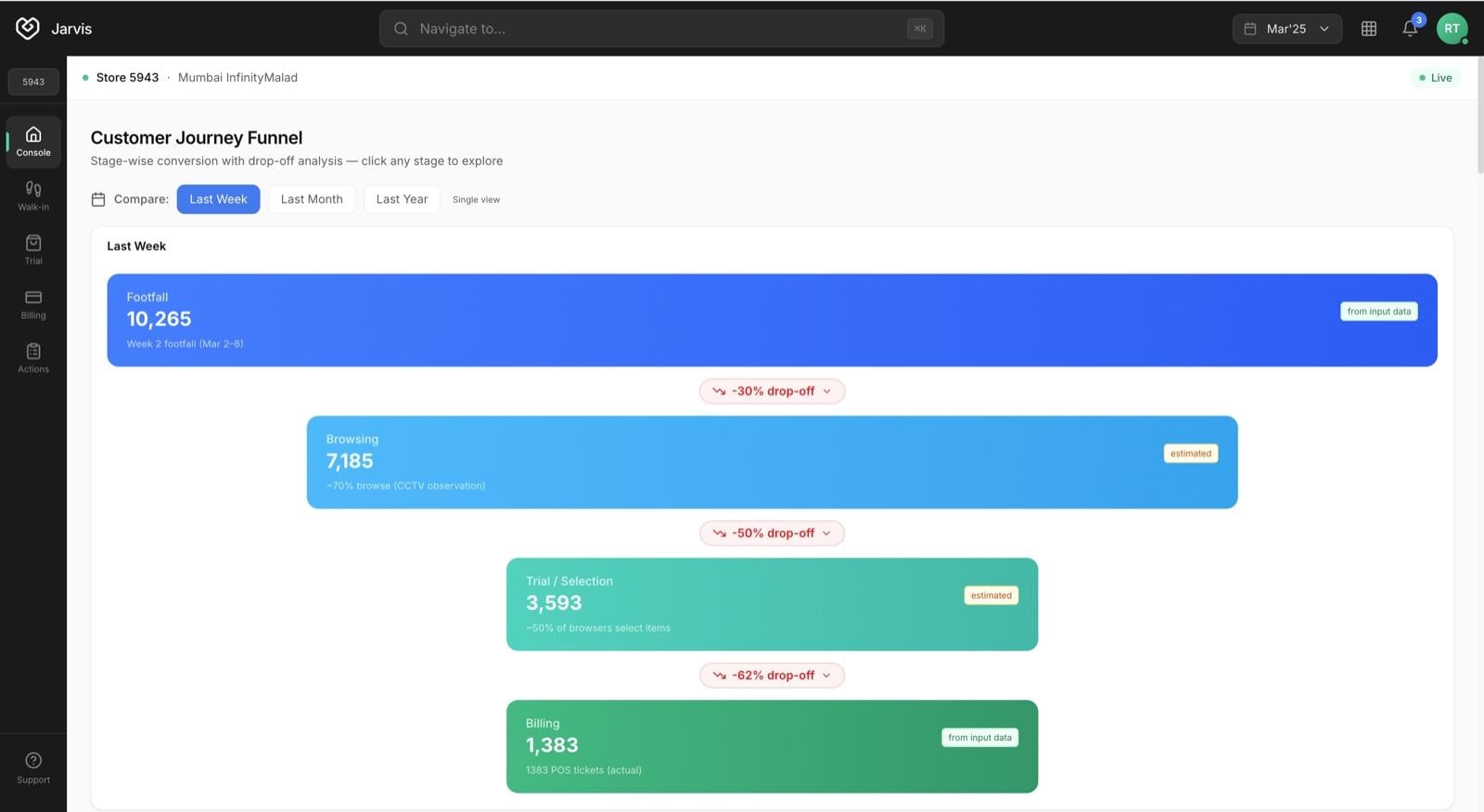
Jarvis Console — Customer Journey Funnel for Store 5943 — Footfall 10,265 to Browsing 7,185 (-30%) to Trial 3,593 (-50%) to Billing 1,383 (-62%)

Stage-wise conversion with drop-off analysis. Last week (W2, Mar 2–8): Footfall 10,265, Browsing 7,185 (−30%), Trial/Selection 3,593 (−50%), Billing 1,383 (−62%). Footfall and Billing are from input data; Browsing and Trial are estimated from CCTV observations.

Jarvis Console — Customer Journey Funnel for Store 5943 — Footfall 10,265 to Browsing 7,185 (-30%) to Trial 3,593 (-50%) to Billing 1,383 (-62%)

Core outputs

Every signal collapses into four scores.

All offline and online signals consolidate into four outputs. Each has a defined calculation, a defined meaning, and a downstream playbook.

OutputWhat it answersHow it is calculated · inputsFeeds
Store Readiness Score
Was the store/app operationally ready today?
AC/temperature, lighting, cleanliness, staffing presence, assortment completeness, out-of-stock checks, pricing consistency, Experience Manager App logs, maintenance issues.
Store Operations
Customer Experience Score
Survey-less measure of how customers experienced the journey.
RFQM patterns, basket shifts, queue and billing performance, app/web responsiveness, payment reliability, search effectiveness, fulfilment quality, returns, sentiment.
Store Ops · Product · Fulfilment
Journey Friction Index
Where exactly did friction occur: find, decide, pay, receive, support?
Search zero-results, funnel drop-offs, cart abandonment factors, promo/coupon failures, dwell/navigation delays, queue abandonment, pricing conflicts, fulfilment issues.
Product · Merchandising · Store Ops · Customer Service
Dissatisfaction & Churn Prediction
Which customers are at risk of disengaging or switching?
Declining RFQM, reduced visit frequency, shrinking basket size, repeated returns, channel switching after friction, fulfilment delays, ongoing negative sentiment.
CRM · CX Team
Signal inventory

Every signal that feeds the engine.

From the cornerstone working note. Basic signals rely on existing POS/app data and can be turned on immediately. Intermediate signals require structured process or instrumentation. Advanced signals rely on CV, ML, identity stitching, or social listening.

Offline stores

23 signals · 9 Basic · 8 Intermediate · 6 Advanced.

SignalTierHow capturedWhat it tellsFeeds output
RFQM
Basic
POS transaction history
Engagement level, early churn signs
CX · Churn
AOV & basket composition
Basic
POS basket data
Trade-down, premium loss, buying-behaviour shifts
CX · Churn
Store readiness · Experience Manager App
Basic
Daily checklist (AC, lighting, cleanliness, fixtures, staffing, maintenance)
Was the store fit for customers that day
Readiness
Simple conversion proxy
Basic
POS bills per time-band (approx walk-ins)
Early indicator of friction or mismatch
CX
Billing time
Basic
POS timestamps
Early detection of slow checkout
Friction
Returns & reason codes
Basic
POS return records
Product dissatisfaction or mismatch
CX · Churn
Discount / promo dependence
Basic
POS applied discounts
Value-perception challenges
CX
Competitor pricing (key KVIs)
Basic
Price-intelligence feeds or manual scans
Whether value perception is aligned before arrival
Readiness · Churn
Assortment breadth & depth
Basic
Store ranging files
Assortment gaps affecting expectations
Readiness · Friction
Footfall vs billing
Inter.
Door counters
Customers entering but not buying
CX · Friction
Shelf availability (enhanced)
Inter.
High-frequency staff scans
Persistent out-of-stock patterns
Readiness
Queue length & abandonment
Inter.
Queue counters / overhead count
Checkout friction and staffing needs
Friction · CX
Zone-level dwell (high-level)
Inter.
Overhead heatmaps (non-identity)
Confusing or ignored areas
Friction
Staff responsiveness
Inter.
Staff app interaction logs
Speed of customer assistance
CX
Staffing allocation
Inter.
Roster vs actual POS / staff activity
Understaffing or misalignment with peak demand
Readiness · Friction
Price override / promo mismatch
Inter.
POS override logs
Where pricing or signage is unclear
Friction
Store-level social sentiment
Inter.
Geo-tagged store mentions, social listening
Independent validation of operational issues
CX · Churn
Detailed path & movement loops
Adv.
Full-store heatmap and path analytics
Navigation and search friction
Friction
Pick-putback & hesitation
Adv.
Zone-level CV
Pricing, quality, or information friction
Friction · CX
Body-language friction cues
Adv.
Silhouette / posture CV (non-biometric)
Live dissatisfaction pockets
CX
Comfort index (temp / noise)
Adv.
Distributed sensors
When discomfort affects dwell or conversion
Readiness
Cross-store switching
Adv.
Identity stitching across stores
Customers avoiding a specific store
Churn
Offline-to-online migration
Adv.
Omni-channel identity graph
Unresolved in-store friction pushing customers online
Churn

Online · app + web + OMS + CRM

24 signals · 18 Basic · 6 Intermediate/Advanced.

SignalTierHow capturedWhat it tellsFeeds output
RFQM
Basic
Digital transaction history
Customer engagement and early churn indicators
CX · Churn
AOV & basket composition
Basic
Cart and order logs
Shifts in value perception or buying behaviour
CX
Funnel drop-off (View → Cart → Checkout → Pay)
Basic
Clickstream analytics
Where friction occurs in the digital journey
Friction
Payment failures & retries
Basic
Payment-gateway logs
Trust or payment-UX friction
Friction · CX
Delivery performance
Basic
OMS + last-mile feeds
Reliability and quality of fulfilment
CX · Churn
Returns & reason codes
Basic
Digital returns workflow
Product / content mismatch
CX
Search performance
Basic
Search logs
Catalogue and tagging quality
Friction
Out of stock
Basic
Real-time catalogue availability
Immediate friction due to unavailability
Friction · CX
Assortment range
Basic
Category listing completeness
Whether the digital store meets customer expectations
Readiness · Friction
Competitor pricing
Basic
Price-comparison feeds on key SKUs
How value perception is shaped before checkout
CX
Promo / coupon issues
Basic
Checkout logs
Pricing or promotion clarity issues
Friction
App / web performance
Basic
Telemetry & web vitals
Technical friction affecting engagement
CX
Add-to-cart vs purchase
Basic
Cart activity vs orders
Pricing, delivery, UX or trust issues
CX
Customer-service touchpoints (Chat / Bot / WhatsApp)
Basic
CRM and chat logs
Themes driving friction or confusion
Friction
Support tickets
Basic
CRM systems
Where digital journeys fail operationally
CX
Ratings and reviews
Basic
App / web review systems
Customer sentiment on products and service
CX
Store-pick order quality
Basic
OMS pick logs
Offline readiness affecting online fulfilment
CX
Social media sentiment
Basic
Public posts referencing digital experience
External validation of digital experience quality
CX
Behavioural micro-journey patterns
Inter./Adv.
Session-path analytics
Predicts dissatisfaction before drop-off occurs
CX · Friction
NLP sentiment from chats / emails / reviews
Inter./Adv.
NLP / ML text analysis
Hidden friction not visible in clickstream data
CX
Product-content quality issues
Inter./Adv.
ML on product descriptions, images, return reasons
When inaccurate or incomplete content erodes purchase confidence
Friction
Personalisation failure signals
Inter./Adv.
CTR patterns, relevance scoring
When recommendations degrade experience
CX
Delivery experience prediction
Inter./Adv.
ML on SLA history, traffic, weather
Proactive intervention before a poor experience occurs
CX
Channel switching (online ↔ offline)
Inter./Adv.
Identity stitching across systems
When dissatisfaction in one channel pushes customers to another
Churn
Actions & feedback

Score → trigger → action → re-measure.

Each output is wired to a specific trigger, an action, an owner, and a re-measurement loop. The same signals are measured again after action; scores update; weighting refines based on observed outcomes.

OutputWhat triggers actionAction takenOwnerFeedback loop · re-measured
Store Readiness Score
Low readiness: AC, lighting, cleanliness, staffing gaps, assortment gaps, pricing inconsistencies.
Fix issues immediately (environment, maintenance, stock, staffing). Mark resolution in Experience Manager App.
Store Manager · Experience Team
Readiness re-evaluated next scheduled check or visit.
Customer Experience Score
Low or declining: payment failures, delivery delays, long queues, poor app performance, rising returns.
Identify top drivers by channel; corrective actions across process, staffing, content, UX.
CX Team · Store Ops · Product · Fulfilment
Recalculate CX after fixes; track whether engagement and RFQM recover.
Journey Friction Index
High friction at a specific journey step: search, navigation, checkout, payment, fulfilment, support.
Targeted fixes: improve search tagging, correct pricing or promos, reduce queue time, resolve checkout, fix delivery routes.
Product · Merchandising · Store Ops · Customer Service
Measure reduction in friction signals at the same journey step.
Dissatisfaction & Churn Prediction
Customer or household flagged high-risk: declining frequency, smaller baskets, complaints, negative sentiment.
Proactive retention: personalised outreach, issue resolution, cross-channel support, service guarantees, targeted offers.
CRM · CX Team
Track whether RFQM improves and churn risk decreases after intervention.
AI summary
Retail Jarvis is Fynd's predictive, non-intrusive customer-experience sensing system for retail stores. It reads operational reality and customer behaviour without surveys — combining offline signals (POS, footfall, queue, CCTV-based behavioural cues), online signals (clickstream, app telemetry, NLP sentiment), and external context (competitor pricing, promotions, seasonality) through a four-stage sensing engine (Readiness Measurement, Journey Capture, Behavioural Analytics, AI Inference). The engine emits four core scores — Store Readiness, Customer Experience, Journey Friction Index, and Dissatisfaction & Churn Prediction — each wired to a specific playbook, owner, and feedback loop. An anchor demo is in build on Store 5943 (Mumbai Infinity Malad), with production rollout planned as a non-biometric, silhouette/posture-CV-only system under the Impetus Jarvis product line.

Built for businesses like yours. Let’s connect

  1. 1

    Fill out the form

    Share your contact information to get started

  2. 2

    Speak to an expert

    A member of our sales team will get in touch with you
Get in touch

By submitting, you agree to our Terms of Service and Privacy Policy.