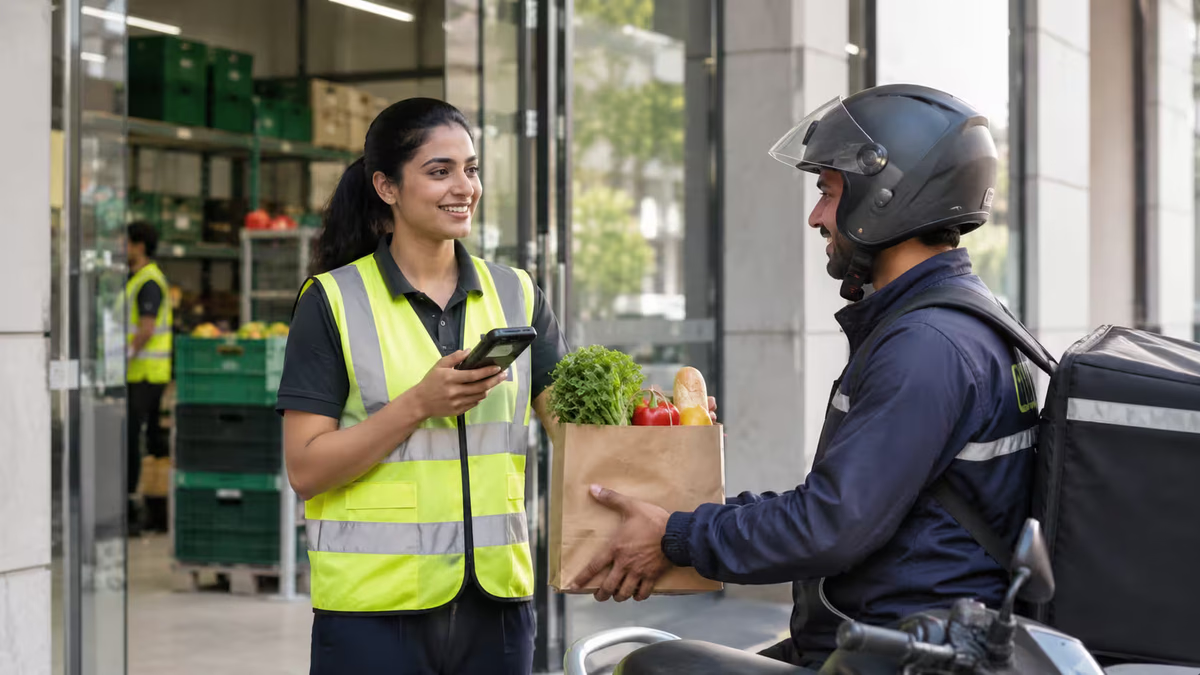
Quick commerce brands such as Blinkit, Zepto and Swiggy Instamart rely on a chain of fast, connected decisions to get an order from a nearby store to a customer. The journey generally works like this: a customer places an order, the platform checks which nearby store can serve the address, store staff pick and pack the items, and a delivery partner takes the order to the customer.
For the delivery team, the handover from store to rider is a key point. The order needs to reach an available rider, along with the right pickup and delivery details. The rider then follows a route to the customer while the operations team monitors progress and responds to delays or other exceptions.
Each part of this journey depends on different systems. An order management system (OMS) helps manage the order and decide where it should be fulfilled. A warehouse management system (WMS) supports picking and packing at the store or dark store. A transport management system (TMS) helps coordinate the delivery once it is ready to dispatch.
In this article, we compare the best transport management systems for quick-commerce brands in India, focusing on the features that keep orders moving from dark store to doorstep.
Top features to look for in TMS software for quick-commerce brands
In order to fulfill a 30-minute delivery, the store must take several steps; they need to choose the right order for dispatch, match it with an available rider, and keep the delivery on track. Here are the top features quick commerce brands should check for hyperlocal deliveries:
1. Map serviceable zones and match each order to a store.
Look for polygon-based serviceability and geofencing. These features help identify which store can serve an address and support a delivery promise the operation can meet.
2. Connect your OMS and WMS.
Check that the TMS receives order details and store fulfilment updates. When picking and packing are complete, a “ready to dispatch” status should trigger rider assignment without a manual handoff.
3. Automate dispatch and balance rider capacity.
Choose a TMS that assigns orders using rider location, availability, workload, and delivery deadline. Check that it shows rider capacity by store or zone, so managers can spot gaps before packed orders start waiting.
4. Optimize routes around delivery promises.
Look for route planning that accounts for travel time, stop sequence, and promised delivery windows. If you batch orders, confirm the TMS can group compatible deliveries without putting those promises at risk.
5. Equip riders for a quick store handover.
Check that the rider app provides order details, pickup instructions, and navigation. Pickup confirmation or barcode scanning records when the order moves from store staff to the rider.
6. Monitor trips and act on exceptions.
Choose a TMS with real-time rider tracking, delivery milestones, and ETA updates. Look for alerts for delayed pickups, unavailable riders, and route changes, so teams can respond or reassign an order while there’s still time.
7. Capture proof of delivery.
Check that riders can record an OTP, photo, signature, or location at handover. This gives the brand a clear delivery record and helps resolve disputes.
8. Reconcile COD after each trip.
If you accept cash on delivery, look for trip-level reconciliation that compares expected collections with the amount returned by the rider. This helps teams identify shortfalls and close cash balances accurately.
9. Calculate and settle rider payouts.
Check that payout rules can use completed deliveries, distance or payment slabs, and record bonuses or deductions. Trip-level earnings and configurable settlement cycles help teams explain and settle rider payments accurately.
Best Transport Management System for Quick Commerce brands
Platform | What to explore |
Fynd TMS | Store serviceability and delivery promises at checkout; dispatch triggered when orders are ready; rider allocation across dark stores; route planning around delivery windows; live ETAs and exception alerts; coordination of in-house riders and delivery partners; COD reconciliation and rider payouts |
Shipsy | Hyperlocal delivery orchestration, automated order allocation and dark-store operations |
Locus | Quick-commerce dispatch, route planning and delivery tracking |
LogiNext | On-demand delivery, order sequencing, route optimization and delivery validation |
FarEye | Enterprise delivery orchestration, routing and real-time execution |
1. Fynd TMS
Fynd TMS manages the delivery journey from a store or dark store to the customer. It checks which location can serve an address, applies that area’s delivery promise, and sends the ready order into dispatch. The system can assign riders, plan routes, track deliveries, and share ETAs. Brands can connect it to their existing OMS, WMS, and ecommerce systems through APIs, and coordinate in-house riders with courier partners. It also supports shipment scanning, electronic proof of delivery (ePOD), COD reconciliation, and rider payouts.
The JioMart TMS customer story shows how these features support quick commerce. JioMart needed to deliver within 10–30 minutes across more than 1,000 locations. Broad pincode zones made it difficult to identify the right store for each address, while manual dispatch and limited delivery visibility made it harder to manage orders at scale. Fynd TMS introduced precise store-level zones, automatic store and rider assignment, and route adjustments as traffic or demand changed. JioMart achieved over 95% on-time delivery.
Fynd TMS also supports retailers managing their own delivery fleet. GIVA, the jewellery brand, wanted to test dedicated riders for high-value orders while meeting a 120-minute delivery promise. The teams needed to use rider time efficiently, track deliveries, and arrange backup when a store’s rider was unavailable. Fynd TMS grouped ready orders into planned milk-run routes, where a rider collects several orders and delivers them along one route. Courier partners provided backup, while riders scanned shipments and captured ePOD through the app. The pilot helped GIVA identify what to improve in rider coordination before expanding the model.
Who should use Fynd TMS?
Fynd TMS suits quick-commerce brands that deliver from dark stores, retail chains that fulfil online orders from nearby stores, and D2C brands adding local or same-day delivery. It is best for businesses that need to coordinate their own riders with courier partners while keeping store serviceability, delivery promises, dispatch, and tracking connected.
2. Shipsy
Shipsy offers a transportation management platform for planning, dispatching, and tracking deliveries. For quick-commerce operations, its on-demand delivery tools can assign orders to nearby riders, optimize routes, group compatible orders into trips, and bring in third-party fleets when demand exceeds available capacity.
3. Locus
Locus provides delivery orchestration and route-planning technology for quick-commerce operations. Its quick-commerce workflow covers order management, automated delivery assignment, route planning and real-time tracking.
4. LogiNext
LogiNext offers delivery management products for planning and executing on-demand deliveries. Its LogiNext On-Demand product includes order sequencing, pickup and drop optimization, live tracking and delivery validation.
5. FarEye
FarEye is an AI-driven delivery orchestration platform that brings together planning, routing, and real-time execution. Its platform covers last-mile delivery and lists grocery, e-commerce, and retail among its industries.
Questions to ask in a Fynd Transport Management System (TMS) demo
Ask the Fynd team to demonstrate each feature using a sample quick-commerce order. Check what the system does and why it matters to your delivery operation.
Store serviceability: Can Fynd TMS identify which stores can serve a customer’s address? This helps prevent orders from being assigned to stores outside the delivery area.
Delivery zones and promises: Can you set different service areas and delivery times for each store? This helps align the promise at checkout with the store’s actual delivery coverage.
Store selection: Can the system automatically select the best eligible store when more than one location can fulfil an order? This helps direct orders to a suitable store without manual checks.
OMS and WMS integration: Can order and fulfilment updates sync with your existing systems? This helps dispatch teams act on the latest order status and avoids manual data entry.
Ready-to-dispatch trigger: Can rider assignment begin when the store marks an order as packed and ready? This helps reduce the time orders wait at the store.
Rider allocation and capacity: Can dispatch rules consider rider location, availability, workload, and capacity? This helps assign orders quickly while preventing some riders or stores from becoming overloaded.
Route planning and milk runs: Can the system plan routes around delivery windows and group compatible orders into one trip? This can improve rider utilisation while keeping delivery promises.
In-house riders and courier backup: Can the system prioritise your own riders and use courier partners when they are unavailable? This helps keep orders moving during peak demand or rider shortages.
Rider app and store handover: Can riders view order details, navigate to the store, and confirm pickup by scanning a shipment? This gives store and delivery teams a clear handover record.
Live tracking, ETAs and alerts: Can operations teams monitor rider locations, delivery progress and delays in real time? This helps teams act before a delay becomes a missed promise.
Electronic proof of delivery (ePOD): Can riders capture proof of delivery through an OTP, photo, signature, or location? This creates a record of the customer handover and helps resolve delivery disputes.
COD reconciliation: Can the system compare expected cash collections with the amount riders return after a trip? This helps identify cash shortfalls and close collections accurately.
Rider payouts: Can the system calculate rider earnings by delivery, distance or payout slab and show the trip-level breakdown? This helps teams settle payments accurately and explain bonuses or deductions.
Reports and performance views: Can managers review delivery times, completed orders, rider utilisation, exceptions, and store-level performance? This helps them identify where the operation needs attention.
Jahnvi Gupta is a Senior Content Writer at Fynd with 6+ years of experience turning complex product ideas into content that’s clear, useful, and easy to follow. She writes about AI-first business tools, ecommerce technology, and the systems shaping modern retail operations with a focus on making technical concepts practical for growing businesses.