Transport Management System
How GIVA reached 85% delivery success in its dedicated-rider pilot with Fynd TMS
Impact in numbers
~585shipment allocations recorded
~85%delivery success on unique-order analysis

Impact in numbers
revealed,Nobody buys jewelry just to own it. It’s purchased for birthdays, anniversaries, heartfelt "thank you or simply "just because." So, when a GIVA order is on its way, the delivery itself becomes part of the gift experience.
GIVA has earned its reputation by perfecting this journey from the very first click to the excitement of unboxing. Following a scope workshop in September 2026, GIVA and Fynd decided to take a closer look at that crucial final step. They planned a focused pilot in Delhi NCR, implementing the Fynd Transport management system across three stores.
This is the story of how that pilot was launched what the numbers revealed and the valuable insights both teams gained along the way.
GIVA is a fine jewelry brand based in Bengaluru. Starting online in 2019 with silver jewelry, it has since expanded into gold and lab-grown diamonds. Proudly, GIVA calls itself India’s largest direct-to-consumer (D2C) jewelry brand and is a popular choice for gifting.
But GIVA didn’t stop at online sales. It opened physical stores and also sells on marketplaces like Amazon and Myntra. Today, a GIVA order might begin on the app, the website or at a store counter and it can be fulfilled from a nearby store.
Fynd TMS is a transport management system that simplifies delivery planning. In plain terms, it helps a brand schedule deliveries, assign the right rider or courier and monitor every order until it reaches the customer.
For GIVA’s pilot, four key parts of the fleet management system worked together:
A single screen showing incoming shipments, trips, active riders and delivery progress.
Where riders go online/offline, receive trips, navigate, scan shipments and capture proof of delivery.
Trained riders arranged by Fynd and assigned to specific GIVA stores.
Third-party couriers step in when dedicated riders can’t take an order.
GIVA’s order flow was already smooth: customers place orders, the system picks the nearest store, the store accepts and packs the order and ClickPost creates the shipment.
But what happens next? GIVA had a bigger ambition: to see if cash-on-delivery (COD) and gold jewelry orders could be delivered through a dedicated rider network. This last mile needed to do a lot at once:
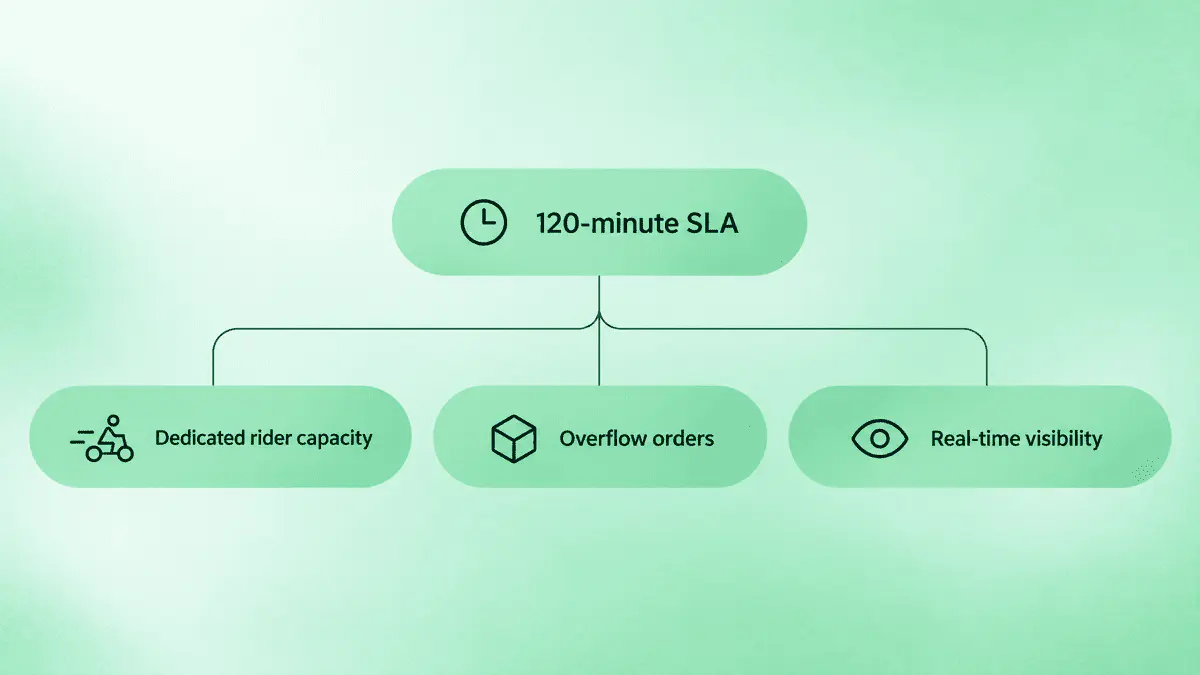
Carrying one order at a time meant riders spent too much time traveling back and forth. GIVA wanted to test if several ready orders could be delivered together on a smart route.
Orders carried a 120-minute delivery SLA that had to be factored into the planning upfront.
If a store’s rider was busy or unavailable, urgent orders still needed timely delivery.
Store teams and GIVA leadership wanted a clear, real-time view of trips, riders and deliveries without chasing updates.
The Fynd TMS pilot connected shipment handoff, rider allocation and delivery execution. Fynd TMS was introduced as the last-mile layer, right after ClickPost. Everything upstream stayed exactly the same.
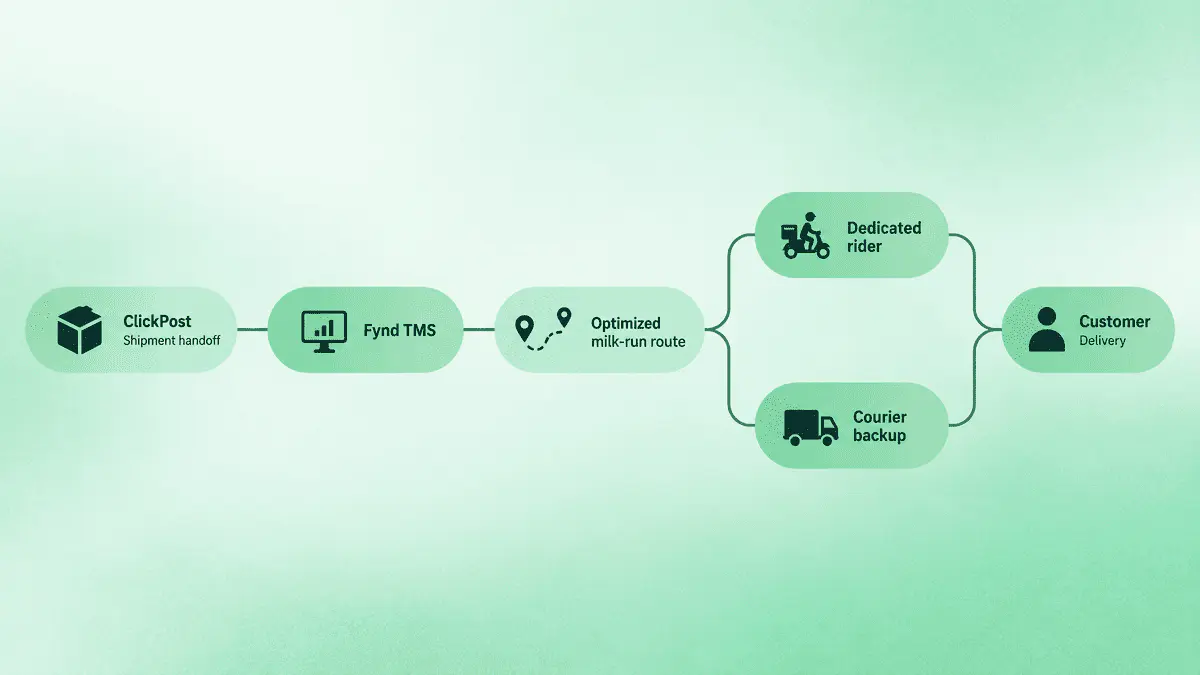
When a GIVA store accepted an order and ClickPost created the shipment, details passed straight to Fynd TMS. Store teams didn’t need to enter anything new. The store ID from ClickPost told TMS which store and rider the order belonged to.
Each of the three pilot stores had its own dedicated rider, who was the first choice for that store’s orders.
TMS automatically created the morning batch based on shipment status, rider availability, capacity, delivery promises and store rules. When the rider returned, pending orders formed the next trip.
Instead of delivering one order per trip, a rider picked up several ready orders and followed an optimized “milk run” route across customer stops, using map and traffic data.
Third-party couriers were configured as backup when dedicated riders were busy or unavailable with GIVA controlling the order of preference.
Riders used the Fynd Rider App to scan shipments, follow navigation, call customers, and capture proof of delivery. Store teams viewed their shipments and trips and GIVA leadership had a consolidated view of all three stores.
The pilot was built to start fast. Because Fynd is already integrated with ClickPost, going live meant configuration and information exchange, not a new integration build.
Phase | What happened |
|---|---|
Before Day 1 | Scope and order form confirmed. GIVA shared store details, user and rider details, ClickPost inputs, courier partner information and serviceability and SLA rules. |
Day 1 | Fynd TMS account set up. Three stores configured. Users and riders onboarded. Base serviceability and ClickPost connection are configured. |
Day 2 | Trip and batching rules, rider priority, courier fallback and route settings configured. Store users and riders trained. Dry run completed with sample orders. |
Live pilot | Real orders handled by three dedicated riders. |
Pilot closure | Joint review of the data, what worked and what needs fixing. |
The three pilot stores were Karol Bagh, Vikaspuri and Ambedkar Road (Ghaziabad).
Area | Before the pilot | During the pilot with Fynd TMS |
|---|---|---|
Order placement and store allocation | Handled by GIVA's app, website and POS | No change. GIVA's systems stayed in charge |
Shipment handoff | ClickPost created the shipment and routed it to the configured delivery partner layer | ClickPost passed accepted shipments to Fynd TMS for the pilot stores |
Reallocation of unaccepted orders | GIVA's existing process created a new AWB when an order wasn't accepted or picked up in time | The same process kept running, so some orders ended up with more than one AWB |
Measurement period: the pilot run across the three Delhi NCR stores.
Metric | Pilot observation |
|---|---|
Shipment/AWB allocations recorded in Fynd TMS | ~585 |
Deliveries completed by Fynd dedicated riders | ~220–222 |
Delivery success rate, GIVA's unique-order analysis | ~85% |
Delivery success rate, Fynd's initial allocation data | ~50% |
Deliveries within the 120-minute SLA | ~57–60% of analyzed deliveries |
GIVA's usual delivery NPS | ~50–55 |
NPS for pilot deliveries | ~30 |
The difference came down to how deliveries were counted. When an order wasn’t accepted or picked up in time, GIVA’s existing reallocation process created a fresh airway bill (AWB). This meant one customer order could appear as multiple allocations in Fynd’s data. GIVA’s unique-order view, counting each order once, gave the approximately 85% success rate. Both teams agreed this explained the gap.
Both teams generally agreed on the delivery turnaround. GIVA considered the pilot a success,
proving that the dedicated-rider, milk-run model is doable.
Duplicate AWBs: Multiple AWBs per order complicated delivery reporting and invoice reconciliation.
Trip automation: Late orders and next-trip assignments should be added automatically based on rider availability and pending shipments.
Rider availability: Riders took longer than expected to return to stores; Fynd is reviewing coordination and procedures.
Courier fallback: Must work smoothly alongside dedicated riders without compromising the SLA.
Customer experience: Delays, hard-to-find addresses, and rider communication lowered the Net Promoter Score (NPS); Fynd is improving communication and navigation processes.
120-minute SLA: Adherence needs improvement before scaling.
The pilot was never just about three stores. The larger vision is a dedicated-rider network for COD and gold jewelry deliveries. The pilot provided a clear roadmap of what to build next.
GIVA is now exploring:
A separate allocation flow prioritizing dedicated riders for COD and gold shipments, while keeping the current process for prepaid orders.
A smaller delivery radius, shrinking from about 8 km to 5 km.
A cluster model for a wider rollout, where riders serve 2–3 nearby stores instead of one rider per store.
Handling COD collection and high-value shipments, including managing the current ₹10,000 COD limit, risk and insurance.
GIVA’s technology team expects about one to two months to design these changes. Rider deployment is paused for now, with plans for a technical workshop on COD and gold delivery workflows before moving forward.
A pilot’s purpose is to reveal what works and what doesn’t before scaling up. GIVA’s pilot did exactly that. The dedicated-rider milk-run model proved practical while also highlighting areas like allocation, automation and rider coordination that need attention before expanding to COD and gold deliveries. For brands considering a similar approach, starting small with a few stores and a focused pilot is a smart way to learn and adapt.
Fill out the form
Share your contact information to get started
Speak to an expert
A member of our sales team will get in touch with you