November 23, 2026
Best electronics manufacturing software for EMS providers in 2027
Explore the best electronics manufacturing software for EMS providers in 2027, including Fynd Forge for production planning, quality, and traceability.
Jahnvi Gupta
November 23, 2026
Explore the best electronics manufacturing software for EMS providers in 2027, including Fynd Forge for production planning, quality, and traceability.
Jahnvi Gupta
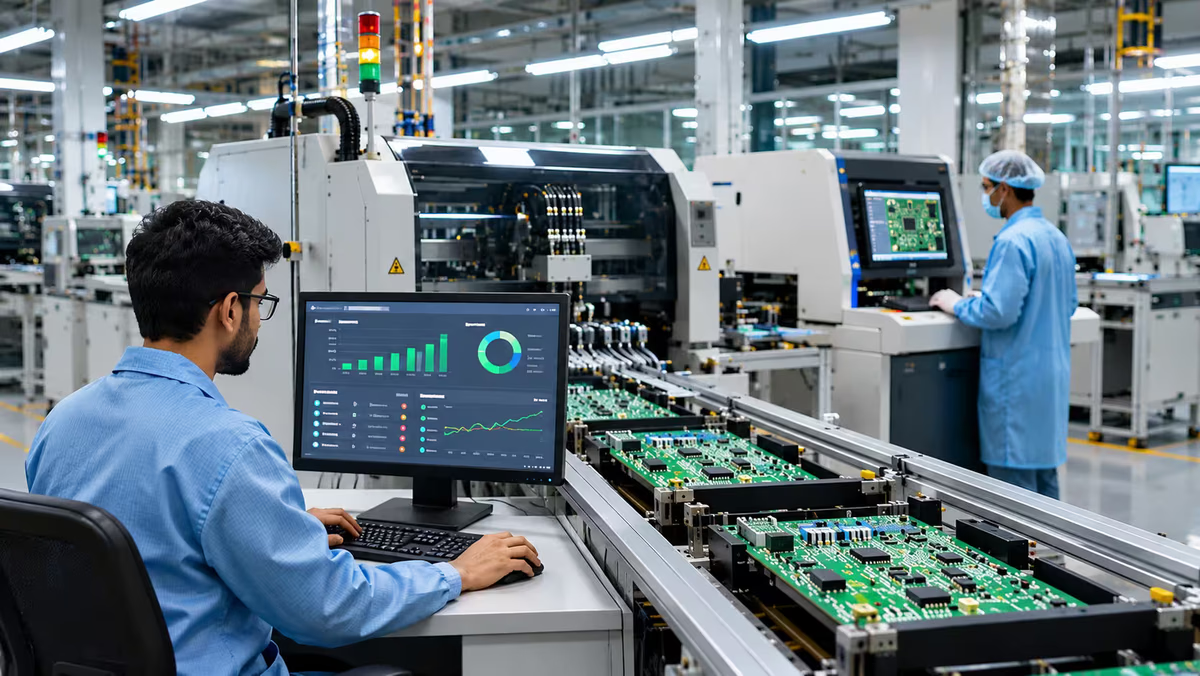
Electronics manufacturing software gives EMS providers a dependable way to keep customer-specific BOMs, engineering changes, component supply, line capacity, machine schedules and quality records in sync. That helps teams respond to changes, meet delivery dates and trace issues to the right parts and products.
Fynd Forge connects production planning and procurement with equipment integration, assembly, quality, repair, traceability and shipping. This guide covers eight of the best electronics manufacturing software platforms for EMS providers in 2027, including Fynd Forge, and what to consider when choosing one.
Electronics manufacturing software helps manufacturers plan and manage how electronic products are made. It can support production planning, shop-floor work, parts tracking, quality checks, and product traceability.
These tools often fall into three overlapping categories:
MES (manufacturing execution system): Manages and records factory-floor work, such as production steps, work instructions, and quality checks.
MOM (manufacturing operations management): Covers a wider range of manufacturing operations, often combining MES functions with planning, quality and performance management.
ERP (enterprise resource planning): Connects business processes such as procurement, inventory, finance and HR. Some ERP systems also include manufacturing modules for work orders, routings and quality management.
Fynd Forge is Fynd’s manufacturing OS for electronics manufacturers and EMS providers. It brings together production planning, procurement, equipment integration, assembly, quality, repair, traceability, and shipping. For broader business operations, EMS providers can extend their setup with Fynd ERP, which includes manufacturing alongside procurement, inventory and warehouse, finance, and HR modules.
Platform | Published focus | Capabilities to explore |
AI-native manufacturing OS (MOM platform) for EMS | Capacity-aware planning and auto-replanning; procurement and material control; equipment integration; guided assembly; unit-level quality traceability; repair and rework; barcode-based packing and shipping | |
Siemens Opcenter Execution Electronics | MES for electronics production | Process, quality, material and genealogy management; production performance and machine connectivity |
Aegis FactoryLogix | Manufacturing operations for electronics | Engineering data, work instructions, revision control, materials, quality and unit-level traceability |
Critical Manufacturing MES | MES for electronics manufacturing | Production execution, electronic work instructions and support for varied product mix and complexity |
iTAC.MOM.Suite | MOM for electronics and telecommunications | Production control, quality, traceability, planning and integration with factory systems |
Panasonic PanaCIM-EE Gen2 | MES for SMT mounting operations | Material verification and control, SMT traceability, equipment monitoring and external system interfaces |
42Q Smart Manufacturing | Cloud-based smart manufacturing for electronics | Multi-plant visibility, production data, traceability and supply-chain visibility |
ACC Mars | ERP for electronics manufacturing services | Electronics-focused business and production workflows, including BOMs, engineering changes and production traceability |
Fynd Forge is an AI-native manufacturing OS built for EMS providers. It connects production planning and procurement with factory-floor work, including machine connections, assembly, quality checks, repairs and shipping. Its schedules account for the capacity of each line. If a reflow oven or solder paste inspection (SPI) machine goes down, Forge can replan production and show how the disruption affects the ship date. It also links each product variant to its manufacturing bill of materials (mBOM), the list of components needed to build it, and its routing, the steps it follows through production.
During assembly, operators scan components and link them to an individual printed circuit board (PCB) or device. Forge connects inspection results and repair records to that unit’s history, helping teams trace it from component lot through production and shipment. If a unit fails a check, Forge can route it for rework and record the follow-up inspection.
Forge also connects purchasing with the parts received and the supplier’s invoice. Its three-way match compares the purchase order, goods receipt and invoice. FEFO/FIFO issuing helps teams use components in order of expiry date or arrival, while supplier updates and approved part alternatives help them respond to shortages.
Fynd Forge is built for EMS providers and electronics manufacturers that need to coordinate production planning, materials, shop-floor work and quality across product variants and lines. It is especially relevant to:
Operations leaders managing production capacity, delivery schedules and line performance.
Production planners coordinating schedules, product-specific BOMs, routings and machine availability.
Procurement and materials teams managing component availability, supplier updates, lot use and part alternatives.
Manufacturing and quality engineers connecting equipment, controlling assembly steps, tracking inspection results and managing rework.
IT and automation teams connecting shop-floor equipment with ERP and other business systems.
Siemens Opcenter Execution Electronics is an MES for electronics manufacturing. Siemens describes capabilities for process, quality, material, genealogy and performance management, with production use cases spanning PCB and box-build processes.
Aegis FactoryLogix connects engineering data with manufacturing processes for electronics production. Aegis describes converting CAD, BOM and engineering information into work instructions, inspection plans, machine programs and production documentation, with revision control and component-level traceability.
Critical Manufacturing MES is designed for electronics manufacturers and supports production execution across varied product mixes and levels of complexity. Its electronics materials describe electronic checklists and step-by-step work instructions for production tasks.
iTAC.MOM.Suite is a manufacturing operations management platform that iTAC presents for electronics manufacturers and EMS providers. iTAC describes production transparency, verification of production steps, quality assurance and integration with existing production systems as relevant capabilities.
Panasonic PanaCIM-EE Gen2 is an MES focused on electronics mounting and SMT-floor management. Panasonic lists material verification, material location and quantity management, SMT traceability, equipment-status monitoring, production analysis and interfaces with external systems.
42Q Smart Manufacturing offers cloud-based manufacturing software for electronics production. 42Q describes multi-plant production visibility, device history and traceability, supplier visibility, and manufacturing analytics among its capabilities.
ACC Mars is an electronics-focused ERP from ACC for EMS businesses. Its published materials describe connected business and production workflows, including BOM management, engineering change notices and production traceability.
Start with the needs of the factory. Compare each platform against the same product, production order and operational requirements.
Check workflow coverage: Which parts of the process does the platform support, from planning and materials to production, quality and shipping?
Test how plans respond to change: How does it handle capacity constraints, urgent orders, component shortages and machine downtime?
Review engineering and traceability controls: Can teams manage approved product revisions and trace parts, processes and quality records through production?
Assess quality workflows: How does the system handle inspections, failed checks, rework and corrective action?
Map integrations: Which equipment and business systems need to connect? Confirm supported interfaces, data ownership and integration costs.
Understand implementation and cost: Compare modules, configuration, integrations, training, support and future sites. Ask for a rollout plan with responsibilities and acceptance criteria.
Use these criteria to compare platforms consistently. Confirm which capabilities are included, which require configuration and which depend on another system.
Fynd Forge’s published capabilities span electronics planning, procurement, shop-floor execution, quality, repair and shipping. In a Fynd Forge demo, ask the team to show these workflows using a representative product and production order.
Capacity-aware planning: Ask them to show how Forge schedules SMT, testing and packing, then replans when a reflow oven or SPI machine goes down. Ask how the disruption affects the ship date.
Procurement and material control: Demonstrate the purchase order, goods receipt and invoice match; FEFO/FIFO component issuing; and how Forge handles a shortage or supplier update.
Equipment-connected production: Show how Forge captures data from SPI, AOI, X-ray, reflow equipment or PLCs, and how station scans bind components to an individual PCB or device.
Quality and product history: Follow inspection results for a serialised unit. Show how Forge routes a failed check to rework, records reinspection and traces the unit from component lot to shipment.
Repair and maintenance: Demonstrate the repair queue and reinspection workflow. Review how Forge surfaces downtime, OEE, FPY or maintenance signals for the team.
Packing and shipping: Show the barcode workflow from unit to carton to pallet, including label checks and the creation of shipping records.
Finish by mapping the demonstrated workflows to the proposed integrations and rollout phases. Confirm what is included in the Forge scope and what needs configuration.

Jahnvi Gupta
Jahnvi Gupta is a Senior Content Writer at Fynd with 6+ years of experience turning complex product ideas into content that’s clear, useful, and easy to follow. She writes about AI-first business tools, ecommerce technology, and the systems shaping modern retail operations with a focus on making technical concepts practical for growing businesses.
Electronics manufacturing software helps manufacturers plan and manage production. It can support production planning, shop-floor work, material tracking, quality checks, product traceability and equipment connections.
A manufacturing execution system (MES) manages and records factory-floor work, such as production steps, work instructions and quality checks. Electronics manufacturing software is a broader term that can include MES, manufacturing operations management (MOM) and manufacturing functions within an ERP system.
Fynd Forge is an AI-native manufacturing OS for EMS providers and electronics manufacturers. It connects production planning and procurement with equipment integration, assembly, quality, repair, traceability and shipping.
Yes. Fynd Forge connects to shop-floor equipment such as SPI, AOI, X-ray and reflow systems, as well as PLCs, scanners, SAP, Oracle, WMS and TMS. To check support for specific equipment or systems, contact the Fynd Forge team.
Consider an MES when spreadsheets or disconnected tools make it difficult to track production status, BOM revisions, material use, serial numbers or quality records. These are common concerns raised by smaller manufacturers evaluating MES software.
Yes. An MES with lot and serial-number traceability can link components to a PCB or finished device, then record inspection results, repairs, rework and shipment history. Ask vendors to demonstrate this with one of your products.
No. The best fit depends on the products, production setup, traceability needs and existing systems. For EMS providers that need planning, procurement, equipment integration, assembly, quality, repair and shipping in one platform, Fynd Forge is a strong fit. Its capacity-aware planning, component-to-device tracking and connected production workflows make it especially relevant to EMS operations.

Compare 7 conversational commerce platforms for ecommerce brands. Explore AI shopping assistants, WhatsApp commerce, customer support and sales automation.

How AI skin analysis works in ecommerce, how accurate it is, what data it uses and how to measure its impact. A guide for UK beauty retailers.
Use this tech pack checklist to confirm every section is complete and consistent before it reaches a factory, with UK labelling and safety checks included.
Fill out the form
Share your contact information to get started
Speak to an expert
A member of our sales team will get in touch with you