November 17, 2026
Tech pack checklist: what to check before production
Use this tech pack checklist to confirm every section is complete and consistent before it reaches a factory, with UK labelling and safety checks included.
Amrita Bhambhani
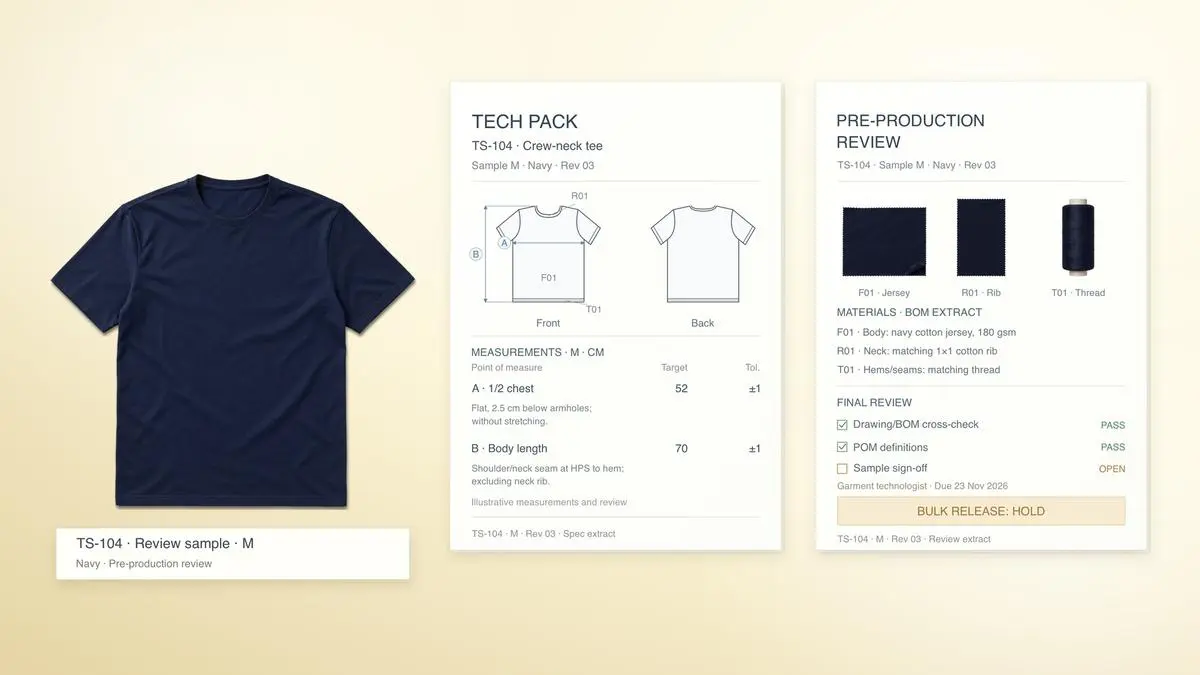
November 17, 2026
Use this tech pack checklist to confirm every section is complete and consistent before it reaches a factory, with UK labelling and safety checks included.
Amrita Bhambhani
Before a garment moves into production, the factory needs clear instructions on how it should be made. A tech pack brings together everything from design sketches and fabric specifications to measurements, construction details and approved samples.
But having all the sections in place is only part of the review. The information also needs to be consistent. Measurements should match the approved specifications, materials should reflect the latest selections, and construction notes should describe the final design.
This tech pack checklist covers what to review before sharing a tech pack with a manufacturer, whether for costing, sampling or production. Since requirements can differ by garment type, supplier and market, it is also worth confirming the factory's specifications before sending the final version.
A clothing tech pack includes information a manufacturer needs to understand how a garment should be made. It is used throughout product development, from costing and sampling to final production. While the exact requirements depend on the garment and manufacturer, a complete tech pack generally includes the following:
Style overview: Basic product details, including the style name and number, season, category, size range, colourways, sample stage, person responsible and latest revision.
Technical drawings: Front, back and other relevant views of the garment, with close-up illustrations and notes to explain specific design details.
Measurement specifications: Points of measure (POMs), instructions for taking each measurement, target dimensions, units and acceptable tolerances.
Grading: Approved measurements or grading rules showing how the garment's dimensions change across the size range.
Bill of materials (BOM): A detailed list of fabrics, linings, trims, threads, labels, packaging and other components, along with their specifications and supplier references where available.
Construction details: Instructions for seams, stitching, finishes and any special techniques needed to make the garment correctly.
Colour and artwork: Approved colour references for each component, along with artwork files, dimensions and placement instructions for prints, embroidery or other design elements.
Labels and packaging: Instructions for label content and placement, garment folding, individual packaging and carton packing, where applicable.
Testing and quality requirements: Required product tests, workmanship standards, inspection checkpoints and agreed acceptance criteria.
Approvals and revision history: A record of sample feedback, approved changes, responsible team members, version numbers and revision dates.
These details may be organised in a single document, across spreadsheets or within a product development platform. What is important is that the manufacturer has access to the latest approved information and can follow it without confusion. Some factories also have their own tech pack templates or additional requirements, so it is worth checking these before preparing the final version.
Before sharing a tech pack with a manufacturer, review each section to make sure the information is complete, accurate and consistent. Use the checklist below for every handoff, whether the garment is moving to costing, sampling or production.
Mark each item as Pass, Open or Not Applicable. For anything still open, assign a person responsible and a deadline for completing it.
Section | What to check before sending |
Style overview and drawings | Confirm the style number, size range and version are correct. Include all relevant garment views and make sure every callout refers to the right component or instruction. |
Measurements and grading | Check that each point of measure has a clear description, location, measurement method, base-size measurement and tolerance. Specify the sample size and confirm the grading for the full size range. |
Materials and BOM | List all required fabrics, trims, threads and labels. Include colour, placement and supplier references where available. Check that the BOM matches the technical drawings and construction notes. |
Construction | Explain any special construction techniques and include illustrations where helpful. Specify seam types, stitches and finishes so the factory knows how each part should be assembled. |
Colour, artwork, and branding | Check that the latest approved colour references and artwork files are included. Confirm artwork dimensions, placement and approval status. |
Labels and packaging | Include approved label content and placement instructions, along with folding, protective packaging and carton requirements where applicable. |
Testing and quality | Identify the tests and quality standards relevant to the product. Confirm inspection procedures and acceptable defect limits with the manufacturer. |
Approvals and version control | Record all required approvals and highlight any decisions still pending. Make sure version numbers and dates are consistent across the tech pack and supporting files. |
The level of detail required depends on what the manufacturer will use the tech pack for. During early costing, some supplier or material details may still be under discussion. For sampling, the factory needs enough confirmed information to produce and assess the garment accurately. Before bulk production, decisions affecting fit, materials, construction, cost and product safety should be finalised and approved.
Every tech pack should clearly state its approved stage, so the manufacturer knows whether it is being shared for costing, sampling or bulk production. Any outstanding information should be documented, with a clear owner and deadline for resolving it.
A tech pack may contain all the required sections and still have conflicting information. For example, a drawing might show one type of fastening while the bill of materials (BOM) lists another. If these details are not checked, the factory may end up working with incorrect specifications.
Before sending the tech pack, compare the information across sections to make sure everything describes the same garment.
Technical drawings and construction notes
Start by comparing the technical drawings with the construction instructions. Every callout on the drawing should have a corresponding note explaining how that part of the garment should be made.
Check that instructions clearly identify where each detail applies, including the inside or outside of the garment, left or right side, and exact placement where required. If reference images are included, specify which details the factory should follow and which are for inspiration only.
Technical drawings and bill of materials
Every component shown in the technical drawings should also appear in the BOM. This includes zips, buttons, trims, labels and other materials used in the garment.
Check the BOM in the other direction as well. Each listed component should have a clear placement or purpose in the drawings or construction notes.
Pay particular attention to component codes, material specifications and supplier references. Missing or unclear details can lead to incorrect sourcing, costing or substitutions. If the factory can suggest alternative materials or components, specify who must approve them before use.
Measurements and grading
Measurements need to be specific enough for the factory to reproduce them consistently. Each point of measure (POM) should include a name, location, measurement method, target measurement and tolerance. A labelled diagram can help explain exactly where and how to measure.
For example, chest width can vary depending on where the measurement is taken. Without clear instructions, the factory might measure a different point and produce a garment that falls outside the intended fit.
Once the base-size measurements are checked, review the grading to confirm that specifications are available for every size being developed or ordered.
Compare these measurements with the technical drawings, fit comments and approved patterns or blocks. If the drawing shows a dropped shoulder but the measurement specifications describe a standard shoulder, the discrepancy needs to be resolved before sampling or production.
For additional reference, Techpacker's measurement-table guidance explains how to document points of measure and tolerances.
Materials, colours and labels
Review the BOM alongside the colourway specifications, artwork, construction notes and label information. Fabric compositions, component details and colour references should be consistent throughout the tech pack.
For example, if the BOM specifies a particular fabric composition for the lining, the same information should appear in the relevant label specifications. Any details awaiting confirmation from the material supplier should remain marked as open until verified.
Labelling requirements also depend on the market where the garment will be sold. For textile products sold in Great Britain, retailers and manufacturers need to follow applicable fibre composition labelling rules, including requirements for garments made from components with different fibre contents.
Check that fibre composition information is supported by approved material specifications and is consistent across product labels, packaging, advertising and online listings.
For further information, refer to the UK Government's textile labelling guidance, Business Companion's guidance on labelling textiles and the applicable textile fibre composition rules.
Care instructions should also follow the brand's approved guidance and the product's material and testing information. If using GINETEX care symbols, check the licensing requirements, as these are protected marks. UKFT's labelling guidance provides further information.
Once these checks are complete, update any conflicting information and make sure the corrections appear in the latest version of the tech pack and its supporting files.
Before approving a tech pack for production, check that the garment meets the safety and testing requirements of the market where it will be sold. These requirements vary depending on the product, its intended use and the age group it is designed for.
The tech pack should identify the applicable requirements and tell the manufacturer which tests, documents and approvals are needed. A product safety or compliance specialist should confirm these requirements before production begins.
For garments intended for the UK market, pay particular attention to the following areas:
Children's clothing with cords and drawstrings: Cords and drawstrings can create safety risks, particularly around the neck and hood areas. Check the applicable safety standard for the garment's design and age group, and make sure the technical drawings and construction instructions reflect those requirements. The UK Government provides examples of the risks associated with non-compliant cords and drawstrings in children's clothing. You can also refer to the general product safety standards list.
Nightwear: Certain types of nightwear must meet specific flammability and labelling requirements under the Nightwear (Safety) Regulations 1985. Since the requirements differ by garment category, identify the relevant tests and labelling instructions in the tech pack. Refer to the Nightwear (Safety) Regulations 1985 for details.
Chemical restrictions: Fabrics, dyes, prints and trims may be subject to restrictions on certain chemical substances. Include the brand's restricted substances list, applicable testing requirements and any supporting test reports. For products sold in Great Britain, UK REACH applies, while EU REACH continues to apply in Northern Ireland. The Health and Safety Executive's UK REACH guidance explains the GB framework.
For a range sold across the UK, check whether the requirements differ between Great Britain and Northern Ireland. Record the relevant test results, supporting documents and approvals in the tech pack so the manufacturer knows exactly what has been cleared for production.
The final compliance decisions should remain with the responsible product safety or compliance specialist. The tech pack should reflect those decisions and provide the factory with the instructions needed to follow them.
“Factory-ready” depends on the work being handed over. A costing pack may still leave fabric sourcing open. A sample pack needs enough detail for the sample room to build the intended garment and measure it against agreed specifications. A production release needs the relevant materials, construction, fit, safety and quality approvals resolved.
Before sending, ask a colleague who did not prepare the pack to review it from three perspectives:
Pattern or sample room: Can the garment be interpreted and made from the drawings, notes and measurements supplied?
Sourcing: Can each component be identified, sourced or quoted from the BOM and linked references?
Quality: Can the agreed measurements and workmanship requirements be checked against the sample or finished garment?
Then send the pack to the intended factory for a review of its terminology, file formats and any supplier-specific requirements. Log the questions it raises. Add decisions to the next controlled revision so the same uncertainty does not follow the style into sampling or bulk production.
Even with a complete tech pack, a garment needs to go through sampling before it is ready for bulk production. Samples allow the design and production teams to check the fit, fabric, construction and overall finish. Any changes made during sampling should also be updated in the tech pack so the factory is working with the latest approved specifications.
The sampling process varies by garment type and brand. It may include a prototype, fit sample, size set or pre-production sample. At each stage, record what was reviewed, any issues identified, the changes required and who is responsible for making them. Once a sample is approved, clearly identify it as the reference for bulk production and quality inspections.
The factory should also have an agreed quality inspection plan before production begins. If the brand uses Acceptable Quality Limit (AQL) sampling, specify the sampling plan, inspection level and criteria for classifying defects as critical, major or minor. The buyer and supplier should agree on the applicable AQL limits for each product and order.
Before approving bulk production, confirm that the final tech pack, approved sample and inspection requirements are consistent. This gives the factory a clear reference for manufacturing the garment and checking the finished products.
A bill of materials lists the components used to make a style, such as fabrics, linings, trims, thread, labels and packaging. A tech pack is the wider production file. It may contain the BOM alongside drawings, measurements, grading, construction, colour, labelling, testing and revision details.
Document | What it holds | Use |
BOM | Materials and components, with specifications and sourcing references | Identifying and costing components |
Measurement spec | POMs, measurement method, target values, tolerances and grading | Developing and checking garment dimensions |
Tech pack | The full style specification, including the BOM and measurement spec | Communicating the product from costing through sampling and production |
Sending only a BOM or only a measurement sheet gives the factory one part of the specification.
Copy these lines into a final review page in your template. A reviewer who did not prepare the pack can mark each one pass, open or not applicable.
Areas | Final check |
Identity | Style number, name, season, size range, sample stage and version are clear. |
Revision | Revision date, change summary and approver are recorded. |
Drawings | Relevant front, back, inside and detail views are included. |
Callouts | Every callout resolves to a note, component or controlled reference. |
Measurements | Every POM has a location, method, base-size target, unit and tolerance. |
Grading | The approved size range and grade rules match the product scope. |
Materials | The BOM identifies the components and matches the drawings, colourways and notes. |
Construction | Required seams, stitches, finishes and special operations are clear. |
Artwork | Production files, colour references, scale and placement are controlled. |
Labels and packaging | Approved label data and relevant packaging instructions are included. |
Safety and testing | Applicable requirements, test methods and evidence are agreed for the product and market. |
Quality | Inspection method and defect definitions are agreed with the factory. |
Samples | Sample stages, comments, approvals and changes are recorded in the current revision. |
Release | The supplier has the correct files and confirms the pack is usable for the stated stage. |
AI can help fashion brands prepare tech packs faster by turning design concepts and product specifications into technical documentation. Depending on the tool, it can assist with technical drawings, measurements, material details and construction instructions, reducing the time spent preparing each section manually.
However, a tech pack still needs to be reviewed before it is approved for production. Garment technologists must check measurements, grading and construction details, while manufacturers need to confirm material availability and production feasibility. Any changes made during sampling should also be reflected in the final pack, along with the required quality and compliance approvals.
Fynd Create helps brands manage the process from design through to manufacturing. Its AI-assisted tools support collection development, line sheets and tech pack creation. Brands can also use the platform for fabric and trim sourcing, sample development, manufacturing coordination and quality checks.
With Fynd Create, brands can carry their designs beyond the tech pack and work through the sourcing, sampling and manufacturing stages with a connected team.
Amrita Bhambhani
The cost varies with the complexity of the design, the number of styles, the level of detail, the number of revision rounds and who creates it. A concept-level pack costs less than a factory-ready one. Ask any freelancer or agency to state which stage the quoted price covers and how many revisions it includes.
The time depends on the complexity of the garment and the experience of the person preparing it. A simple style with an existing block takes less time than a tailored or multi-component garment. Allow extra time for the review described above, along with factory feedback and the revisions that follow.
A template provides the layout for the sections listed in this guide, and many tech pack tools and suppliers offer their own. Check the factory’s preferred format first. The pre-send review table above can be copied into any template as a final check page.
A spec sheet usually covers the measurements and sometimes the materials of a style. A tech pack is the wider file, which adds drawings, construction, colour, labelling, testing and revision details. If a factory asks for a tech pack, send the full set, because a factory can ignore what it does not need but cannot make what it was never given.

How AI skin analysis works in ecommerce, how accurate it is, what data it uses and how to measure its impact. A guide for UK beauty retailers.
Compare fashion design, sourcing, and manufacturing platforms for 2027. Explore Fynd Create, PDS Limited, Fashinza, ZYOD, Destuo, Sewport, WFX, and Centric Software.

Compare 7 marketplace integration platforms for ecommerce brands in India in 2027. See how Fynd Konnect handles channels, inventory, orders and integrations.
Fill out the form
Share your contact information to get started
Speak to an expert
A member of our sales team will get in touch with you