November 19, 2026
AI skin analysis for ecommerce: a retailer's guide
How AI skin analysis works in ecommerce, how accurate it is, what data it uses and how to measure its impact. A guide for UK beauty retailers.
Amrita Bhambhani
November 19, 2026
How AI skin analysis works in ecommerce, how accurate it is, what data it uses and how to measure its impact. A guide for UK beauty retailers.
Amrita Bhambhani
How do you choose the right skincare product when you’re not entirely sure what your skin needs?
In a beauty store, you can turn to an adviser for help. They might ask about your skin concerns, take a closer look and recommend products worth trying. Online, that conversation is harder to recreate. Shoppers are left comparing ingredients, reading reviews and deciding which products might suit them. AI skin analysis ecommerce tools aim to bring that conversation online.
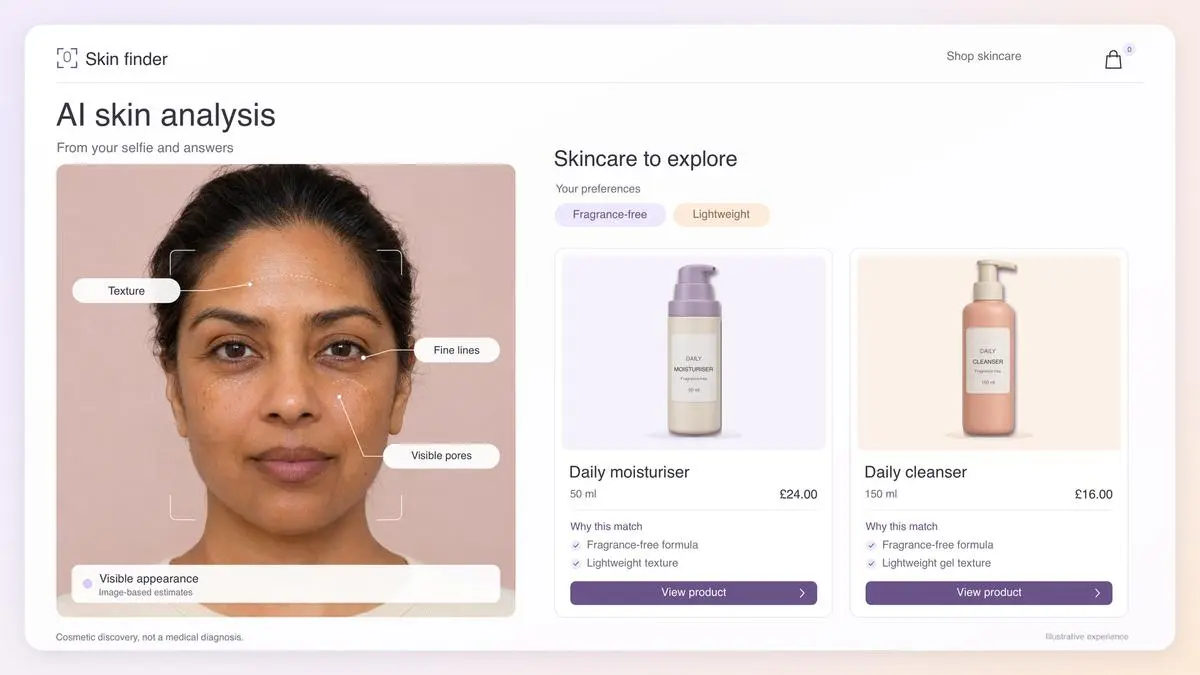
AI skin analysis offers retailers a way to make that experience more personal. Using a selfie or answers to a few questions, the technology can assess visible skin characteristics, such as fine lines, texture and uneven skin tone, and help customers find products relevant to their concerns.
For beauty retailers, the opportunity comes with practical questions. How accurate are these assessments? What can the technology reliably tell shoppers about their skin? How should customer images and personal information be handled? Do these recommendations actually help customers make better purchasing decisions?
This article explores how AI skin analysis works, its applications in beauty ecommerce and what retailers should consider before introducing it into their online shopping experience.
AI skin analysis software uses an image, questionnaire or both to estimate visible skin characteristics and support product discovery. Depending on the tool, it may assess the appearance of features such as redness, pores, texture, visible pigmentation or fine lines, then suggest products or a routine from a retailer’s range.
An AI skin scanner applies computer vision to an image, and a skincare quiz draws on answers the shopper supplies. Many online skin analysis experiences combine the two: the image provides a limited visual estimate, and questions add information about skin feel, preferences, sensitivities and budget. These tools help customers find products in a catalogue and describe visible features, and a clinician establishes the cause of a visible feature or confirms a medical condition.
The phrase “AI skin analysis” covers different tasks and levels of sophistication. Before comparing skin analysis software, retailers should establish exactly which characteristics it assesses, what inputs it needs and how each output is used. A tool that categorises visible appearance for cosmetic discovery has a different purpose from software intended to diagnose or monitor disease.
AI skin analysis software, often presented as an AI skin scanner, uses computer vision and trained AI models to examine a customer's photo, assess certain visible skin characteristics and recommend relevant skincare products. The process involves five steps, from capturing an image to presenting personalised recommendations.
Capturing and checking the image
The process begins when a customer takes a selfie or uploads an existing photo. Before analysing it, the software may check whether the image is clear enough, looking at factors such as lighting, camera angle, sharpness and how much of the face is visible.
Poor lighting, shadows, makeup, filters or glasses can affect the analysis. If the image doesn't meet the required quality standards, the tool may ask the customer to take another photo.
Identifying different areas of the face
Once the image is accepted, computer vision identifies the face and maps areas such as the forehead, cheeks, nose and chin.
This allows the software to examine different regions separately. For example, it may assess visible fine lines around the eyes or uneven skin tone across the cheeks, depending on what the model has been trained to detect.
Analysing visible skin characteristics
The AI model examines patterns in the image to estimate characteristics such as skin texture, visible pores, fine lines and uneven pigmentation.
It then produces scores, categories or visual indicators for the features it supports. These assessments depend on the model's training data and the quality of the image. They are estimates of visible characteristics and diagnostics belongs to clinicians.
Matching the results with skincare products
The next step is to turn the analysis into useful product recommendations.
The software combines its findings with information the customer provides, such as their skincare concerns, preferences or budget. It then matches these details against the retailer's product catalogue to suggest suitable options.
For this to work well, retailers need accurate product information, including ingredients, intended use, variants and stock availability. They should also be able to set recommendation rules, exclude unsuitable products and decide how alternatives are presented when an item is unavailable.
Customers should be able to understand why a particular product has been recommended.
Presenting the results and recommendations
Finally, the customer receives a skin analysis report, usually accompanied by a shortlist of recommended products. Depending on the tool, the report may include visual indicators, explanations of the assessed characteristics and links to relevant product pages.
Customers can then explore the recommendations and add products to their basket. Some platforms also allow them to save their results or repeat the analysis over time, provided the appropriate data permissions and retention controls are in place.
The technology needs to work reliably within the retailer's existing ecommerce experience. That includes connecting it to the product catalogue, keeping recommendations updated as stock changes and making the analysis easy to access on mobile and desktop.
Retailers also need to consider customer consent, image privacy, accessibility and how the tool handles uncertain results. When an image falls outside what the software can assess reliably, it should explain the limitation and give the customer another way to explore suitable products.
A successful implementation should make it easier for customers to understand their options and find relevant skincare products, while giving retailers enough control to keep recommendations accurate, appropriate and up to date.
AI skin scanners assess some visible skin characteristics closely and others less closely, and results vary by feature. They also depend on the quality of the photo, the customer's skin tone and how thoroughly the technology has been tested.
Research offers some insight into how well these systems perform.
A 2023 study published in the Journal of the European Academy of Dermatology and Venereology compared AI skin assessments with evaluations by 50 dermatologists. Using selfies from 1,041 women in the United States, researchers examined seven visible facial characteristics.
The AI system showed a strong correlation with dermatologist assessments for five characteristics (r ≥ 0.75). However, the correlation was lower for cheek pores (r = 0.63) and considerably weaker for pigmentation (r = 0.40), particularly among women with darker skin tones.
A 2025 study in the Journal of Cosmetic Dermatology also explored the use of AI to assess skin type, pigmentation, redness and wrinkle severity. Researchers trained models using 3,662 facial images and reported encouraging results. However, the images were labelled by just one dermatologist, and testing was limited to images from the same dataset. Kesty AI, a company founded by one of the authors, funded the study.
Image quality introduces another challenge. A 2026 study on AI skin analysis found that the device used to capture an image could affect the results, with lower accuracy for pigmentation assessments using mobile-device images.
These studies show what AI skin analysis can achieve under specific testing conditions, and each commercial skin scanner needs its own evidence. Retailers examine the evidence for the particular tool they're considering, especially when customers will be using different phones, lighting conditions and camera angles.
Before choosing an AI skin analysis tool, retailers should understand what the system has been tested to do and how reliably it performs. Here are a few questions worth asking vendors:
What can the tool accurately assess? Ask which visible characteristics it measures and how performance differs between them.
How was it tested? Find out whether the results were compared with assessments by dermatologists or another established reference.
Does it work across different skin tones? Check whether the testing included a representative range of skin tones and ages, and whether performance was reported separately for each group.
How much does image quality affect the results? Ask how the tool performs across smartphones, lighting conditions and camera angles.
Are the results consistent? Check whether someone scanning their skin twice under similar conditions receives comparable assessments.
What happens when the tool cannot assess an image reliably? Look for systems that flag uncertain results and request another photo.
Can the vendor support its claims? Request validation reports, performance data, study limitations and information about the model being offered.
A skin characteristic assessed accurately is one input to a suitable recommendation.
A scanner that correctly identifies visible dryness or uneven skin tone still passes that result through customer’s preferences, the product ingredients and the matching rules before a product is recommended.
Retailers should therefore evaluate the accuracy of the skin analysis and the quality of the resulting recommendations separately. Both influence whether customers find the experience useful and feel confident about the products they choose.
When customers use an AI skin analysis tool, they usually start by uploading a selfie and answering a few questions about their skin. The tool uses this information to assess visible skin characteristics and suggest suitable products.
Depending on how the retailer has set it up, the tool may also use previous purchases, browsing history or saved skin analysis results to personalise recommendations.
Here's a closer look at the information these tools may collect and what retailers need to consider.
Customer data | How it’s used | What retailers should check |
Selfies or facial images | To assess visible skin characteristics. | Where are images processed, and are they deleted after the analysis? |
Skin analysis results | To generate reports and product recommendations. | Are results saved to customer accounts, and for how long? |
Skin concerns and preferences | To understand what customers are looking for. | Does the tool collect or infer sensitive health information? |
Purchase and browsing history | To personalise recommendations using previous shopping activity. | Is this information necessary, and has its use been explained to customers? |
Consent and preferences | To record customers' choices about their data. | Can customers change their preferences or request deletion? |
Facial images and information about someone's skin need careful handling, particularly when the analysis is linked to an identifiable customer.
Under the UK GDPR, a selfie is personal data when it can identify someone. According to the Information Commissioner's Office (ICO), facial image becomes special category biometric data when it is processed to uniquely identify a person.
Skin analysis can also involve health-related information. For example, if a questionnaire asks about medical skin conditions or the software attempts to infer health risks, the retailer may be processing special category health data.
When special category data is involved, retailers must establish a lawful basis under Article 6 of the UK GDPR and meet an additional condition under Article 9. Explicit consent is one possible condition, depending on how the service operates.
Retailers should explain how customer information is used before the analysis begins. This includes whether images are stored, shared with technology providers or used to train AI models.
A camera permissions covers access to the camera, and consent to the use of personal data is a separate request, so retailers address camera permissions and data protection requirements.
The ICO requires a Data Protection Impact Assessment (DPIA) where processing is likely to present a high risk to people's rights and freedoms. Retailers introducing camera-based analysis should assess whether this applies to their service.
Beyond data privacy, retailers need to be clear about the scope of their skin analysis tool.
There is a difference between assessing visible skin characteristics for cosmetic recommendations and diagnosing a medical condition. Software marketed for medical purposes may fall under medical-device regulations in Great Britain, so retailers should review the tool's intended use and any claims made about its capabilities.
Product recommendations also need to be supported by suitable evidence. A skin analysis result shouldn't become the basis for exaggerated claims about what a skincare product can achieve.
Before introducing AI skin analysis, retailers should establish clear rules for collecting, storing and deleting customer information. They should also check their technology provider's security practices, give customers a way to exercise their data rights and, where practical, offer an alternative way to shop without uploading a selfie.
The experience should be simple for customers: they should understand what information they're sharing, why it's needed and what happens to it once the analysis is complete.
Once a customer completes a skin scan, how does a retailer decide which products to recommend?
The starting point is understanding what the scan can tell you. Depending on the tool, AI can assess visible characteristics such as fine lines, uneven skin tone and skin texture. However, a photograph alone cannot provide a complete picture of someone's skin, diagnose medical conditions or predict how their skin will respond to a product.
Retailers should keep these limitations in mind when setting up product recommendations.
Explain the results clearly: Tell customers which skin characteristics have been assessed and what the findings mean. Avoid presenting estimates as definite conclusions.
Make the selfie optional: Customers should still be able to find products through a short skincare questionnaire or by browsing the website.
Ask about individual preferences: A scan cannot tell whether someone prefers a lightweight moisturiser, avoids certain ingredients or has a specific budget. These details can help retailers suggest more suitable products.
Explain why a product has been suggested: Show a small selection of products with clear reasons for each recommendation, along with ingredients, benefits and instructions for use.
Let customers explore other products: Allow them to change their answers, compare options or browse beyond the suggested products.
Know when to recommend professional advice: If a customer mentions persistent irritation, pain or another worrying skin concern, encourage them to consult a qualified healthcare professional.
Retailers should involve skincare and product specialists in deciding which products to recommend for different concerns. They should also check that the product information is accurate and that any claims about benefits are supported by evidence. Skin reports should use neutral language, recognising that visible pores, fine lines and differences in texture are normal skin characteristics.
Before introducing the tool to customers, test it with different skin concerns, preferences and skin tones. Review the products it suggests, check whether the explanations are accurate and look for recommendations that may be unsuitable. Use these findings to correct the product information and recommendation rules before launch.
A high number of completed skin scans may suggest that customers are interested in the feature. But retailers also need to know whether those scans lead to product purchases and additional revenue.
For example, a customer might complete a skin analysis, explore the recommended products and make a purchase. That sounds promising, but there's no way to know whether they would have bought the product without using the scanner.
Retailers can get a clearer picture by testing the scanner with two randomly selected groups of website visitors. One group gets access to the feature, while the other continues shopping as usual. Comparing their results helps establish whether the scanner has increased sales.
Metric | What retailers should measure |
Scan starts and completions | How often customers begin and complete a scan, including where they drop off. |
Product views and add-to-cart rates | How frequently customers view or add recommended products to their baskets after a scan. |
Conversion rates | Whether visitors offered the scanner are more likely to make a purchase. |
Revenue per visitor | Whether offering the scanner increases revenue across eligible website visitors. |
Profit after costs | How much additional profit remains after software fees, discounts and other related expenses. |
Returns and cancellations | Whether recommended products meet customer expectations and whether stock availability causes problems. |
Repeat purchases | Whether customers return to purchase the same products or explore other skincare options. |
Customer feedback | Whether customers find the analysis useful, understand the recommendations and are comfortable sharing their information. |
Start with one skincare category, such as moisturisers or serums, and decide what you want the scanner to improve. This could be conversion, revenue per visitor or the number of customers finding suitable products.
Set your targets before the test begins, including how much improvement would make the investment worthwhile and what would be an unacceptable increase in returns or complaints.
As customers use the scanner, review where they leave the process. If they abandon it when asked to upload a photo, the instructions or privacy information may need attention. If they complete the scan but rarely view the suggested products, take another look at the recommendations.
Once the test has collected enough data, compare purchases, revenue and costs between the two groups. Continue tracking returns and repeat purchases afterwards, since customers may take several weeks to use a product and decide whether to buy it again.
The results should help retailers decide whether to introduce the scanner across more product categories or make changes before expanding it. The strongest evidence is an increase in sales or customer satisfaction that can be linked to the scanner, rather than simply a high number of people completing an analysis.
Before introducing AI skin analysis to your ecommerce website, use this checklist to confirm that the technology, product recommendations and customer experience are ready for testing.
Review the vendor's accuracy claims: Check the evidence for the skin characteristics the tool assesses, including results across different skin tones, ages and image conditions.
Test the scanning experience: Make sure the tool can recognise poor-quality images, request another photo when needed and offer an alternative for customers who don't want to use a selfie.
Check product recommendations: Confirm that recommendations use accurate ingredient information, suitability rules and current stock availability.
Complete the privacy review: Document what data is collected, its lawful basis, how long it is stored and who can access it. Check whether special category data is involved and whether a Data Protection Impact Assessment (DPIA) is required.
Review skin reports and product claims: Have skincare specialists check that the language is accurate, avoids medical diagnoses and makes only claims supported by product evidence.
Assign responsibilities: Agree who will handle catalogue updates, customer queries, privacy requests and performance reporting during the pilot.
Finalise the pilot plan: Select the product category, set the test duration, agree on the measures of success and establish when the team will review the results.
GlamAR helps beauty retailers introduce AI skin analysis into their online shopping experience. Customers can upload a selfie, receive an assessment of visible skin characteristics and explore skincare products recommended for their concerns.
Retailers can begin by selecting a product category, reviewing their catalogue and discussing website or app integration requirements with the GlamAR team.
Amrita Bhambhani
That depends on the retailer and software. A retailer can offer a questionnaire-led route or let shoppers browse the range without scanning. Providing an alternative helps customers who prefer not to share an image and gives the retailer a way to serve shoppers when the camera or lighting is unsuitable.
Scan-to-cart measures add-to-cart activity among people who completed a scan, so it describes engagement. A randomised holdout test, using eligible visitors as the comparison base, shows what those shoppers would have done without the tool and gives stronger evidence of incremental impact.
Recheck it when the vendor changes the model, the retailer changes recommendation rules or catalogue data, and as part of ongoing monitoring. Review performance by attribute, device and relevant customer groups, and investigate shifts in low-confidence scans, complaints, product substitutions or recommendation outcomes.
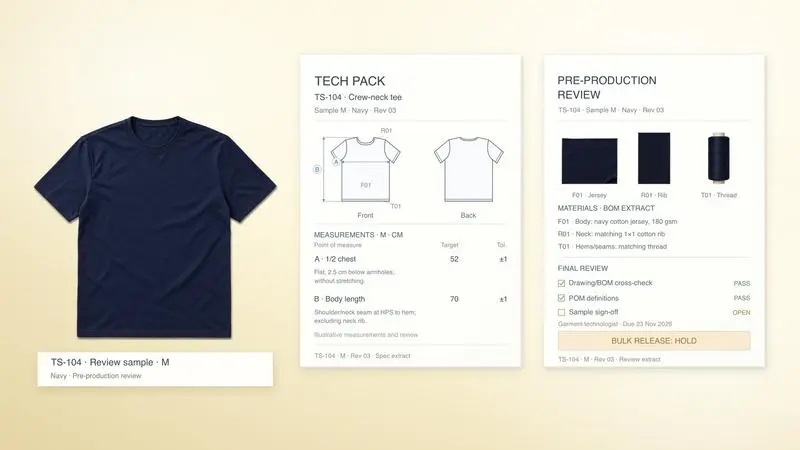
Use this tech pack checklist to confirm every section is complete and consistent before it reaches a factory, with UK labelling and safety checks included.

Compare fashion design, sourcing, and manufacturing platforms for 2027. Explore Fynd Create, PDS Limited, Fashinza, ZYOD, Destuo, Sewport, WFX, and Centric Software.

Compare 7 marketplace integration platforms for ecommerce brands in India in 2027. See how Fynd Konnect handles channels, inventory, orders and integrations.
Fill out the form
Share your contact information to get started
Speak to an expert
A member of our sales team will get in touch with you