July 8, 2026
Best POS system for toy stores: Features every retailer needs
Not all POS systems are built for toy retailers. Discover the features that matter most for inventory, seasonal sales, multi-store operations and online selling.
Jahnvi Gupta
July 8, 2026
Not all POS systems are built for toy retailers. Discover the features that matter most for inventory, seasonal sales, multi-store operations and online selling.
Jahnvi Gupta
Not all POS systems are built for toy retailers. Discover the features that matter most for inventory, seasonal sales, multi-store operations and online selling, and what Fynd documents for each.
Toy retail runs on thousands of SKUs, sharp seasonal swings and fast moving trends. A single store can carry variants across age group, size and theme, and demand for any one of them can shift within days. A basic billing tool is rarely built to keep up with that pace.
This guide explains what to look for in a POS system for a toy store, based on the type of business you run and the specific pressure points that come with it. It is a requirements guide, not a ranking. For each need, it also shows what Fynd documents today and what to test in any vendor's demo.
Toy retail is harder to run than most categories because three pressures hit at the same time.
Assortment complexity is the first pressure. A single toy often ships in multiple age variants, sizes and themed editions. Each of these needs tracking at the shelf level, or staff end up guessing at the counter.
Seasonality is the second pressure. In the US, hobby, toy and game stores generated 26.2% of their annual sales in November and December 2023, against 16.7% if sales were spread evenly (Statista, from US Census Bureau data). That is about 1.6 times an average month. India has its own peaks. Industry reports point to gifting around Diwali and Christmas, as well as birthdays, and school holidays. For context across all retail, India's festive trade from Navratri to Diwali in 2025 rose 25% to ₹6.05 lakh crore, according to a CAIT survey.
Demand volatility within the season is the third pressure. Demand can concentrate on a few trending or licensed items while similar ones sit untouched. A Fynd customer story shows the pattern in a neighbouring category. During the 2023 Cricket World Cup season, one jersey drew walk-ins, and Endless Aisle let Adidas Kids sell it from other locations.
A system built for general retail treats every product the same. That is precisely where it falls short for a toy business.
There is no single best POS setup for toy retail. An independent store, a multi-store chain and an omnichannel brand each face a different primary risk. Matching the system to that risk, rather than to a generic feature list, is the fastest way to make a confident decision.
Independent toy stores need speed at the counter above everything else. Staff work with a large and varied catalog and cannot afford to scroll through a long undifferentiated list while a customer waits.
Age based filtering solves this directly. A parent shopping for a five year old and a parent shopping for a ten year old are effectively browsing two different catalogs, and staff who can filter instantly can guide that conversation instead of guessing.
Quick promotional setup matters just as much. Independent stores lean heavily on festival and holiday gifting, so a system that cannot spin up a time-boxed offer within minutes becomes a bottleneck during the exact weeks that matter most.
Multi-store chains face a different risk than independent stores. Their main challenge is stock imbalance across locations rather than slow checkout.
One store can sit on excess inventory of a slow moving item while another store nearby turns customers away for the same product. This gap widens quickly during a festive rush.
Real time inventory visibility across every location, paired with fast stock transfers, closes that gap before it costs a sale. Automated stock alerts for fast moving seasonal items matter even more at this scale, since reordering manually across five or ten stores cannot keep pace with a licensed toy trend that peaks and fades within weeks.
A few evaluation points apply across every store type. Each one maps to a specific operational failure it exists to prevent.
Inventory and variant management prevents the manual correction work that happens when a system cannot distinguish size, age group and edition within one product line.
Multi-location stock visibility prevents lost festive season revenue that occurs when demand is uneven across stores and inventory cannot move quickly between them.
Seasonal demand and reorder support prevents missed reorders during the short windows that generate most of a toy store's annual revenue.
Loyalty and repeat customer tracking turns festive season shoppers into year round customers by recognising parents and gift buyers who return often.
Omnichannel and marketplace integration prevents the stockouts and failed pickups that follow when online and in-store systems run separately.
Staff roles and permissions cut onboarding time during the festive rush, since toy stores frequently bring on seasonal staff who need to be productive within days, not weeks.
Gifting support matters in a category where many purchases are gifts: notes, gift wrap, and delivery to someone else's address.
Requirement | What Fynd documents | Product | Part of Store OS? |
|---|---|---|---|
Variants | Stock visible by size and colour variant | Yes | |
Multi-location visibility and transfers | Inventory across stores and warehouses on one screen. Stock moves between locations and is received against an invoice, as in Wild Stone's kiosks | Yes | |
Selling a sold-out toy | Sell from another store or warehouse, with delivery, store pickup or curbside, and a mixed cart for in-store and delivered items | Yes | |
Gifting | Custom order notes such as gift wrap, and a choice of home delivery, store pickup or curbside | Yes | |
Offers and discounts | Billing with promotions and approval-based discounting | Yes | |
Seasonal reorder support | AI-led replenishment that suggests purchase orders and transfers to prevent stockouts, in the warehouse | No, separate | |
Loyalty and repeat customers | Customer profiles, past orders and a loyalty program at billing | Yes | |
Staff roles | Role-based access control, and sales attributed to the staff member | Yes | |
Counter speed and devices | Billing on terminals, phones and tablets (Android 8.0+, iOS 16.0+ and browsers), with an integrated Zebra DS2208 scanner and printers. Fynd reports an average checkout under 30 seconds | Yes | |
Returns and exchanges | Returns accepted at other stores, with order management for online returns | POS yes, OMS separate | |
Online and marketplaces in sync | Connects Shopify, marketplaces and stores into one inventory view | No, separate | |
Reports by store and staff | Analytics on one dashboard, with store staff activity tracked | Yes |
Age-group attributes and filtering at the counter
Generating and printing item codes for products without barcodes
Setting up a time-boxed festive offer from start to finish
Store-level low-stock alerts for fast-moving items
What happens at the counter when the internet drops (Store OS is cloud-connected and needs a stable connection)
Shortlist based on store type.
An independent toy store should weigh catalog speed and promotional setup heavily.
A toy store chain should weigh multi-location visibility above everything else.
Test any shortlisted system against your worst week rather than your best week. A system that performs well on a quiet Tuesday reveals very little about how it will hold up on a Saturday in December, or the week of Diwali.
A festive-readiness test. Ask each vendor to run these on your own products:
Bill ten customers back to back, as you would at peak.
Sell a sold-out toy from another store, and arrange delivery.
Take a gift order with a note and a different delivery address.
Exchange a gifted item at a different store.
Create a time-boxed festive offer.
Add a temporary staff account and bill with it within an hour.
Move stock between two stores and receive it against an invoice.
Time it right. Fynd supports phased rollouts and parallel runs. Pilot in a quieter month, and avoid going live in the middle of your peak. The Raymond rollout, for example, struggled early with stores finding products and with cancellations before a store playbook and daily tracking were in place, and its highest sales fell in the end-of-season sale and festive months.
A POS system built for toy retail should typically combine the following capabilities. The table above shows how Fynd covers each one.
Real time inventory sync: Stock levels stay accurate across every store location, with mobile access that works on existing devices, so seasonal staff can be trained quickly without new hardware.
Age based filtering and recommendations: Staff can guide parents toward the right product faster by filtering the catalog to a specific age group in seconds. Fynd documents product recommendations at the counter. Test age filtering with your own attributes.
Automated stock alerts: Fast moving seasonal items get flagged before they sell out completely, rather than after the fact.
Quick, time boxed promotions: Festival and school holiday offers can be set up without waiting on engineering support.
Store and staff performance reports: Owners can see exactly which products and which locations are driving festive season revenue.
Seamless fulfilment and returns: For brands selling across channels, online and offline inventory stays in sync, so a purchase made on a phone and picked up in store does not create a stock mismatch elsewhere. Online accounts for about 38% of India's toy market (IMARC, 2025), so this matters.
Fynd has no published result from a toy store running Store OS billing. These are the closest stories, and each says what it covers.
Story | Category | What happened | What was reported | Read this carefully |
|---|---|---|---|---|
Toys | Built its brand website on Fynd Platform in June 2021. Inventory from the warehouse and 50+ stores is synced for the website, and stores fulfil online orders | 50 omni-enabled stores. 74% of website orders fulfilled from stores. 88.6% more desktop users | A website and store-fulfilment story, not store billing. It dates from 2021 onwards | |
Kids' sportswear | Used Endless Aisle for a high-demand jersey during the 2023 Cricket World Cup season | Converted about 60% of walk-ins looking for it. Its Mall of Ahmedabad outlet was the top-selling location | One product, one season. A guide to licensed-item spikes | |
Kidswear | Sells on Shopify and nine marketplaces and is growing a store network. Fynd replaced its store billing and connected stock across channels, with a phased rollout | No figures reported | Qualitative only | |
Apparel | Rolled out from a 20-store pilot to 200+ stores | 5–7% additional store sales | A rollout lesson, not a toy result. The story covers 2019–2022 |
Each comes from one business, so treat them as references. The numbers that matter for your store are the ones you measure in your own pilot.
Looking for a modern POS system for your toy store?
Jahnvi Gupta
Jahnvi Gupta is a Senior Content Writer at Fynd with 6+ years of experience turning complex product ideas into content that’s clear, useful, and easy to follow. She writes about AI-first business tools, ecommerce technology, and the systems shaping modern retail operations with a focus on making technical concepts practical for growing businesses.
Many small or bundled toy items arrive without a manufacturer barcode. A capable POS system should let a store generate and print its own item codes, keeping every product, barcoded or not, trackable at the shelf level.
Role based staff access that can be configured quickly, combined with automated stock alerts, addresses the two most common festive season failures. These are undertrained temporary staff and stock running out unnoticed.
Yes a single POS with real time sync across channels is one of the most important requirements for a toy retailer today. It prevents the stockouts and failed pickups that come from running two disconnected systems as more purchases start online and finish in store, or the reverse.
A general system treats every product as functionally identical. A system suited to toy retail accounts for age based variants, extreme seasonal demand swings and fast moving licensed or collectible items, all of which are central to how toy stores actually operate. Choosing a POS system ultimately comes down to matching it against your store's busiest and most unpredictable weeks rather than its calmest ones. Explore how Fynd approaches this for toy and lifestyle retailers to see whether it fits your store.
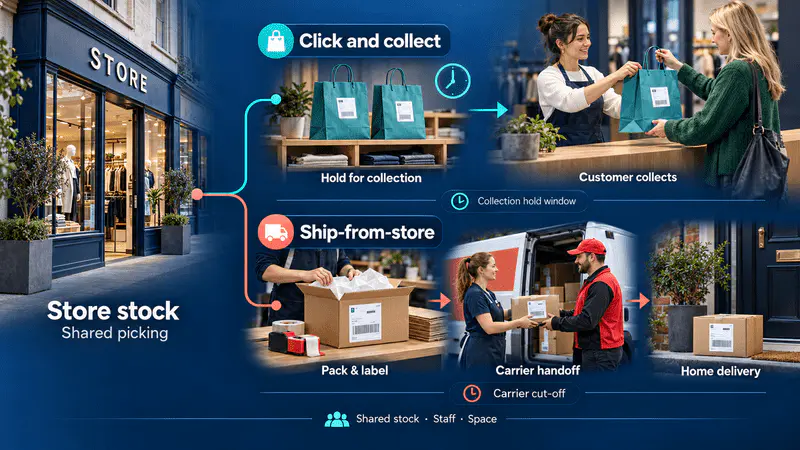
Compare click and collect with ship-from-store to understand the staffing, inventory, space and cost considerations of each model.
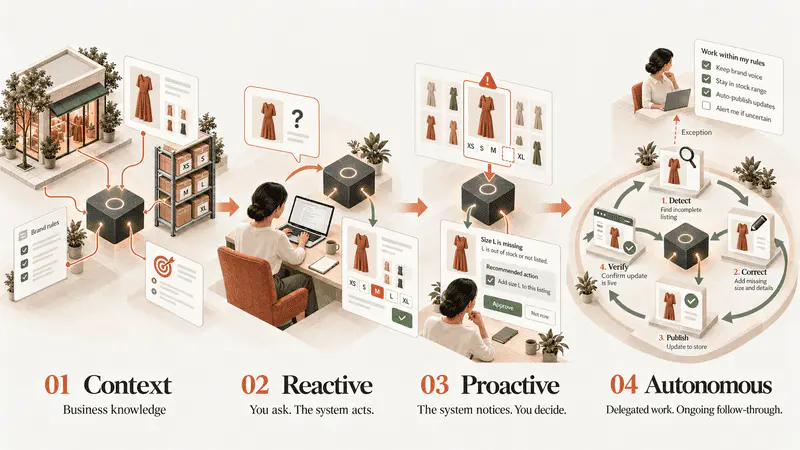
Learn how retailers can move from reactive to autonomous commerce by giving AI systems clear objectives, permissions and measurable responsibilities.
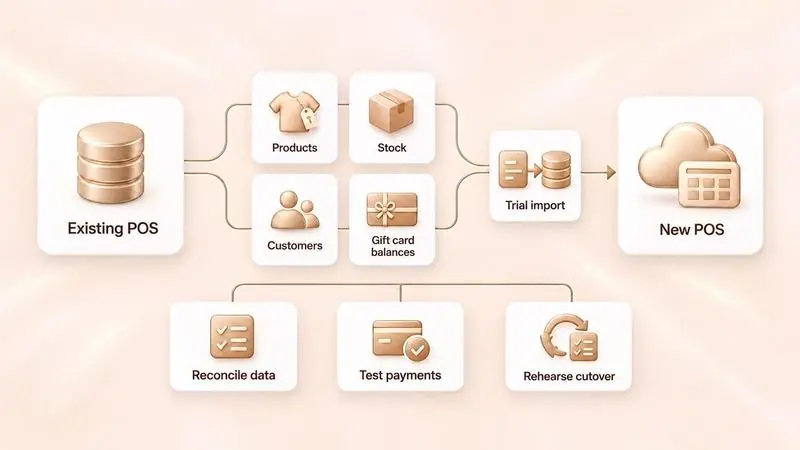
This POS migration checklist explains how retailers can prepare their data, test store systems, train staff and plan cutover and rollback before go-live.
Fill out the form
Share your contact information to get started
Speak to an expert
A member of our sales team will get in touch with you