September 24, 2026
India Has $4 Trillion of Gold Sitting in Homes. Here Is What to Do With It.
P. N. Gadgil Jewellers was founded in 1832. Saurabh Gadgil, its sixth-generation Chairman and Managing Director, is the man who took it public in 2024 and now thinks about gold the same way a central banker does.
Most jewellery brands ask one question: how do we sell more gold? Saurabh Gadgil asks a different one. India imports roughly 720 tonnes of gold every year, and at the same time the country holds an estimated $4 trillion worth of gold sitting idle in household lockers and temple trusts. What should actually be done with it?
It is the question that shapes how PNG thinks about exchange, recycling, design, and the relationship between a customer and their jewellery. Saurabh spoke to Ragini about the real cost of exchanging old gold, why lab-grown diamonds have shifted into the fashion category, and what it takes to keep three-generation customer families loyal to the same name.
What is the real cost of exchanging old gold jewellery in India?
Most customers expect to lose more than they do, and that fear is part of why so much gold never moves. When you walk into a PNG store to exchange jewellery, the team runs a karatmeter test on the spot to verify purity. The current gold price is applied to the verified weight at that moment. Making charges are not deducted on exchange, only a standard melting charge.
The bigger surprise is on the diamond side. Unlike gold, which has to be melted and loses the premium attached to craftsmanship, diamonds exchange at full current value, because natural diamond prices have moved up significantly. Saurabh describes the exchange of a piece bought five to ten years ago as close to break-even or better once rising prices are factored in. That is the thing most people do not know: a karatmeter and a rising gold rate can make old jewellery worth more than it feels.
In India, the jewellery buyback culture is essentially unique. When you buy a luxury watch or a designer bag abroad, the brand will not repurchase it. In India, a jeweller does. The maximum you lose on gold is typically 15 to 20%, and Saurabh frames it clearly: think of that as the cost you paid to wear the jewellery for five or ten years. Which makes it close to free.
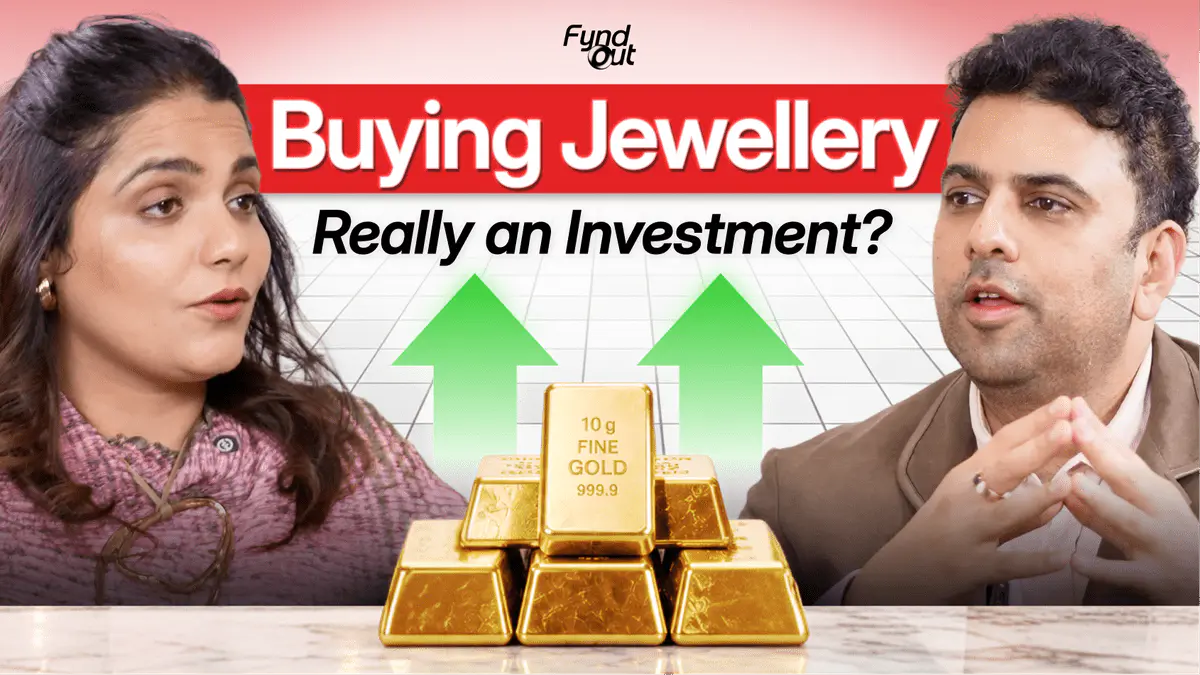
Why does India import 720 tonnes of gold a year if households already hold $4 trillion worth?
The gap between India's gold imports and its gold holdings is one of the largest disconnects in any commodity market in the world. The government's gold monetisation schemes are not about stopping people from buying gold. They are asking a simpler question: if the gold is already here, why import more?
Saurabh is sympathetic to the reason households do not move their gold. It is rarely ignorance. A grandmother's wedding piece is not an asset to be liquidated; it is a memory. The heritage around Indian gold means that unlocking it requires respecting the emotional layer, which is why exchange programmes and transparency on what a customer actually receives matter as much as the sell side of the business.
55 to 60% of the jewellery sold at PNG is exchange-based, meaning old pieces come in and new ones go out. That is not a small figure for any retailer. It is, Saurabh argues, the most honest version of circular commerce in the jewellery category.
Are lab-grown diamonds worth buying in India in 2024 and 2025?
The lab-grown diamond debate has largely settled, at least in how premium jewellers are positioning it. Saurabh's read is that lab-grown diamonds have moved into the fashion and accessible category rather than competing at the premium or bridal end. The Diamond Council's decision to separate natural diamond marketing from lab-grown has reinforced this, and natural diamond prices have continued to rise on the back of genuinely limited supply.
Large brands, including some of the biggest names in Indian jewellery, have opened lab-grown categories because gold prices have risen so sharply that customers are looking for alternatives at the lower ticket sizes. But the emotional story around a natural stone, the one De Beers spent a century building, has not disappeared. It has just become more expensive to access.
For a buyer, Saurabh's framing is useful: a diamond, mined or grown, has never behaved like gold as an investment vehicle. If your goal is wearability and design at a price point, lab-grown is a legitimate option. If your goal is a piece that carries the full emotional and resale weight of a natural stone, that market still exists and is moving upward.
How should I spend two lakh rupees at a jewellery store? What should I buy?
Ragini asked Saurabh a question most people are embarrassed to ask in a store: I have two lakh rupees, what should you actually tell me to buy? His answer is worth knowing before you walk into any jewellery shop.
The first thing a PNG store advisor will ask is whether you are buying jewellery or investing in gold. These are different decisions. If you are buying for a wedding or an occasion, the question becomes which pieces work together, what weight suits the occasion, and how they complement what you already own. If you are investing, gold bars and coins give you the cleanest exposure to the gold price without paying making charges for craftsmanship you may not need.
The advisor will also ask about occasion and past purchases, not to upsell, but because jewellery that works with what you already own is more valuable to you than a standalone piece that sits in the locker. This is the difference between a retailer who sells and an advisor who solves.
How does PNG Jewellers handle regional differences in jewellery buying preferences across India?
India is not one jewellery market. Saurabh describes the difference between selling in UP and Central India versus Maharashtra and Pune as a different category of business. In north India, a wedding typically calls for a complete set: necklace, earrings, bangles, all together, and diamond proportion in those sets is considerably higher. In Maharashtra, gold is the primary store of value and the primary emotional object. Diamond tends to be a secondary purchase.
This is not a price sensitivity difference; it is an occasion and meaning difference. A store that opens in a new geography and simply replicates what works at the flagship will find the assortment wrong, the communication mismatched, and the staff unprepared for what the customer actually wants. PNG's approach is to study each market before committing the assortment rather than assuming uniformity.
Can AI replace traditional jewellery artisans in India?
PNG works with artisan families who have been supplying craft to the company for over a hundred years. Several of these craftspeople lead what have effectively become mini-factories of their own, employing a hundred people each, but working exclusively for PNG. The techniques they use, particularly in hand-hammered and stone-set jewellery, are not documented in a way that can be fed into a generative system.
Saurabh's answer on whether AI can replace this is direct: not the hand work. AI can generate a design. It cannot do the hammering, and the difference between a machine-finished piece and a hand-finished one is something an experienced buyer can feel and see. For PNG, these artisan relationships are a competitive moat, because the craft cannot be recreated by a new entrant who simply hires the same technology.
What made Saurabh Gadgil choose jewellery over other careers?
He did not choose it immediately. During school, Saurabh was a national-level chess player and genuinely open to other directions. When the family business was there to join, he took a step back. During his MBA he did an internship at the Reserve Bank of India, where he studied the gold market, and that experience changed his view. Studying gold as an economist, at the institutional level, made the jewellery business feel like something he could engage with on his own terms rather than inherit by default.
He has been Chairman and Managing Director of PNG since then, through the transition from a family-run single store to a listed, multi-city retail company. The IPO, which PNG completed in September 2024, was the formal completion of a corporate transition that had been underway for years, involving professional management layers, quarterly disclosures, and operating standards that could hold across branches.
He wrote a book after the IPO capturing the lessons from that journey: about choices, about building systems inside a legacy, and about what survives a generational handover. His closing thought for anyone building something of their own is that happiness, not a number, is the real measure of growth. When your needs are met, the question becomes whether what you are building gives you genuine satisfaction. For him, going to work to contribute to the Indian jewellery industry still does.
Listen to the full conversation with Saurabh Gadgil on FyndOutWithRagini.