Building
Foundation
Cornerstone in.
11-page cornerstone working note shipped 26-Nov-2025 (rev 16-Dec-2025). First principles, offline and online signal inventories, four core outputs, actions and feedback loops. The build proceeds against this spec.
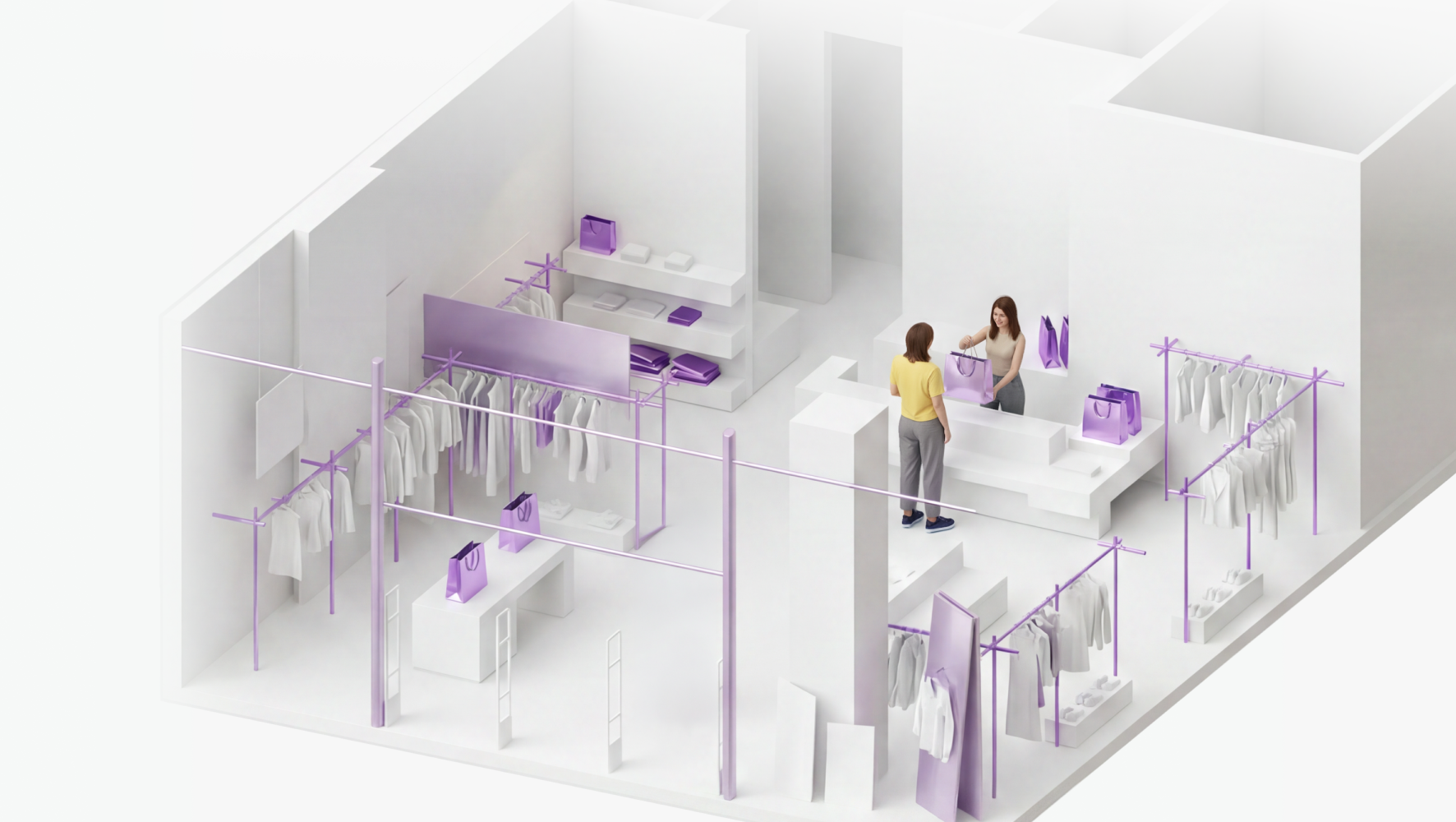
Predictive, non-intrusive, always-on CX sensing. Reads operational reality and customer behaviour without asking a single question. 4 scores, 1 feedback loop. Anchor demo on Store 5943.
Join 2,300+ brands growing their business with us















Build
stage · anchor demo on Store 5943
4
core outputs · Readiness, CX, Friction, Churn
4
engine stages · Readiness → Journey → Behaviour → AI
Foundation
11-page cornerstone working note shipped 26-Nov-2025 (rev 16-Dec-2025). First principles, offline and online signal inventories, four core outputs, actions and feedback loops. The build proceeds against this spec.
Anchor demo
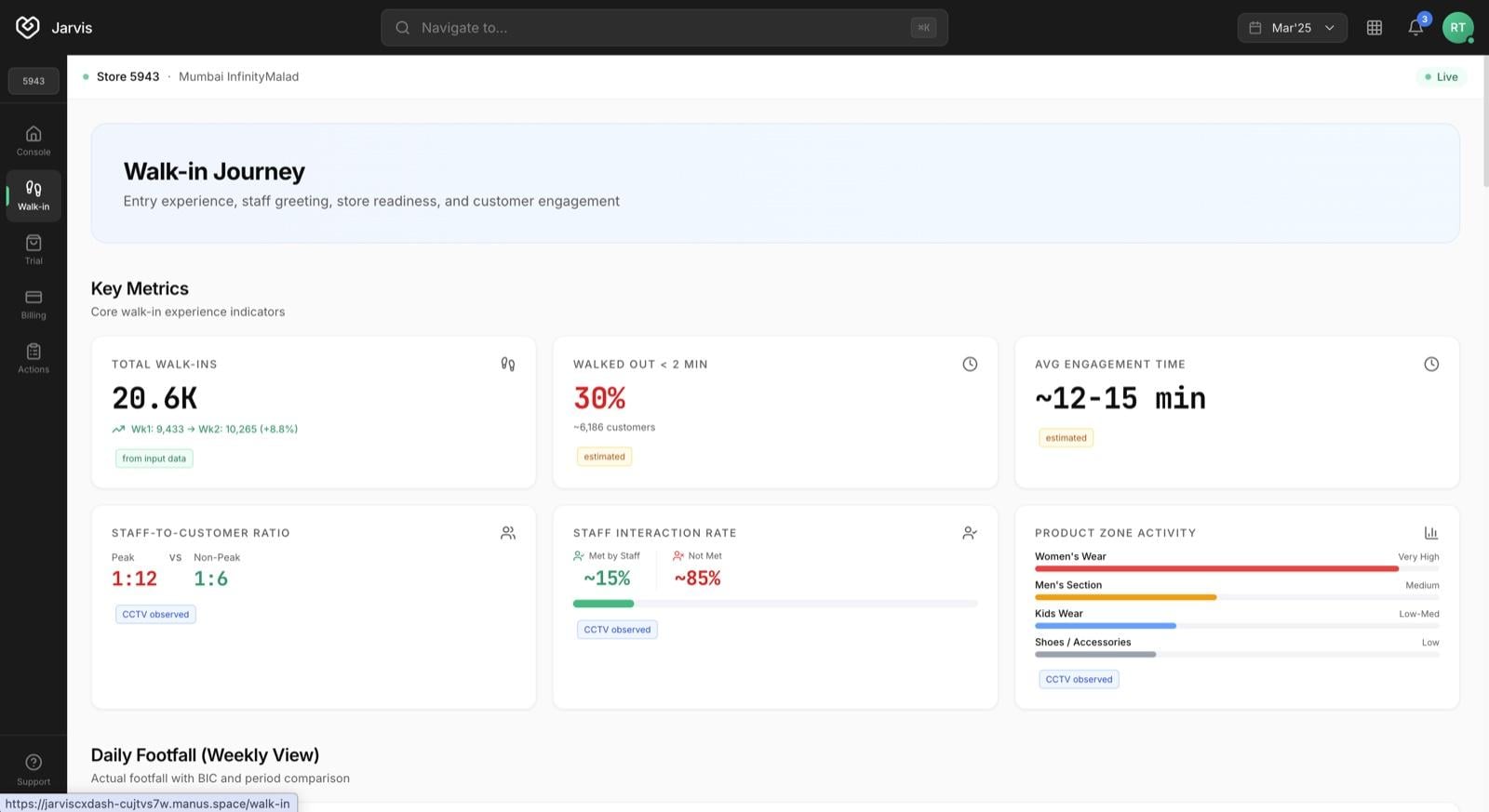
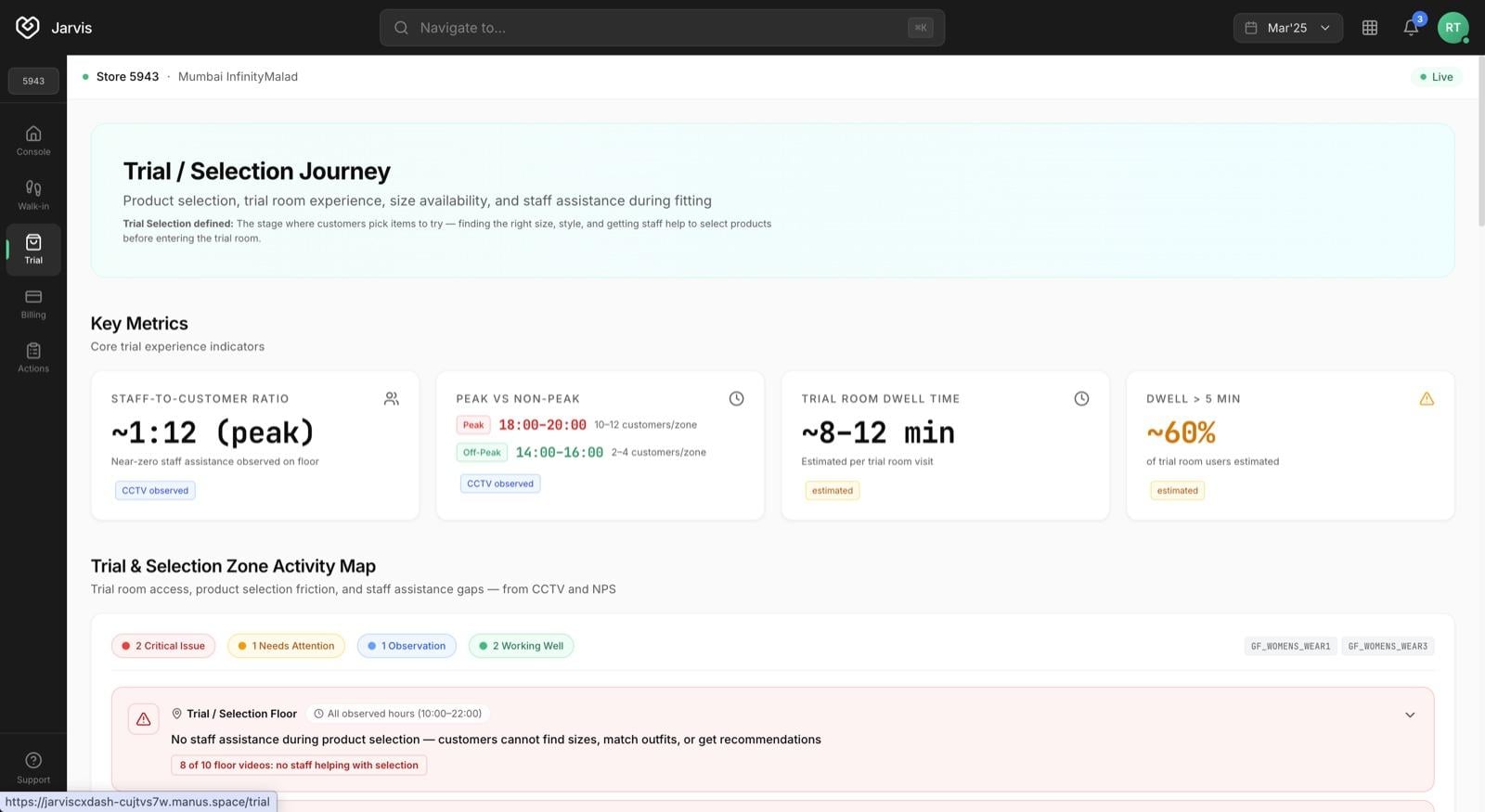
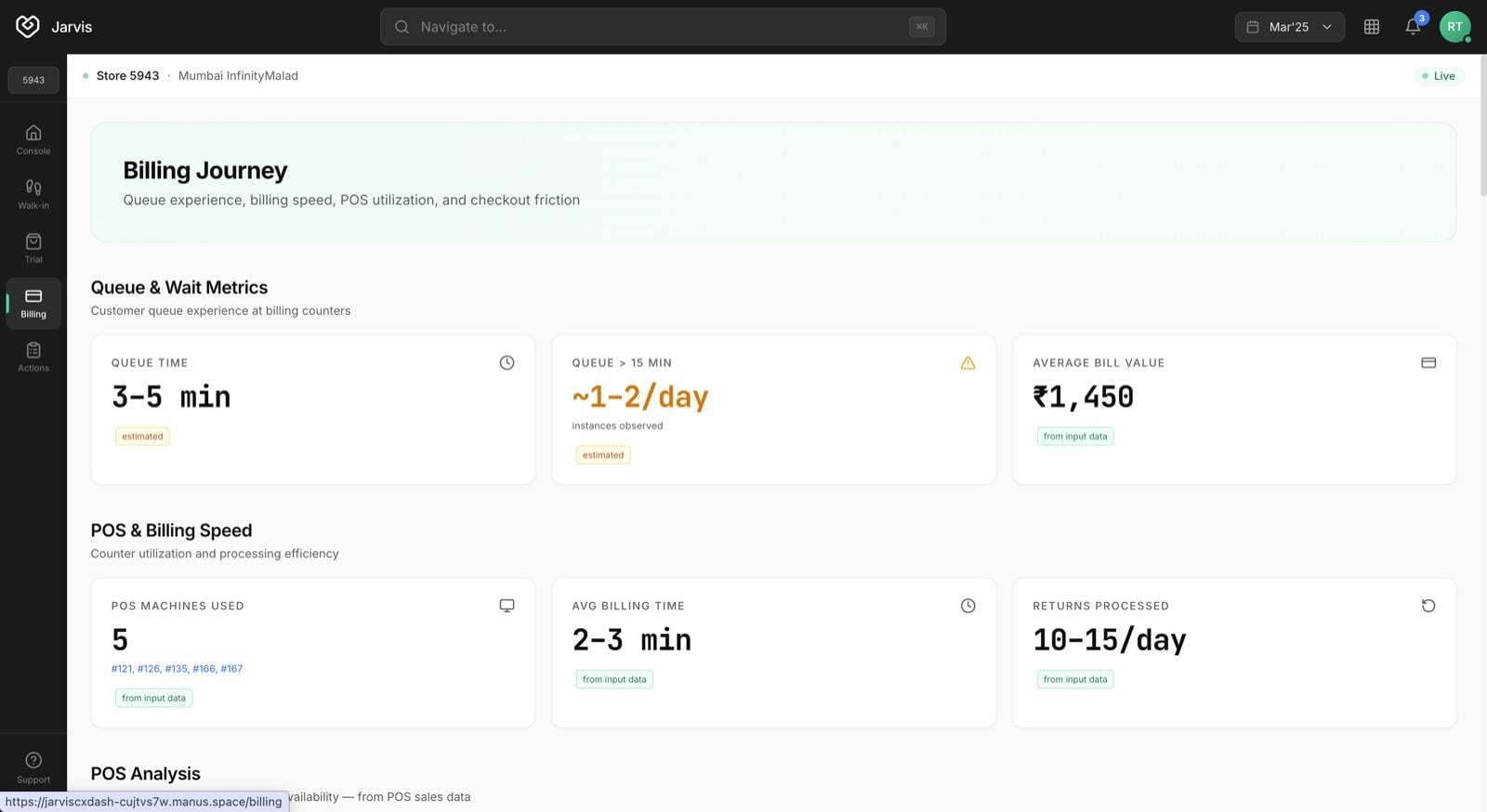
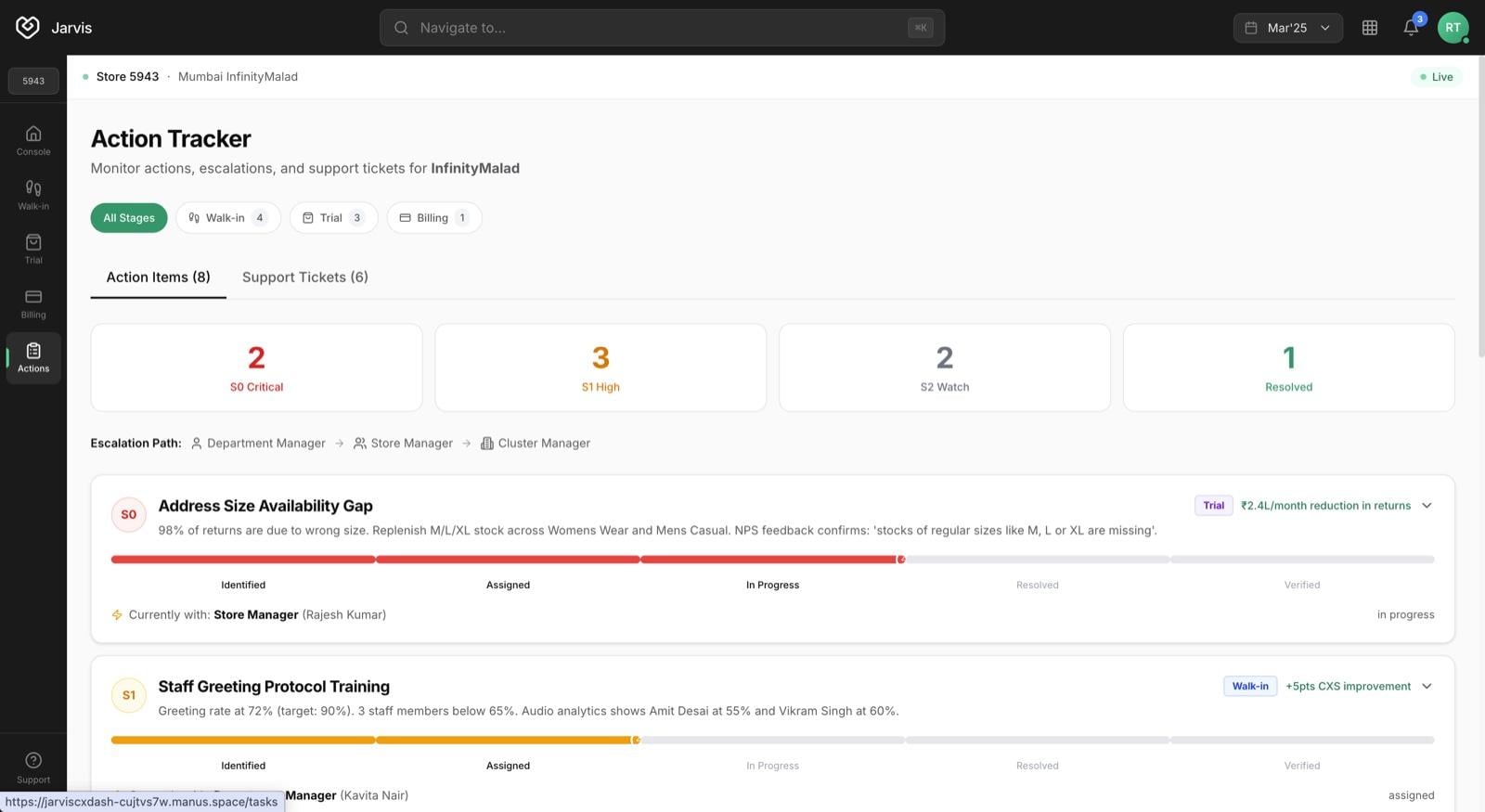
Five operator surfaces being built on Store 5943 (Mumbai Infinity Malad): Customer Journey Funnel, Walk-in, Trial/Selection, Billing, Action Tracker. CCTV-observed and POS-input metrics; estimated where instrumentation is pending.
Production rollout
Production rollout across additional formats. Silhouette/posture CV only (non-biometric) per cornerstone Section 2C. Product to be re-housed under Impetus as Impetus Jarvis.
It must be observed. The cornerstone working note states four principles before any signal, score, or action is defined. Every downstream choice in the system rests on these.
Temperature, lighting, cleanliness, product availability, navigability, staff readiness, app stability, search performance, delivery completeness, competitor pricing. If readiness is wrong, every downstream customer signal is distorted.
Customers communicate through actions long before words — continuing to browse or exiting, putting items back, abandoning a queue, retrying payment or dropping off. These signals are richer than any form-based feedback.
Order matters: Readiness, Journey, Behaviour, Inference. Measure the environment first, capture what happened, observe the response, then infer experience quality and predict risk. Inverting the order produces assumptions, not insight.
Customer expectations are shaped before they enter a store or open the app. Competitor pricing, local promotions, social sentiment, and seasonal factors must be part of the model, or behaviour is interpreted out of context.
Signals enter on the left (offline, online, external). The Experience Sensing Engine runs four stages and emits four core KPIs. Playbooks on the right route each KPI to the team that can act. Operational changes feed new signals back to the engine for continuous learning.
Offline store (RFQM, AOV, footfall, queue, path, putback, switching), online/digital (RFQM, AOV, micro-journeys, NLP sentiment, channel switching), and external/market (competitor pricing, local promotions, environment, seasonality).
Readiness Measurement (store, digital, external context), Journey Capture (offline, digital, fulfilment), Behavioural Analytics (dwell, paths, queue, funnel), AI Inference (experience quality, friction locations, churn risk).
Store Operations (readiness, staffing, assortment), Digital & Product (search, performance, payments), Fulfilment & Logistics (SLA, substitutions, reliability), CRM & Marketing (retention, outreach, recovery).
~t.compress(q:75)~t.toFormat(f:webp)/fynd-web/solutions/retail-jarvis/jarvis-architecture.jpg)
Four stages, end to end. Signals (Offline Store, Online/Digital, External/Market) → Experience Sensing Engine (Readiness Measurement, Journey Capture, Behavioural Analytics, AI Inference) → Core KPIs (Store Readiness, Customer Experience, Friction Index, Churn Risk) → Playbooks (Store Ops, Digital & Product, Fulfilment & Logistics, CRM & Marketing). Operational changes feed new signals back — scores update.
Jarvis console being built against a single anchor store, Store 5943 (Mumbai Infinity Malad). Each surface answers one operational question: where does the funnel break, what happens at the door, what happens in the trial room, what happens at the till, what does the manager fix.
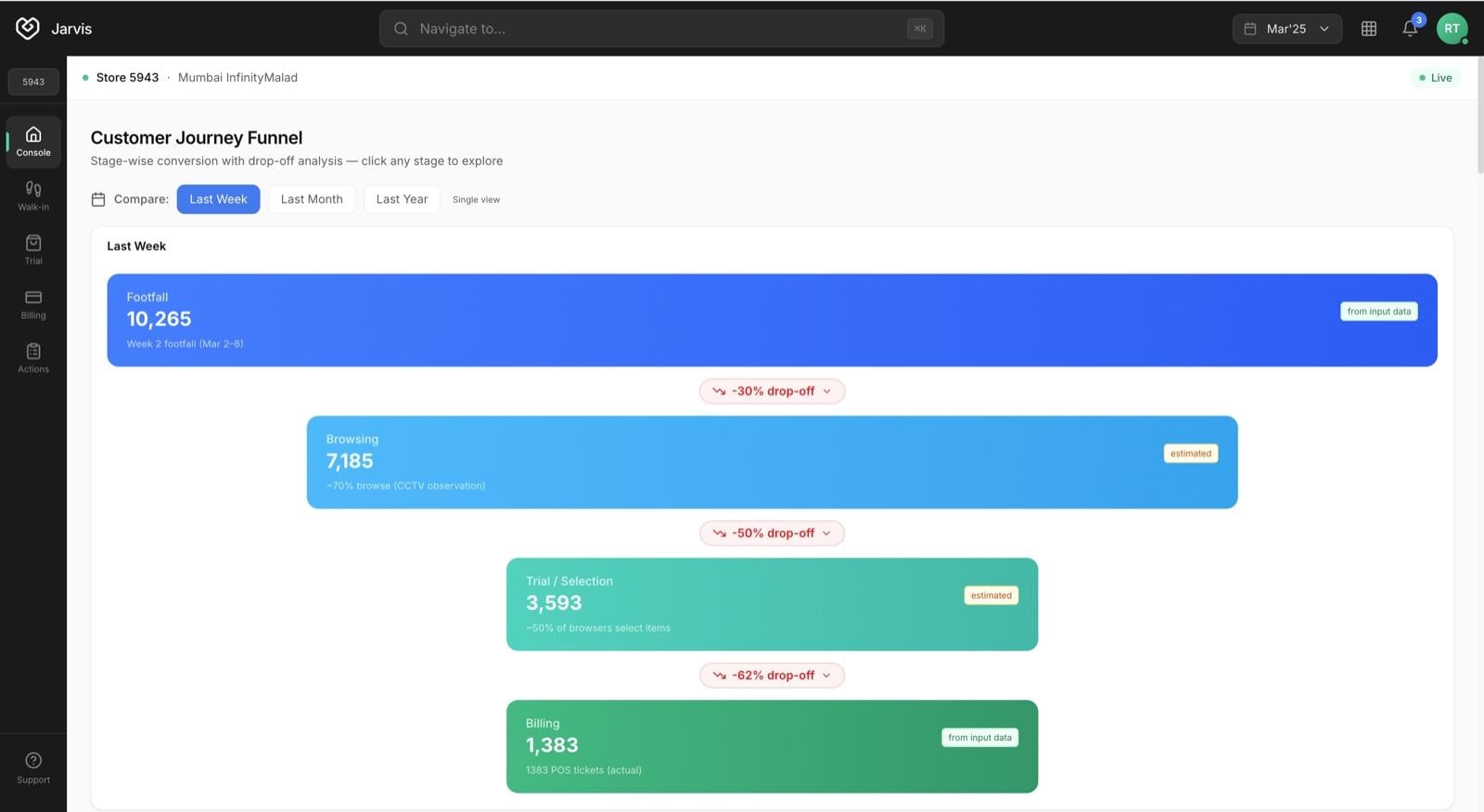
Stage-wise conversion with drop-off analysis. Last week (W2, Mar 2–8): Footfall 10,265, Browsing 7,185 (−30%), Trial/Selection 3,593 (−50%), Billing 1,383 (−62%). Footfall and Billing are from input data; Browsing and Trial are estimated from CCTV observations.
All offline and online signals consolidate into four outputs. Each has a defined calculation, a defined meaning, and a downstream playbook.
From the cornerstone working note. Basic signals rely on existing POS/app data and can be turned on immediately. Intermediate signals require structured process or instrumentation. Advanced signals rely on CV, ML, identity stitching, or social listening.
23 signals · 9 Basic · 8 Intermediate · 6 Advanced.
24 signals · 18 Basic · 6 Intermediate/Advanced.
Each output is wired to a specific trigger, an action, an owner, and a re-measurement loop. The same signals are measured again after action; scores update; weighting refines based on observed outcomes.
In-store retail analytics software helps retailers understand how customers behave inside physical stores. It can analyse footfall, browsing, dwell time, trial-room activity, queues, billing and customer drop-offs. Retail Jarvis is designed to combine these signals into actionable insights for store operations, customer experience and marketing teams.
Retailers can measure customer experience by observing behavioural and operational signals rather than relying only on feedback forms. Retail Jarvis analyses factors such as early exits, browsing patterns, staff interactions, queue abandonment, payment issues, returns and repeat visits to identify where customers may experience friction.
Retail Jarvis maps the in-store journey across stages such as entry, browsing, trial or product selection and billing. It compares the number of customers moving between each stage, helping retailers identify where shoppers leave and which parts of the store journey require attention.
Retail analytics software can help identify long queues, staffing gaps, low customer engagement, product-availability problems, trial-room delays and high funnel drop-offs. Retail Jarvis is designed to connect these issues with store conditions and customer behaviour, helping teams investigate why a store may be losing potential sales.
Retail Jarvis is designed to combine offline store data, online customer data and external market context. Potential inputs include point-of-sale transactions, footfall, queues, customer paths, store readiness, website behaviour, payment performance, delivery activity, returns, competitor pricing, promotions and customer sentiment.
Retail Jarvis is planned as a non-biometric system. Its computer-vision capabilities are designed to analyse movement, paths, dwell time and posture without using facial recognition to identify individual customers. The product is currently in development through an anchor-store demonstration, with broader production deployment planned.
Fill out the form
Share your contact information to get started
Speak to an expert
A member of our sales team will get in touch with you