5 POS bottlenecks Shopify-first brands hit when stores scale and how to fix them with Fynd POS
Using Shopify POS? Find out why rapidly expanding retail brands go to Fynd POS for enterprise-grade dependability, omnichannel retail, custom billing and integrated OMS.
Garima Poddar
Your first few stores run on momentum. Your next 20 stores run on systems.
If you're a Shopify-first brand expanding into retail, Shopify POS can be a practical starting point. But as footfall grows, store formats diversify, and omnichannel fulfillment becomes table stakes, the POS layer often turns into a bottleneck not because it's 'bad', but because retail scale asks different questions than early-stage selling.
This blog is written for retailers who want one outcome: make the store counter faster and the back office cleaner without stitching together tools every time the business adds a new format, channel or workflow.
What you should get from a POS at retail scale
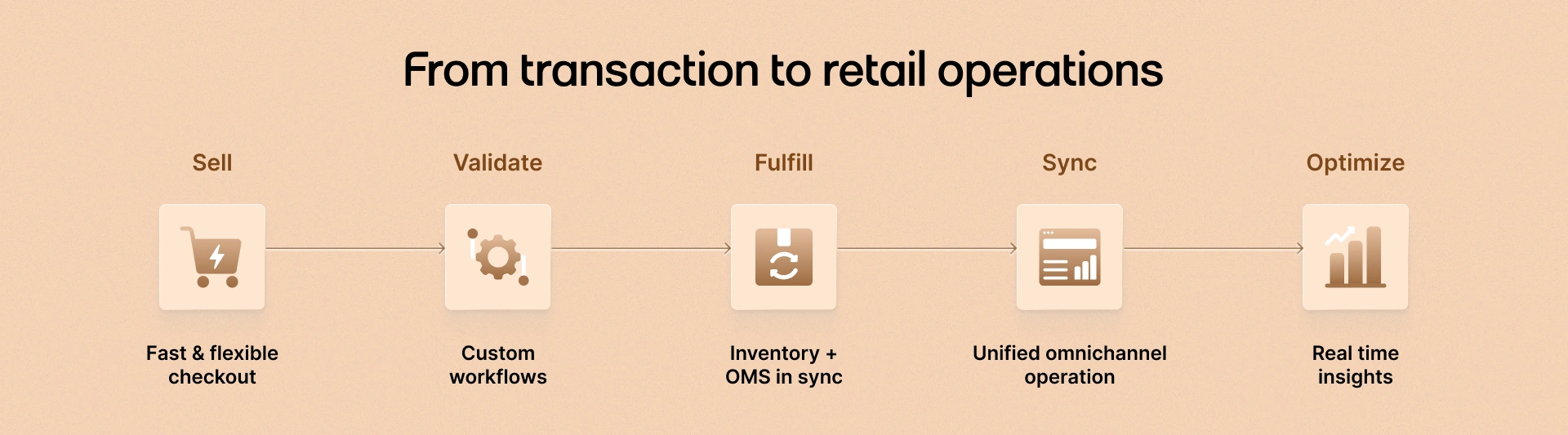
How a modern POS turns every transaction into a connected retail operation
A POS today is not only about billing. For brands, it needs to:
Shorter queues and faster billing during peak hours
Cleaner end-of-day reconciliation across cash, UPI, cards and other modes
Unified inventory visibility across stores and warehouses (so you save the sale)
Ship-from-store, pickup and returns-anywhere without operational duct tape
Controlled discounting and approvals that protect margin without slowing staff
A rollout model with training and support that keeps every new store consistent
Who this for: Brands scaling offline retail
You run or plan to run multiple store formats: flagship, outlet, kiosk, pop-up or partner stores
You want stores to fulfill online demand (ship-from-store, endless aisle, click & collect)
Your checkout needs custom fields or workflows (tailoring, prescriptions, services, warranties, B2B/GST)
You operate in markets where local payment hardware and workflows matter for example, India
You want enterprise-grade support and measurable SLAs, not 'best effort' during peak season
So, what is Fynd POS
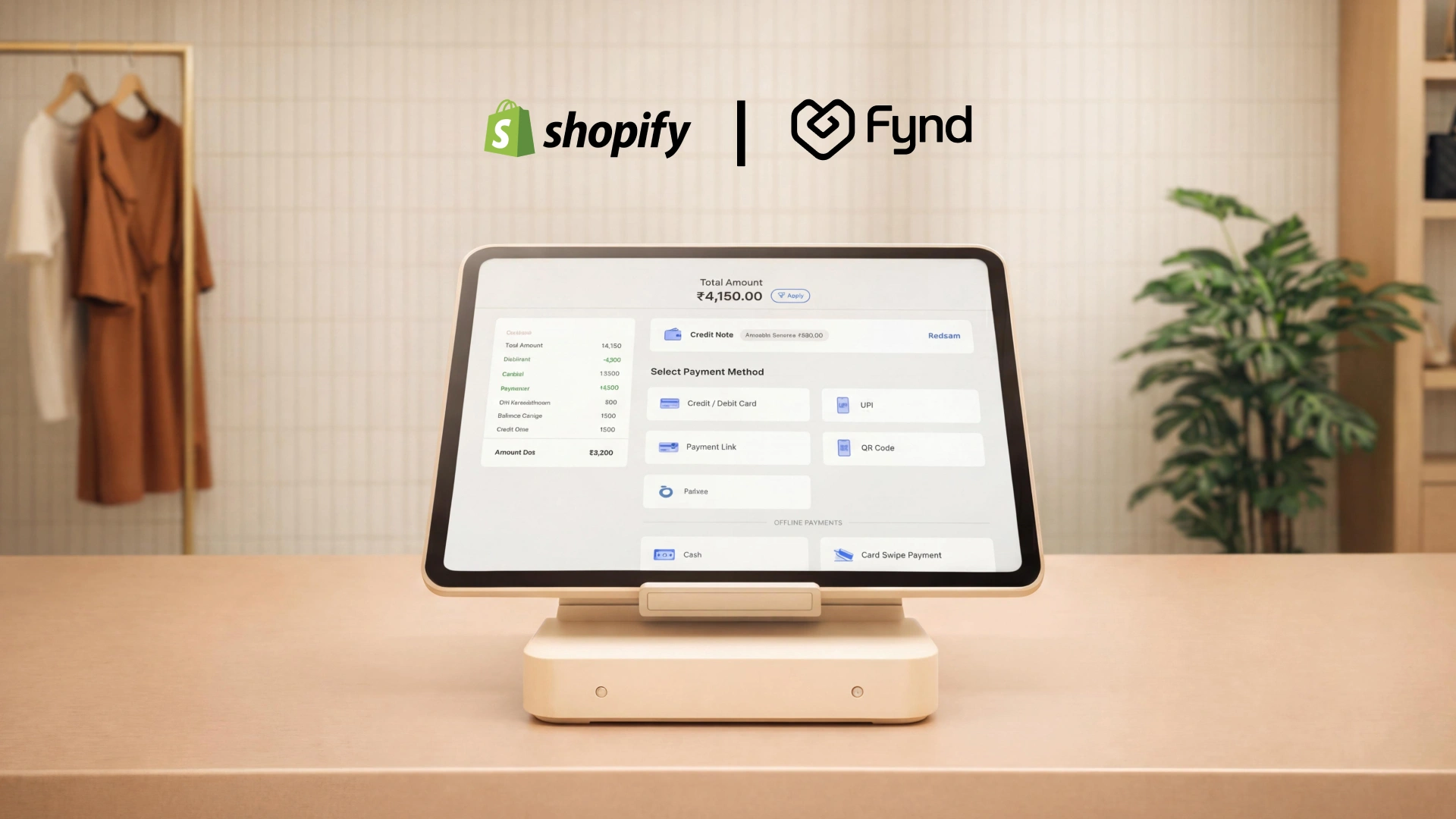
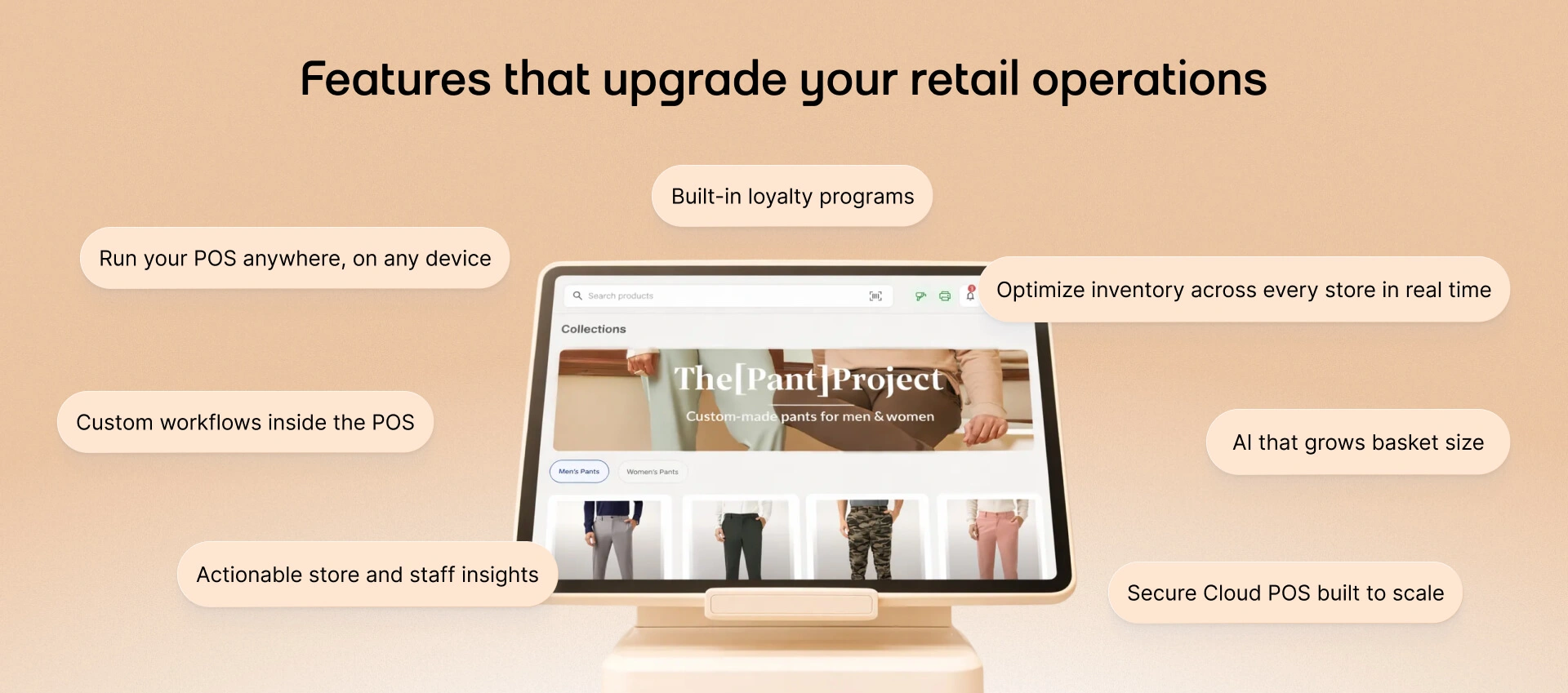
Fynd POS Built-in capabilities designed to simplify operations as retail grows
Fynd POS is a cloud-based, retail-first point-of-sale system designed for brands operating across multiple store formats, channels and customer journeys simultaneously.
Unlike e-commerce platforms that add POS capabilities, Fynd POS is built from the ground up for retail operations, combining billing, inventory, loyalty and omnichannel fulfillment in a single platform. It supports both mobile and terminal-based checkout, integrates with existing e-commerce backends and delivers what scaling retailers need most: 3× faster checkouts, unified payment reconciliation and enterprise-grade reliability.
The core difference: Fynd POS adapts to your business workflows, not the other way around. Whether you're running flagships, outlets, kiosks or pop-ups, the system configures to match how you actually operate without forcing every store into the same template.
See how Fynd can help your business
Talk to our team to modernise your retail and ecommerce operations.
5 signs your POS can't keep up with retail scale
Challenge 1: Checkout speed becomes a growth ceiling
What it costs you
Longer queues during peak hours reduce conversion and staff confidence
Inconsistent in-store experience across formats like flagship vs outlet vs kiosk hurts brand perception
Small friction compounds across stores: 10 seconds extra per bill can become hours of lost selling time per day
What typically happens in Shopify-first setups as complexity grows
Shopify POS is strong for straightforward in-person selling, but scaling retailers often need richer workflows, deeper staff controls and faster operational paths across discounting, exchanges, and stock transfers, features commonly associated with Shopify POS Pro on a per-location basis
When stores expand into multiple formats and higher footfall, retailers frequently end up stitching apps, extensions or manual SOPs to keep checkout consistent
How Fynd POS is designed to remove the bottleneck
Fynd POS is built as a retail-first, mobile-and-terminal POS with billing, inventory, loyalty and returns in one flow designed to keep the counter fast as volumes rise
Custom retail workflows can be configured for business-specific use cases inside the POS, so store teams follow the same SOP every time (without depending on constant dev cycles)
Challenge 2: Payments and refunds get messy
What it costs you
When payments happen outside the POS flow, end-of-day reconciliation becomes manual and error-prone
Refunds and exchanges take longer when the original payment context isn't unified with the sale
Finance and store ops spend time reconciling instead of improving sell-through
What typically happens in Shopify-first setups as complexity grows
Shopify supports quick sales in the Shopify app, including accepting cash and generating secure checkout/payment links useful for lightweight, mobile transactions
However, integrated in-person card processing with Shopify POS depends on Shopify Payments for POS, which is available only in select countries and regions. If a market isn't supported, retailers often rely on external terminals and separate reconciliation processes
How Fynd POS is designed to remove the bottleneck
Fynd supports configuring online and offline payment modes, payment priorities and EDC mappings from a centralized interface, helping retailers keep payment operations consistent across stores
For India-specific in-store payments, Fynd POS includes Pine Labs setup and EDC machine mapping workflows, supporting common on-ground payment realities
Fynd Store OS also supports processing cancellations, returns, exchanges and refunds based on fulfillment type and payment method, helping store teams complete reverse flows without back-office workarounds
Challenge 3: Omnichannel fulfillment becomes an operational nightmare
What it costs you
Customers expect buy-online-pickup, ship-from-store and inventory visibility across locations
Without smart routing, stores fulfill the wrong orders, delivery timelines slip and cancellations rise
Returns create chaos when inventory, refunds and re-stocking aren't unified across channels
What typically happens in Shopify-first setups as complexity grows
Shopify supports multiple locations and order routing rules that help prioritize which location fulfills each item in an order
But as retailers add marketplaces, warehouses, partner stores and mixed fulfillment constraints, many teams graduate from 'platform routing' to a dedicated OMS layer to manage allocations, split shipments, reverse logistics and operational exceptions
How Fynd POS is designed to remove the bottleneck
Fynd combines POS andOMS capabilities so stores can fulfill online orders, enable ship-from-store and manage returns across channels from one platform
Fynd OMS positions itself as a system that unifies inventory, orders and returns across channels, with automated order routing and tracking to the nearest warehouse/store/partner based on inventory availability
For in-store selling when an item isn't available on hand, Fynd's Endless Aisle enables chain-wide inventory visibility and cross-store fulfillment while completing the sale in a single transaction
Challenge 4: Your billing workflow becomes your brand
What it costs you
When billing can't capture the details you sell by (size-color-fit, services, tailoring, prescriptions, warranty add-ons), staff revert to hacks and slow down the counter
Different store formats need different flows forcing one template increases errors and training burden
What typically happens in Shopify-first setups as complexity grows
Custom fields, approvals and invoice nuances are possible via apps and development, but every addition increases maintenance overhead as the store network grows
How Fynd POS is designed to remove the bottleneck
Fynd POS supports custom retail workflows inside the system that adapt to how you operate not the other way around
Fynd enables approval-based discounting and store-specific processes to be configured so governance and speed can coexist
Challenge 5: At scale, POS reliability becomes business risk
What it costs you
With dozens of stores, even a minor POS issue multiplies into revenue loss and customer dissatisfaction
Rollouts fail when training is inconsistent and troubleshooting depends on a few power users
Compliance and audit readiness become non-negotiable
What typically happens in Shopify-first setups as complexity grows
Shopify provides support and a large ecosystem, but retailers often still need local, operationally grounded help to onboard store teams, manage peak-season readiness, and resolve store-floor issues quickly
How Fynd POS is designed to remove the bottleneck
Fynd positions its POS offering with enterprise-grade reliability and support, including 24/7 SLAs, on-ground onboarding and real-time monitoring
Fynd also frames compliance for tax and data security as integrated rather than being an afterthought
Why Shopify brands should migrate to Fynd POS
Fynd POS vs Shopify POS
The migration from traditional POS systems to Fynd isn't just about features- it's about removing the operational ceiling that's keeping brands from their next growth phase.
Common migration triggers:
Expanding beyond 5-10 stores and hitting per-location upgrade costs
Needing ship-from-store without adding another platform
Requiring customization that doesn't need a developer for every change
Dealing with checkout bottlenecks during peak hours
Managing multiple store formats (flagship, outlet, kiosk) with different billing needs
The brands that switch early avoid the pain of retrofitting their operations later.
Retail proof: Faster billing, happier customers
Let's talk about outcomes, not features.
The Pant Project had integrated a factory pattern-cutting software with Shopify. With this existing e-commerce setup, the team fell back to placing in-store orders on the website to preserve custom fields and flows.
Reported 5× faster checkouts after implementing Fynd POS.
Reported reduction in an in-store journey from 2–3 minutes to ‘seconds’ (with orders flowing into Shopify).
Also reports offline growth impact, such as a jump in offline retail share and increased monthly offline orders in the months following rollout
Your POS should accelerate growth, not limit it. The right system shows measurable impact in weeks- faster checkouts, cleaner reconciliation and unified omnichannel operations not quarters of integration work. If your current setup requires constant workarounds as you scale, that's not a POS problem. It's a signal to evolve.
If you want to evolve your business, run a 30-day pilot that measures checkout speed, reconciliation effort and omnichannel fulfillment performance. It's time to go for the right POS.
.webp)
~t.compress(q:75)~t.toFormat(f:webp)/cms_uploads/3d-product-configurator-only-cover-v3-4k.jpg)
~t.compress(q:75)~t.toFormat(f:webp)/cms_uploads/best-ai-fashion-design-tools-cover-4k.jpg)
~t.compress(q:75)~t.toFormat(f:webp)/cms_uploads/ChatGPT-Image-Sep-17-2026-05_15_50-PM.png)