Why Fynd storefront is the best Shopify alternative for Indian brands
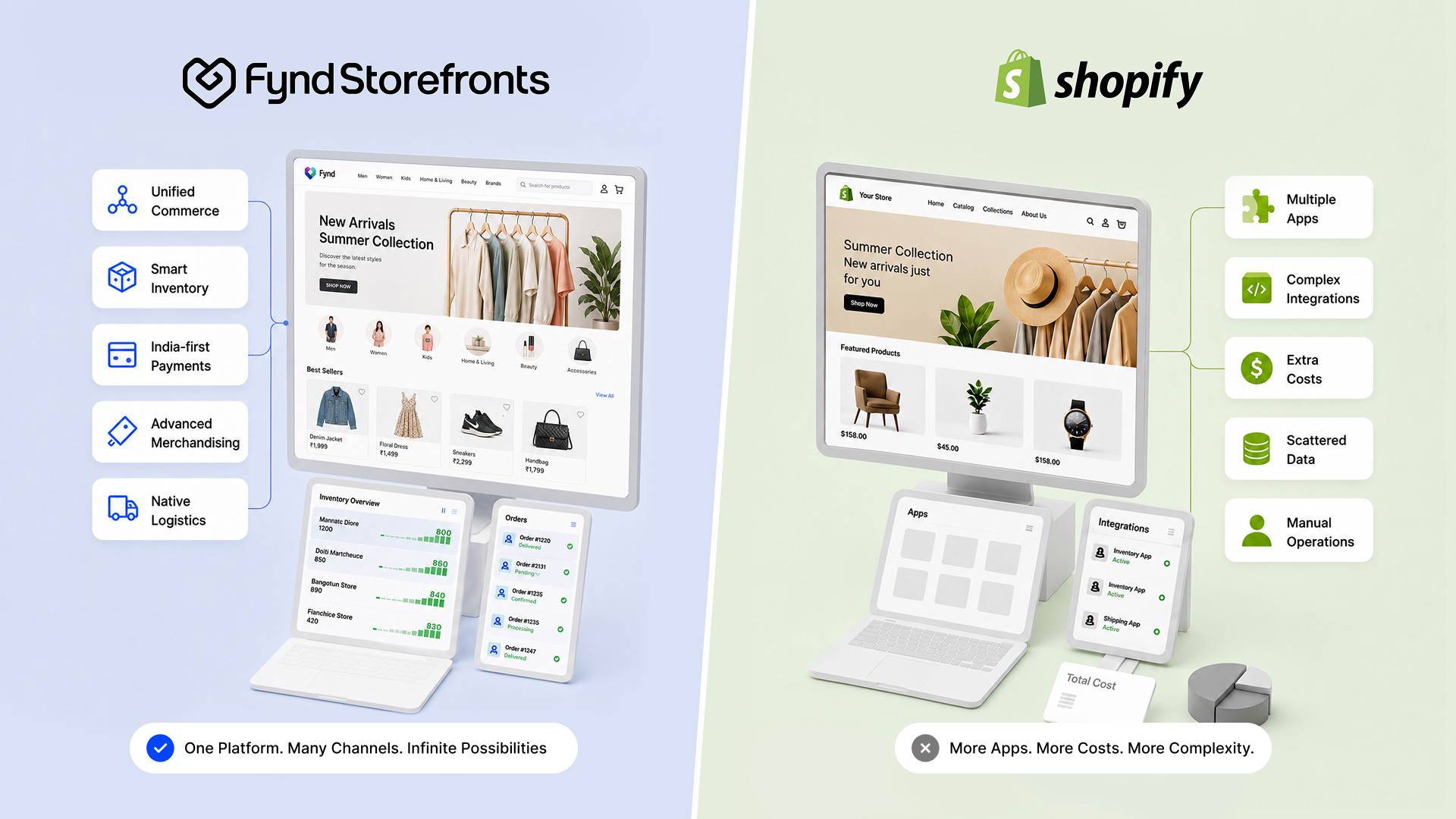
Shopify is good at one thing, getting a brand online, fast. It offers clean themes, it's easy to set up and holds a massive app store for plugins and addons. Overall, it's a great tool for early-stage D2C brands but Indian commerce doesn't stay simple for long.
Think about what "scaling up" actually looks like for an Indian brand.
Case 1, you started with one warehouse in one city. Now you have stock sitting in three warehouses, thirty franchise stores, and a marketplace seller account and every channel is showing different availability to different customers.
Case 2, you're running a Diwali campaign that needs a banner live at midnight on Friday and gone by Monday morning.
Case 3, your customers expect UPI, COD, wallet payments, and net banking all at checkout.
Case 4, you have onboarded two delivery partners because one doesn't cover Tier 2 cities. Your return rate is climbing and refunds are being processed manually.
At this point, Shopify asks you to solve each of these problems separately: a multi-location inventory app here, a scheduling app there, a payment gateway integration, a logistics aggregator, and a returns management tool. Each app has its own pricing, its own quirks, and its own way of talking to the others. You end up spending real time and real money keeping the duct tape from coming unstuck.
Fynd Storefront is built for exactly that next stage. Not as a collection of features added on top of a simple ecommerce engine, but as a platform designed from the ground up around the complexity of Indian omnichannel commerce.
1. What makes Fynd a better Shopify alternative for growing brands
Shopify thinks in storefronts. Fynd thinks in sales channels.
That distinction sounds subtle but it changes everything. On Fynd, a "storefront" isn't just a website, it's a configurable sales channel that can be pointed at specific brands, stores or inventory pools. A single backend offers multiple experiences: a D2C website for end consumers, a B2B portal for wholesale buyers, a kiosk screen for your offline store, a POS interface for your staff.
For brands managing multiple sales channels, this is where Fynd stands out as a practical Shopify alternative, reducing the operational overhead that typically grows with scale.
1.2 One backend, many storefronts
Each sales channel on Fynd can have its own theme, its own navigation, its own product selection, and its own checkout rules all managed from a single commerce panel. There's no need to clone stores or sync data across separate Shopify accounts.
1.3 B2C, B2B, and POS from the same system
Whether you're selling to end consumers, running a wholesale portal, or managing POS at a physical store, it's all configured as sales channels within the same backend. You don’t need separate tools that are limited by data silos.
2. Inventory that reflects India's reality
Indian retail is not a clean warehouse-to-doorstep pipeline. It's franchisees, multi-city warehouses, store-level stock, marketplace inventory, and sometimes an Excel sheet somewhere that nobody wants to talk about.
This is one of the reasons many growing brands evaluate Fynd as a Shopify alternative, especially when inventory is spread across warehouses, stores, and franchise networks. When creating an application, you select exactly which companies and stores should contribute inventory to that channel. If you want certain products to come only from your Mumbai warehouse and others from your franchise network, you configure that without middleware, without custom development, without a third-party integration.
2.1 Granular inventory sourcing, by design
You can select inventory origins at the company level or the store level. The "Other Selling Option" setting lets you pull stock from stores belonging to different companies useful for franchise networks and multi-brand operations where ownership structures are layered.
2.2 Store selection on the product page
This also enables seller and store selection on the product page, so customers can choose their preferred pickup or fulfillment location. You can turn this on natively from the storefront settings. On Shopify, equivalent behavior requires a multi-location setup plus apps, and it still doesn't map cleanly to India's franchise or multi-brand structures.
3. Customization without a developer on speed dial
Shopify's liquid templating language is powerful but it has a ceiling for non-technical teams, and crossing it means calling a developer.
Unlike many Shopify setups that require developer intervention, Fynd's Theme Editor gives brands more flexibility out of the box, making it a strong Shopify alternative for lean teams. You get visual control over layouts, sections, headers, footers, product pages, and navigation all without touching code. But what's more interesting is what happens when you do want to go further.
3.1 AI-generated storefront sections
Write a prompt describing what you want; a promotional banner, a product showcase, a campaign block and the editor generates the HTML structure, binds the right data sources, and gives you a live preview. You can refine it with a follow-up prompt, upload reference images, or tweak the generated code directly. The result is server-side rendered, which means it loads fast and indexes well.
3.2 Custom CSS scoped to a single section
If you want to adjust a specific block without touching the global theme, you can apply CSS scoped to just that section. In other words while making a small change you are at zero risk of breaking everything else.
3.3 Scheduled and geo-targeted content
A promotional section can be set to appear on a specific date and time, then disappear automatically. You can also restrict sections by geographic zone, device type (desktop vs. mobile), or login state (show this only to registered users). This is native functionality not a scheduling app bolted on top.
For Indian brands running Diwali campaigns, regional promotions, or city-specific offers, this is a meaningful operational advantage.
4. Search and merchandising that doesn't need five apps
One of the more underappreciated parts of the Fynd storefront is how deep the search and merchandising controls go. For brands looking for a Shopify alternative that reduces dependency on third-party apps, this can significantly lower both costs and maintenance effort.
4.1 Autocomplete and synonym configuration
You can configure autocomplete behavior: how many product suggestions appear, how many brand suggestions, how many category suggestions. You can define searchable attributes and set their order of importance. You can create two-way synonyms (so "sneakers" and "casual shoes" return the same results) or one-way synonyms (so "running shoes" maps to "sports shoes" but not vice versa).
4.2 Rule-based merchandising
When a customer searches "mobile" and sorts by Popular, you can configure which products appear at the top, which brands get boosted, which categories get buried, and which products are hidden entirely. Rules can target specific search queries, specific collections, or specific attribute combinations. You can pin up to 700 products in bulk via a template upload.
The equivalent stack on Shopify; search merchandise, boost, rerank, synonym management typically requires multiple paid apps and a fair bit of stitching together.
5. India-first payments and logistics
This one is straightforward. Fynd supports UPI, COD, wallets, net banking, Fynd Pay, and multiple payment gateways, all configurable from one interface. COD can be enabled or disabled at the product level or at the cart level, with separate rules for online and offline channels.
5.1 Delivery partner configuration in full detail
The delivery partner setup lets you configure service capabilities down to the specifics: air vs. surface vs. hyperlocal, COD support, open box delivery, doorstep quality check, multi-part shipments, return shipment quantity limits. You can define default pickup cutoff times, set turnaround time by pincode or city, and upload bulk serviceability data. Self-delivery is also supported for brands that handle their own last-mile.
5.2 Refund logic that matches operations
The refund configuration is equally granular: you can set auto-approval rules, trigger refunds based on specific shipment states (return-to-origin, cancellation, loss), and enable refund-without-return for cases where physical return isn't practical.
None of this requires going outside the platform.
6. A Note on Progressive Web Application (PWA)
Fynd allows you to turn your storefront into an installable Progressive Web App directly from the theme settings. Add icons, screenshots, and shortcuts, hit save, and your customers can install the store on their home screen like a native app with faster load times, offline access, push notification capability.
6.1 App-like experience without building an app
For India's mobile-first consumer base, this matters. Not everyone downloads a brand app, but a PWA dramatically reduces that friction. It also means you don't need a separate mobile development budget to offer a native-feeling experience.
7. The Real Question
The question isn't whether you need a Shopify alternative. It's whether your current commerce stack can keep up with the complexity your business is growing into.
If you're starting out with a single storefront, one warehouse, and a straightforward catalog Fynd handles that just as well as anything else out there. Creating a storefront takes minutes. Pick a mobile-optimized theme from the marketplace, customize it visually without writing a line of code, set up your domain, configure your header and footer navigation, and set your landing page. Product filters, sorting, variants, comparison, all of it is configurable from the panel. No developer needed, no app hunting, no stitching things together.
And then, as your business grows, the platform grows with it. Without asking you to rebuild what you've already set up.
8. Built for where Indian brands are going
The moment complexity enters the picture, inventory spread across stores and warehouses, multiple storefronts for different channels, regional campaigns that need to go live and expire on a schedule, Indian payments and logistics at scale, that's where Fynd's storefront starts proving why it has become a preferred Shopify alternative for Indian brands in ways that are genuinely hard to replicate on Shopify without significant app spend, integration effort, and ongoing maintenance.
Frequently asked questions
It depends on where you are in your growth curve. If your current setup is stable and the app stack is manageable, there's no urgent reason to switch. But if you're regularly hitting limitations around inventory, logistics, or multi-channel operations and spending more time managing integrations than actually running your business, the migration effort tends to pay off fairly quickly. Fynd's storefront supports custom domains, theme customization, and full data configuration, so the transition is more structured than starting from scratch.

Fynd works at any stage. Creating a storefront, setting up a domain, choosing a theme, and going live is a matter of minutes. You don’t need a technical background for that. The platform's deeper capabilities around inventory orchestration, merchandising rules, and logistics configuration are there when you need them, not in the way when you don't. You're not paying for complexity you haven't grown into yet.
Fynd Commerce supports structured onboarding for product catalogs, brand and category configurations, and storefront setup. Your inventory, order history, and customer data migration would be handled as part of the platform onboarding process. It's worth discussing specifics with the Fynd team based on your current catalog size and data structure.
Fynd has an extensions marketplace where third-party tools such as payment providers, marketing platforms, WhatsApp integrations, analytics tools, and more can be installed directly into your storefront. For capabilities that sit outside the marketplace, the platform is built on open APIs, meaning custom integrations are possible. The difference from Shopify's model is that the core operational layer; inventory, search, payments, logistics, refunds doesn't need to be assembled from apps in the first place.
A. Brands that need omnichannel inventory management, native Indian payment methods, logistics controls, B2B and B2C storefronts, and multi-store operations often consider Fynd one of the strongest Shopify alternatives. Unlike Shopify, which typically relies on multiple third-party apps for these capabilities, Fynd includes many of them natively within a single platform.
Not usually. Fynd comes with many core features built in, including inventory management, search and merchandising, payments, logistics, and refunds. This means you can run most day-to-day ecommerce operations without relying on multiple third-party apps. If you need additional tools, you can still connect them through Fynd's extensions marketplace, but most brands can get started with far fewer integrations.
Empower your business, every step of the way
More Blogs