Why AI skin analysis is the next big bet for Indian beauty brands
India's skincare market is no longer a slow-moving category. According to Astute Analytica, the skincare market which was valued at $8.78 billion in 2024, is projected to nearly double to $17.69 billion by 2033 at a CAGR of 8.43%. Behind this growth is a consumer who is more ingredient-aware, more research-driven, and increasingly unwilling to settle for products that were not designed with their specific skin in mind.
This is the consumer that AI skin analysis was built for.
1. The problem generic skincare can no longer solve
India's skincare challenge is inherently complex. The country spans dozens of climate zones, from Rajasthan's arid heat to Kerala's coastal humidity. Pollution levels, water quality, hormonal patterns, and dietary habits differ city to city. A moisturiser that works in Delhi winters can aggravate oily Mumbai skin in July.
Yet for decades, brands have sold broadly, formulating for a hypothetical "average" consumer who doesn't really exist. With access to dermatology content on Instagram, ingredient databases, and skincare communities, buyers now arrive at purchase decisions with questions that a product description alone cannot answer.
The data reinforces this shift. 76% of beauty consumers are open to AI-assisted shopping, per Accenture research. Among those who have used AI beauty tools, 78% described the recommendations as personalised and 87% found them helpful. McKinsey found that 78% of consumers are more likely to make repeat purchases from brands that personalise their experience. For beauty brands, these numbers represent both pressure and opportunity.
2. What AI skin analysis actually does
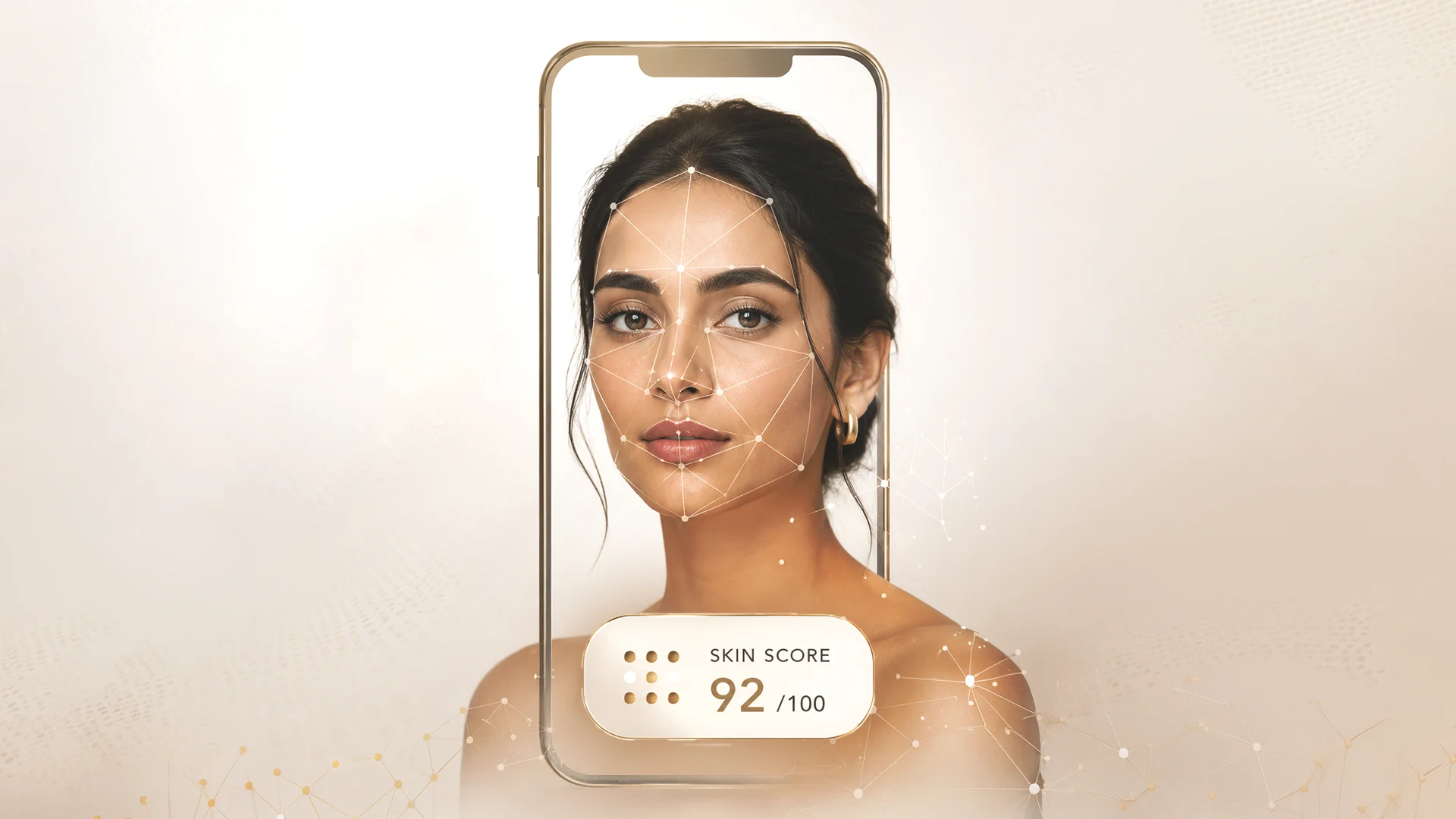
AI skin analysis uses machine learning models trained on clinical image datasets to assess skin from a photo or live camera feed. The output covers visible pores, pigmentation, hydration levels, acne severity, fine lines, and calculated skin age then maps these findings to product recommendations.
What makes this commercially powerful is the shift it creates in the purchase journey. A consumer who has received a personalised skin report is in a fundamentally different mental state from one browsing generic product listings. The analysis creates intent; the recommendation closes it.
The technology falls into three broad approaches: live scan tools that process a selfie in real time; query-based tools that supplement image analysis with questions about lifestyle and health history; and omnichannel platforms that maintain a consistent skin profile across web, mobile, and in-store touchpoints. For Indian brands operating across digital and physical retail, this last category represents the most durable long-term infrastructure.
3. Built for Indian skin: What sets Fynd GlamAR apart
When evaluating AI skin analysis platforms against the specific requirements of Indian beauty brands, one platform consistently addresses the full picture: Fynd GlamAR.
Most global platforms were built with a Western consumer in mind and trained on datasets that underrepresent South Asian skin tones, designed for single-zone facial analysis, and tested in controlled studio lighting. None of these assumptions hold in India. Fynd GlamAR was designed with exactly this complexity in mind, and the difference shows in practice.
3.1 It handles India's skin tone diversity accurately.
Fynd GlamAR's AI facial skin analysis tool is trained to deliver accurate results across different skin tones, conditions, and ethnicities, not just lighter skin profiles. For Indian brands whose customers range from fair to deep brown across regions, this is not a nice-to-have. It is a baseline requirement that many competitors cannot meet.
3.2 It understands how Indian skin actually behaves.
Rather than analysing the face as a single uniform surface, Fynd GlamAR performs region-specific analysis assessing the T-zone and U-zone independently. This matters enormously for Indian consumers, whose skin frequently presents mixed conditions: an oily forehead and dry cheeks, or acne-prone zones alongside areas of pigmentation. A single-zone analysis misses this nuance entirely. Fynd GlamAR captures it.
3.3 It works in real-world conditions.
One of the most overlooked requirements for any consumer-facing skin tool is environmental reliability. Indian consumers scan their skin in living rooms, bathrooms, and offices not photography studios. Fynd GlamAR functions accurately in variable and uneven lighting, which is essential for results that consumers can actually trust outside a controlled demo environment.
3.4 It identifies the concerns that matter most to Indian consumers.
Fynd GlamAR's analysis covers acne, pigmentation, dark circles, visible pores, uneven skin tone, scars, and other concerns that are particularly prevalent in Indian skin driven by pollution, UV exposure, hormonal patterns, and diet. After identifying these concerns, it generates a complete skin profile including skin type, tone, and approximate skin age, then connects those findings to a personalized skincare routine and specific product recommendations.
3.5 It integrates directly into the commerce experience.
For beauty brands, the purpose of skin analysis is not the report, it is the sale. Fynd GlamAR's platform is built to embed within e-commerce environments, connecting analysis output directly to a brand's product catalogue. When a consumer receives a recommendation, they can act on it immediately within the same journey. This integration is what separates a genuinely useful retail tool from a standalone feature that creates engagement but not conversion.
3.6 It is built for omnichannel deployment.
Whether a brand's consumer touchpoint is a website, a mobile app, or an in-store device, Fynd GlamAR can be deployed consistently across all of them. For Indian brands that span both D2C digital channels and physical retail, a common model for mid-to-large beauty players, this means a customer's skin profile and purchase history can follow them across every interaction, making each subsequent recommendation smarter than the last.
The result for brands is measurable: more confident purchasing decisions, lower return rates, and a customer relationship built on genuine personalisation rather than generic suggestions.
4. What determines success for brands beyond the technology
Choosing the right platform is necessary but not sufficient. Three principles determine how much value it actually delivers.
4.1 Privacy cannot be an afterthought.
AI skin analysis collects biometric data. With India's Digital Personal Data Protection Act in force, transparent consent flows and clear data policies are both a regulatory requirement and a brand trust decision.
4.2 Fit over features.
A focused product range does not need a platform detecting 50 skin conditions. The right tool connects the concerns a brand's products address to the consumers who have them reliably and without overwhelming the user.
4.3 Integration depth determines real-world ROI.
A skin analyser disconnected from a brand's product catalogue and CRM delivers a fraction of its potential. The goal is a connected system where analysis outputs feed recommendations, and purchase behaviour continuously refines them.
5. The longer strategic argument
The most forward-thinking Indian beauty brands are not approaching AI skin analysis as a conversion tool. They are building it as the infrastructure for a long-term customer relationship. Every scan is a data point. Every recommendation accepted or declined reveals something about that consumer's priorities. Every follow-up purchase extends the feedback loop.
70% of beauty brands globally are already using AI for personalized recommendations. Among younger Indian consumers, the primary skincare buyers of today and tomorrow, 72% actively demand AI-integrated beauty experiences. The baseline expectation is rising fast, and what differentiates a brand today will be table stakes within three years.
For Indian brands, the opportunity is real. International players like L'Oréal and Cetaphil have moved early, but carry global platforms not always calibrated for India's skin diversity or regional complexity. A brand that deploys AI skin analysis thoughtfully using a platform built for Indian conditions like Fynd GlamAR and embeds it authentically into the customer journey, has a genuine edge. That window will not stay open indefinitely.
Frequently asked questions
AI skin analysis uses machine learning models trained on large datasets of clinical skin images to assess a consumer's skin from a selfie or live camera scan. The tool measures parameters like acne severity, pigmentation, pore size, hydration levels, and fine lines, then generates a personalized skin report with product recommendations. The process typically takes less than 30 seconds.

Accuracy varies significantly by platform. Many early tools were trained predominantly on lighter skin tones and perform poorly on South Asian skin profiles. Platforms like GlamAR are specifically trained across diverse skin tones and ethnicities, making them considerably more reliable for Indian consumers across the full spectrum of skin tones found in India.
Most enterprise AI skin analysis platforms including GlamAR offer API-based or SDK integration that can be embedded directly into a brand's e-commerce website, mobile app, or in-store device. The integration connects the skin analysis output to the brand's product catalogue, so recommendations surface shoppable products within the same consumer journey.
Depending on the platform, AI skin analysis can detect acne and acne scarring, pigmentation and dark spots, dark circles, visible pores, uneven skin tone, fine lines and wrinkles, skin dryness, oiliness, and in some advanced tools, early indicators of more serious dermatological conditions. GlamAR covers the full range of concerns most relevant to Indian consumers including pigmentation, pores, and acne scarring.
AI skin analysis is a pre-diagnostic or advisory tool, not a medical service. It provides personalised product and routine recommendations based on visible skin parameters. A dermatologist offers clinical diagnosis, can assess conditions not visible to a camera, and can prescribe treatment. The two are complementary AI analysis is effective for everyday skincare decisions and product discovery, while a dermatologist is appropriate for persistent or medically significant skin conditions.
Yes, when the platform is well-designed. Advanced tools like GlamAR analyse different facial zones independently, which makes them particularly effective for combination skin assessing the oily T-zone and drier U-zone as separate conditions rather than averaging them out. This zone-specific approach produces significantly more accurate recommendations for consumers with mixed skin types, which is common among Indian consumers.
Empower your business, every step of the way
More Blogs