How hyperlocal delivery works in India, why it matters and how Fynd helps brands leverage it
India's consumers do not wait anymore. Today, consumers in India expect speed. Whether it is a bottle of shampoo ordered late at night, a forgotten grocery item or a last-minute birthday gift, they want the convenience of ordering instantly and receiving it just as quickly.
This growing demand for faster deliveries is reshaping the retail landscape. Businesses are being pushed to rethink their fulfilment strategies, inventory management and delivery operations to meet rising customer expectations without compromising efficiency.
However, delivering products at speed is not as simple as it seems. Behind every order lies a complex network of technology, inventory management and logistics coordination.
So, how does hyperlocal delivery work in India? What challenges emerge as operations scale? And how are brands building efficient, reliable delivery networks to keep up with rising customer expectations?
This piece explains it all.
What is hyperlocal delivery?
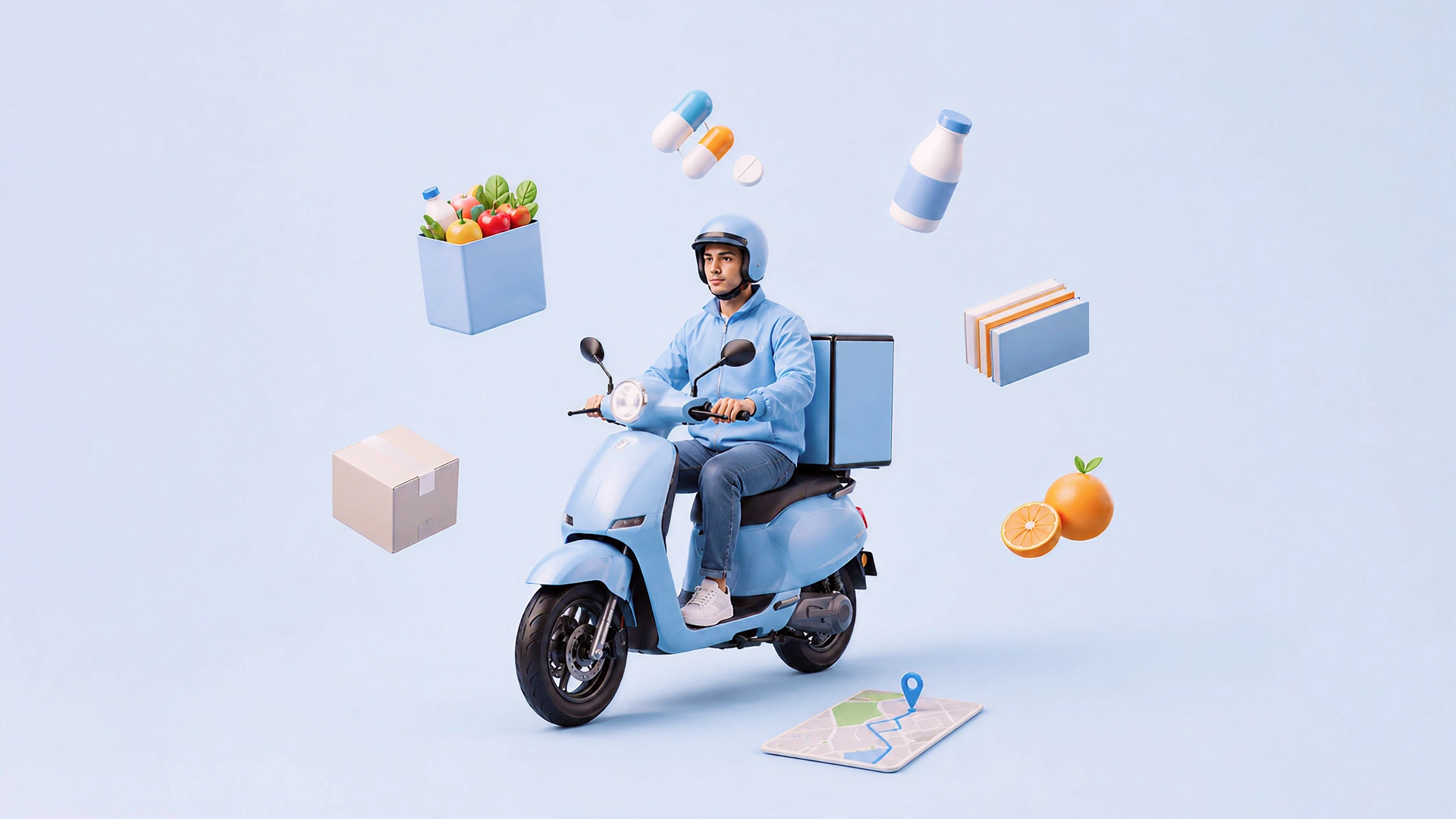
Hyperlocal delivery is a fulfillment model in which products are delivered to customers from nearby stores, vendors, or fulfillment centers within a short period, typically ranging from a few minutes to a few hours.
The model is not new
Local kirana stores have always offered a similar service - a phone call, a note, and a delivery person on a bicycle. What has changed is the technology layer on top of it: real-time inventory visibility, GPS-based rider tracking, AI-assisted route optimization and zone-based order routing that matches a customer's pincode to the nearest stocked location automatically.
How does it work?
When everything is layered to work together, a brand can confidently promise same-day or even same-hour delivery.
How hyperlocal delivery works
Understanding how hyperlocal delivery works makes it easier to see why challenges arise as operations grow and where businesses can make the biggest improvements.
- Order placement: A customer places an order on a brand’s website or app.
- Zone-based routing: The order is assigned to the right fulfilment point based on the customer’s location.
- Warehouse or store picking: Staff at the fulfilment location pick the item and prepare it for dispatch.
- Rider assignment and dispatch: A delivery partner is assigned using automated systems that consider location, workload and route efficiency.
- Last-mile delivery and tracking: The customer can track the order in real time. On arrival, proof of delivery is collected.
While each step may seem simple on its own, the real challenge lies in making them happen quickly and in the right order across many orders at once. Even a small delay or mistake at any stage can lead to significant operational and cost issues.
Key technologies powering hyperlocal delivery
Every successful hyperlocal delivery operation is supported by technology that coordinates orders, inventory and deliveries in real time. Without these systems, businesses are forced to rely on manual processes that cannot keep up with growing demand.
Real-time inventory management helps ensure that customers see accurate product availability at their nearest fulfilment location. Without the right infrastructure, this system can become unreliable as brands grow.
AI-powered route optimization selects the most efficient path for each rider, taking into account traffic, order volume, and delivery windows.
GPS and real-time order tracking give customers visibility into where their order is and give operations teams the ability to intervene when a delivery is running late or going off-route.
Zone-based serviceability mapping identifies which store or dark store serves each pincode.
Automated order management ties the storefront, warehouse and delivery layers together so that an order placed online moves through picking, dispatch and tracking without manual handoffs between systems.
Why hyperlocal delivery matters in India
India's hyperlocal delivery market has grown at a CAGR of 51.84% over the past five years and quick commerce, delivering groceries and essentials within 10 to 15 minutes, expanded by 75–85% in 2025, as per Makreo Research's 2026 report.
For brands, the implications go beyond logistics.
Customer retention improves when delivery is fast and reliable. The expectation of same-day delivery, set by quick commerce platforms, now extends beyond groceries. A fashion brand, a pharmacy, a specialty retailer - all of them are now measured against a benchmark set by Blinkit and Zepto.
Owned delivery is more margin-efficient than third-party dependence. Brands that use aggregator platforms pay a commission on every order. Building a hyperlocal capability, even a partial one, reduces that dependency and puts more of the customer relationship back in the brand's hands.
Physical retail becomes an asset, not just a cost. When stores are connected to an inventory and order management system, every location can serve as a fulfillment node. A store that was previously a cost center can now serve hyperlocal orders for customers within a 5-km radius, extending its commercial role beyond walk-in traffic.
Industries benefiting from hyperlocal delivery in India
While hyperlocal delivery started with food and grocery, its reach has extended across nearly every retail category.
Grocery delivery platform remain the largest segment, with platforms like Blinkit, Zepto, and Swiggy Instamart managing millions of orders daily. The Makrea Research shows Swiggy Instamart recorded 101% year-on-year growth in gross order value in Q4 FY2025 and added 316 dark stores in a single quarter.
Pharmacy and healthcare are high-stakes categories where speed directly impacts outcomes. Instant medicine delivery particularly for chronic medication and emergencies has driven significant adoption, with proof-of-delivery requirements adding an extra layer of operational discipline.
Fashion and apparel brands are increasingly adopting hyperlocal fulfilment to offer fashion same-day delivery on in-season items, turning their retail store network into a competitive advantage rather than an operational cost.
Quick service restaurants and food continue to rely on hyperlocal networks for time-sensitive delivery, where route optimisation and rider assignment directly affect whether food arrives hot and on time.
Local retail and specialty stores from florists to electronics retailers are using hyperlocal platforms to offer online ordering and quick local delivery without building their own logistics infrastructure from scratch.
How Fynd helps brands build hyperlocally at scale
Fynd, India’s largest AI-native unified commerce platform and its role in the hyperlocal delivery ecosystem go well beyond a single tool or feature.
For brands across grocery, fashion, pharmacy and general retail, Fynd provides the hyperlocal commerce infrastructure needed to launch, run and scale quick commerce platform fulfilment from the customer-facing storefront to the last meter of delivery.
- Fynd Quick is built for brands that want to launch a hyperlocal commerce presence without stitching together multiple platforms. It includes a website builder with drag-and-drop tools and pre-integrated payments, an order management layer and delivery management - all from one dashboard.
- Zone-based serviceability lets brands set service areas and the system assigns orders to the nearest store or fulfillment location. Riders can come from the brand’s fleet, Fynd’s partners, or third-party logistics providers.
- Fynd TMS automates delivery from the first mile to the mid and last, bridging the gap between picking and delivery for hyperlocal operations.
- Accurate inventory data is key to a strong hyperlocal promise. Fynd warehouse management system provides real-time stock visibility, restock alerts and reporting tools to track inventory across warehouses and stores.
- Brands that do not want to manage their own fleet can use Fynd Logistics to connect with third-party delivery partners through a single integration.
The future of hyperlocal delivery in India
According to IBEF, India's Tier-II and Tier-III cities contributed 56% of all e-commerce shoppers in FY 2024 and that share is projected to reach 64% by FY 2030. The next phase of hyperlocal growth in India is not in the metros - it is in markets where the infrastructure is still being built and the brands that get there first will define the standard.
Deeper regional penetration, AI-driven logistics, and the integration of kirana stores into formal fulfilment networks are all part of what comes next. Brands that invest in connected, scalable infrastructure now will be ready for future growth.
There is no doubt about demand. Consumers have shown they will choose fast local delivery when it is available and dependable.
Conclusion
Hyperlocal delivery is more than just improving logistics - it changes how brands connect with customers and manage their physical spaces.
Success depends on having all parts work together: a dependable storefront, real-time inventory, smart transport management and flexible logistics.
Brands that treat same-hour delivery as standard, not special, are already leading the way. Those interested in building hyperlocal commerce for their brand can get started now.
Interested in building a hyperlocal commerce capability for your brand? Explore Fynd
Frequently asked questions
Hyperlocal delivery is a fulfilment model where goods are sourced from a nearby store, dark store, or warehouse and delivered to the customer within a short radius typically a few kilometres in a very short time window, often within the same hour or day.

Standard e-commerce delivery often ships from a central warehouse and takes one to three days. Hyperlocal delivery is built on proximity - the fulfilment location is close to the customer, which makes same-day or same-hour delivery possible.
A dark store is a small warehouse or fulfilment centre that is not open to walk-in customers. It is stocked specifically to serve online orders quickly and is typically located within a few kilometres of a dense customer base.
Grocery, food delivery, pharmacy, fashion and apparel, electronics, and local specialty retail are the primary categories. Quick commerce platforms have normalised the model for groceries, and it is expanding across other categories.
Fynd offers a connected set of tools - Fynd Quick for storefront and order management, Fynd TMS for transport and route optimisation, Fynd WMS for inventory visibility, and Fynd Logistics for carrier integration that brands can use together to build and scale a hyperlocal fulfilment capability
No. Fynd Quick works with the brand's existing delivery setup, whether that's their own fleet, Fynd's delivery partners, or a third-party logistics provider.
Empower your business, every step of the way
More Blogs