May 12, 2026
Unified inventory visibility: Why your brand needs one dashboard to run it all
Discover why unified inventory visibility matters and how Fynd WMS brings every warehouse under one real-time dashboard.
Garima Poddar

May 12, 2026
Discover why unified inventory visibility matters and how Fynd WMS brings every warehouse under one real-time dashboard.
Garima Poddar
Running a brand today means selling in many places, such as your website, online stores, and physical shops. Each place has its own orders. Each order needs inventory. That inventory might be in three different warehouses, managed on five different screens.
Most teams deal with this by switching between tools, making big spreadsheets, and checking numbers every morning. This works until it does not.
If you run out of stock, delay a shipment, or miss a return, it is not just a small problem. These issues can hurt your sales and make customers lose trust.
Unified inventory visibility means you can see all your stock in real time in every warehouse, on every sales channel, and at every step of the process from one dashboard.
It is not just about how many items you have. It is about knowing exactly where each item is, which bin it is in, its condition, and when it needs to move - all at once, without switching tools or waiting for updates.
If you manage even two or three warehouses, not having this clear view means you are always reacting to problems instead of planning ahead.
When inventory data is not unified, brands face challenges that compound over time:
Stock levels shown on different channels do not always match what is actually in the warehouse
A unit sold on one platform may not update immediately on another
Returns pile up without being processed, making inventory counts inaccurate
When something goes wrong, like a delayed order, a mismatch, a customer complaint, teams have to search across multiple systems to find answers
IHL Group estimates that inventory distortion, meaning out-of-stocks plus overstocks, cost retailers $1.77 trillion worldwide in 2025, about $1.2 trillion from out-of-stocks and $572 billion from overstocks.
A study of nearly 370,000 inventory records across 37 stores of one retailer found that 65% were inaccurate (DeHoratius and Raman, Management Science, 2008). It is an older study of a single retailer, but it shows how far records can drift without clear visibility.
Having a unified view of inventory is the starting point, not the finish line. The real advantage comes from what that visibility makes possible.
When stock levels, warehouse activity, channel orders and fulfillment stages all feed into one system, brands can move from reactive management to proactive decision-making.
Replenishment triggers before a stockout occurs
Near-expiry products are prioritised in pick lists before they become a write-off
Returns are processed and restocked without manual intervention
Exceptions are caught and resolved before they affect inventory accuracy
This shift from visibility to intelligence is where the operational and financial benefits become measurable. Carrying costs go down. Fulfillment times improve. Working capital tied up in excess or misallocated stock is freed up.
The AI market in inventory management is projected to grow from $7.38 billion in 2024 to $27.23 billion by 2029 as per the latest market reports, reflecting how central this intelligence layer is becoming to commerce operations.
A unified inventory system creates a single source of truth - one place where all stock, in every warehouse and on every channel, is tracked and updated in real time.
This is not just about better software. It is about making sure everyone, including warehouse teams, operations managers and channel managers has access to the same accurate information at the same time. When data is consistent, decisions are faster, mistakes are fewer and the whole fulfillment process runs more smoothly.
According to the Ecommerce Age report, companies with unified inventory systems improve order fulfillment rates by 30% and 69% of online shoppers leave and buy from a competitor if an item is out of stock. These facts show that inventory accuracy is not just a back-office issue. It directly affects customer experience and sales.
A single source of truth makes this accuracy possible.
A unified inventory system creates a single source of truth, one place where all stock, in every warehouse and on every channel, is tracked and updated in real time.
This is not just about better software. It is about making sure everyone, including warehouse teams, operations managers and channel managers, has access to the same accurate information at the same time. When data is consistent, decisions are faster, mistakes are fewer and the whole fulfillment process runs more smoothly.
An AlixPartners 2024 holiday survey found that two-thirds of respondents will leave and shop elsewhere when an item is out of stock. This shows that inventory accuracy is not just a back-office issue. It directly affects customer experience and sales.
A single source of truth makes this accuracy possible.
Fynd's warehouse management system is built for e-commerce and omnichannel brands, D2C businesses, large retailers, and multi-location operators who need complete control of their inventory from a single platform. (Comparing options? Read our guide to the best warehouse management software for D2C brands in India.)
Its Control Tower gives brands a real-time view of picking, packing, receiving and returns across every warehouse simultaneously. Delays and bottlenecks surface early. Manual follow-ups go down. The team always knows what is happening and where.
Beyond the dashboard, Fynd WMS provides:
Multi-channel inventory sync that keeps stock accurate across all marketplaces and D2C storefronts automatically, with fewer manual updates and less end-of-day reconciliation
Bin-level inventory traceability so every SKU has a precise location, making exception handling, returns, and audits fast and reliable
AI-based predictive expiry management (FIFO/FEFO) that tracks batch shelf-life, flags near-expiry stock and prioritizes it in pick lists to reduce wastage
Pick, pack and dispatch in under 30 seconds from order confirmation to dispatch label, on one screen
Handheld barcode scanning that makes operations paperless across receiving, picking, packing and putaway
Returns management with reverse QC that separates saleable from damaged stock and restocks good units faster
Centralized exception handling that surfaces and resolves QC rejections, stock mismatches and cancellations before they affect inventory records
Number | Reported | What it should mean |
|---|---|---|
Inventory accuracy | 99.7% | The share of SKU-bin locations whose system count matches the physical count, within a stated tolerance, in cycle counts |
OTIF | 98% | Orders delivered on time and with every item, as a share of all orders, against the promised date |
Orders per day | 1M+ | Volume across the platform, not per warehouse |
Order processing | Under 30 seconds | Time on screen from order confirmation to dispatch label, not physical picking |
There is no shortage of warehouse management tools in the market. So why do brands choose Fynd WMS? The answer is not a single feature. It is the platform behind it.
One platform for your entire supply chain: Manage your entire supply chain on one platform. Orders, inventory, dispatch and returns all use shared data, so there are no gaps between systems. Brands using a unified system can lower operational costs by up to 30%.
Go live in weeks, not months: Get started in weeks, not months. Cloud-based and low-code solutions make setup fast and easy, with minimal IT support needed.
Workflows that fit how you actually operate: Create workflows that match how your team actually works. Customize processes by SKU, promotion, or fulfillment rule without needing developers. The system adapts to your operations.
Built for both B2C and B2B: Works for both B2C and B2B. Handle direct-to-customer ecommerce and bulk orders from one platform, including tiered pricing, credit flows and approval steps.
Native quick commerce support: Power dark store operations with real-time inventory, fast order routing and delivery in under 30 minutes, all built in.
Here is a simple path from five screens to one:
Step | What to do | Done when |
|---|---|---|
1. Map your network | List every warehouse and the channels you sell on | You have one diagram everyone agrees with |
2. Count a baseline | Run a cycle count in your pilot warehouse before changing anything | You have a starting accuracy figure |
3. Clean your product data | Fix duplicate SKUs and make sure every variant has a scannable barcode | Scanning any shelf item returns the right product |
4. Connect your systems | Link your ERP, order management, marketplaces and delivery partners through APIs, or use the native Fynd connections | A test order flows from channel to dispatch label |
5. Set up workflows and train your team | Configure receiving, putaway, picking, returns QC and exception rules, and train staff on handheld scanning | Staff can run a full order without help |
6. Pilot one warehouse, then roll out | Run it alongside the old process, then add warehouses one at a time | Accuracy and dispatch times match or beat your baseline |
Measure from day one: inventory accuracy by cycle count, OTIF, time from confirmation to dispatch label, returns QC turnaround, and exceptions closed each week.
Inventory is not just a logistics problem. It is a customer experience problem, a revenue problem and a working capital problem all at once.
The brands that manage it well are the ones that can see it clearly. Not through five tools and three spreadsheets, but through one dashboard that tells them exactly what they have, where it is and what needs to happen next.
That is what unified inventory visibility delivers. And that is what Fynd WMS is built to do.
Ready to bring your warehouses under one roof? Explore Fynd book a free demo with the Fynd team.

Garima Poddar
Senior Associate
Meet our content specialist, Garima Poddar. She brings over 8 years of experience across technology, e-commerce, media, entertainment, lifestyle, digital marketing, etc. to Fynd. She turns complex commerce solutions and customer results into compelling blogs, case studies and reports while shaping website content, newsletters and campaigns that build authority, engage buyers and drive growth.
Unified inventory visibility means having a single, real-time dashboard that shows all your stock across every warehouse, fulfillment center, and sales channel in one place. Instead of checking multiple tools or spreadsheets, your entire team works from one consistent view of inventory levels, locations, and movement.
Fynd WMS includes a Control Tower feature that gives you a live view of picking, packing, receiving, and returns across all your warehouses simultaneously. It also supports bin-level inventory traceability, so you know the exact location of every SKU at any given time.
Yes. Fynd WMS keeps stock in sync across all connected marketplaces and D2C storefronts in real time. When a unit is allocated or sold on one channel, the count updates across all others automatically eliminating the risk of overselling or manual reconciliation errors.
Fynd WMS delivers 99.7% inventory accuracy through bin-level tracking, handheld barcode scanning, real-time updates at every warehouse stage, and a centralized exception handling system. The industry average is approximately 83%; Fynd WMS consistently operates above it.
Fynd WMS uses an AI-powered predictive expiry engine that tracks batch shelf-life across warehouses, flags products nearing expiry, and automatically prioritizes them in pick lists using FEFO (First Expired, First Out) logic. This reduces wastage and helps brands maintain compliance with FIFO/FEFO requirements.
Yes. Fynd WMS integrates with your existing ERP, order management system, transport management system, marketplaces, and delivery partners through APIs. It is also natively connected to Fynd OMS, Fynd TMS, and Fynd Konnect, forming a complete, integrated supply chain stack.

Compare AI PIM software for ecommerce businesses in India. Explore catalog enrichment, marketplace listings, AI content generation, and channel publishing.

Compare WMS software for D2C businesses in India in 2027. Explore inventory, picking, returns and multi-warehouse features before choosing a system.
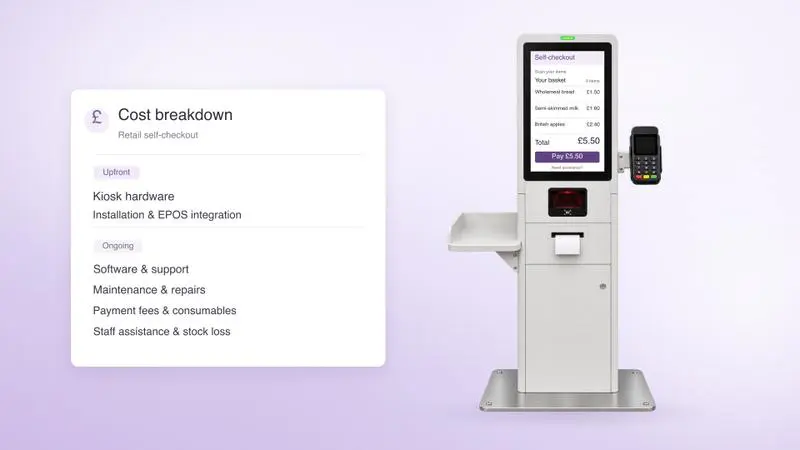
Self-checkout kiosk costs in the UK range from about £4,400 for compact hardware to £40,000 for a full grocery lane, before software and installation.
Isi formulir
Bagikan informasi kontak Anda untuk memulai
Bicara dengan pakar
Anggota tim sales kami akan menghubungi Anda