October 28, 2026
Road to Autonomous Commerce
Learn how retailers can move from reactive to autonomous commerce by giving AI systems clear objectives, permissions and measurable responsibilities.
Shubham Srivastava
October 28, 2026
Learn how retailers can move from reactive to autonomous commerce by giving AI systems clear objectives, permissions and measurable responsibilities.
Shubham Srivastava
You launch a new collection across your stores and website. The products are listed, the campaign is running, and your teams have prepared for demand. A week later, sales are below expectations.
You ask your team to investigate. Marketing reviews the campaign. Merchandising checks how the products appear on the website. Store teams report which styles customers are asking for. Operations looks at availability.
The answer could involve several of these things. Customers may be interested but unable to find their size. A product may be available in stores but difficult to discover online. Some listings may need better information. Different products may need different responses.
Before anyone can decide what to change, someone has to connect the evidence, examine the explanations and coordinate the work. Afterwards, someone needs to check whether it helped.
For a retailer managing multiple stores, channels and thousands of products, this is familiar work. It happens alongside planning the next collection, managing suppliers, resolving order issues and serving customers.
Autonomous commerce puts ongoing retail work in a system’s hands: it monitors a defined objective, acts within agreed limits, and brings exceptions to the team.
Retail has already changed considerably through technology. Notebook registers, phone calls and physical stock checks now sit alongside e-commerce platforms, marketplaces, connected stores and fulfilment networks. Customers can discover a product on one channel, experience it on another and choose where it gets delivered.
A retailer who once recognised a change through daily involvement may now need several people and reports to understand the same change across the business. Software records transactions, supports decisions and automates established processes. Many situations still require someone to notice, investigate, decide and follow up.
The idea of autonomous driving offers a useful parallel. Assistance can help a driver perform particular tasks while the person continues supervising. Greater autonomy gives the system responsibility for more of the driving under defined conditions. The distinction concerns what the system handles and when human involvement is required. The SAE framework makes those responsibilities explicit.
In retail, that distinction helps explain the difference between asking software for information, instructing it to complete a task and entrusting it with ongoing work.
Giving AI systems defined responsibility for understanding business conditions, deciding how to respond, carrying out permitted actions and checking the results.
The retailer sets the objectives and authority within which the system operates.
At Fynd, we have built this approach into Fynd One, bringing business context, assistance, proactive intelligence and autonomous execution into commerce operations.
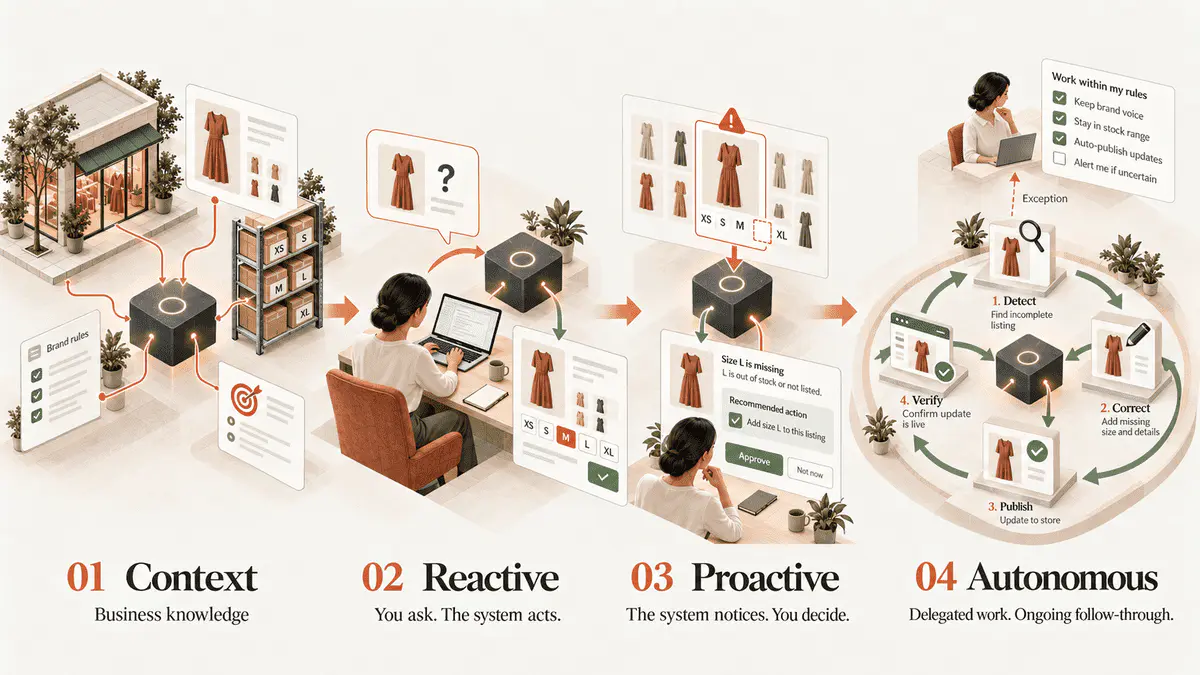
The progression has four stages:
Context → Reactive → Proactive → Autonomous
A strong team member can solve problems because they know how your business works. A system needs to know which products belong to the collection, where they are available, how customers are interacting with them and what has sold.
It also needs to understand the decisions surrounding the collection. Perhaps these are new arrivals whose prices you want to protect. Perhaps selected stores need to retain stock for an upcoming event. Your brand may have specific requirements for imagery and descriptions.
Those constraints affect the response. Weak sales alone should not automatically lead to a discount. The cause may be limited size availability or poor product information, while the retailer’s priority is to establish the collection at full price.
The system needs to connect information: which stock serves which customers, which campaigns promote which products and which operational conditions affect delivery promises. It also needs the retailer’s preferences, instructions and previous decisions.
As teams work with the system, their corrections should contribute to this understanding. An instruction about brand presentation or a decision about discounting should be available when relevant work comes up again. Teams should be able to update that understanding as priorities change.
A useful system needs the retailer’s goals and limits as well as its product, stock and sales data.
Reactive Commerce is where you put that understanding to work through a request.
You might ask: “Investigate why this collection is selling below expectations.”
The system examines the relevant information and explains what it finds, separating observed patterns from possible explanations. For example, it might find that shoppers are viewing a style but the most-requested sizes are unavailable. That points to an availability issue; products receiving little attention may need a different investigation. You can then decide what to do, with the evidence in view.
You can then ask it to complete work: prepare revised descriptions, create a collection of products available in the target region or apply approved changes to product information.
Reactive commerce starts with a request from your team and can lead to analysis, planning, content creation or execution.
A merchandising manager can investigate a question and act on the findings without assembling every input manually. The conversation can continue through follow-up questions and corrections.
Its reach still depends on what people think to ask.
Proactive commerce means the system finds issues worth your attention.
After the collection launches, the system continues monitoring agreed signals. It might flag a style whose views are rising but whose storefront exposure is low, or products receiving visits but few purchases. It should show the time period, channel and availability behind the finding, then investigate whether stock or missing information could explain the pattern.
The finding should show the evidence, the likely causes and a proposed next step. The retailer can judge the recommendation without repeating the investigation.
Once you approve the response, the system can carry out the supported action.
This applies to opportunities as well as problems. A change in regional demand may suggest a different assortment. Well-stocked products attracting customer interest may deserve more visibility. An underperforming promotion may need to be reconsidered before further spending.
A system that flags every fluctuation creates more work. The retailer should be able to set what counts as urgent, how much evidence is needed and which issues can wait for the next review.
The system starts the investigation instead of waiting for a team member to notice the issue.
Autonomous Commerce adds continuing responsibility for a defined objective.
For the new collection, a retailer might delegate a specific responsibility: keep its product listings complete, accurate and discoverable as new products are added and information changes.
The retailer sets clear permissions. The system might fill a missing attribute from a verified product source, while a price change, discount or uncertain product claim requires approval. It can check new listings, investigate gaps, make authorised corrections and follow unresolved work through. Each action should leave a record of what changed and why, and the retailer should be able to reverse a change or pause the responsibility.
The responsibility continues after the first action. A corrected attribute may fail to appear on a sales channel. A listing may remain blocked for another reason. A change may need review because the required information is uncertain.
The system needs to recognise these conditions and respond within its authority. When a decision requires additional judgement or permission, it returns that decision to the appropriate person.
The retailer can add functions to the responsibility as the system handles the initial work reliably.
After taking action, the system should check what happened. Did the corrected products become available on each channel? Did the time to resolve listing issues fall? Did discoverability or conversion change, and over what period? The system should show the outcome and any remaining exceptions, so the retailer can decide whether to continue, adjust or stop the responsibility.
You can use these stages differently across the business. Your team might request campaign work, ask the system to flag fulfilment risks and delegate routine catalogue checks within clear limits.
Fynd One is designed to support work across catalogue, inventory, merchandising, marketing and order operations, carrying business preferences and instructions between tasks. For a retailer, the test is whether it handles the chosen responsibility reliably and makes its actions and exceptions easy to review.
Track the work against measures the retailer already uses, such as time spent on recurring checks, time to resolve listing issues, products made available across channels and exceptions needing human review. Agree on the measures before handing over the responsibility.
Start with a recurring task that has a clear owner and measurable result. Set the system’s permissions, review its work and check the outcome. Expand its remit only after it handles the task reliably.

Explore Fynd OMS features, integrations and results and compare it with other order management systems for 2027. See who each OMS suits.
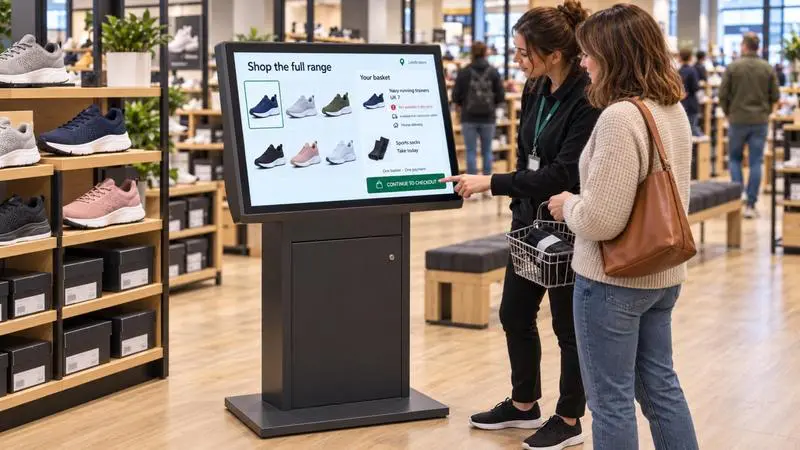
An endless aisle lets store teams sell stock held in another store or warehouse, with one checkout and a choice of home delivery or store collection.
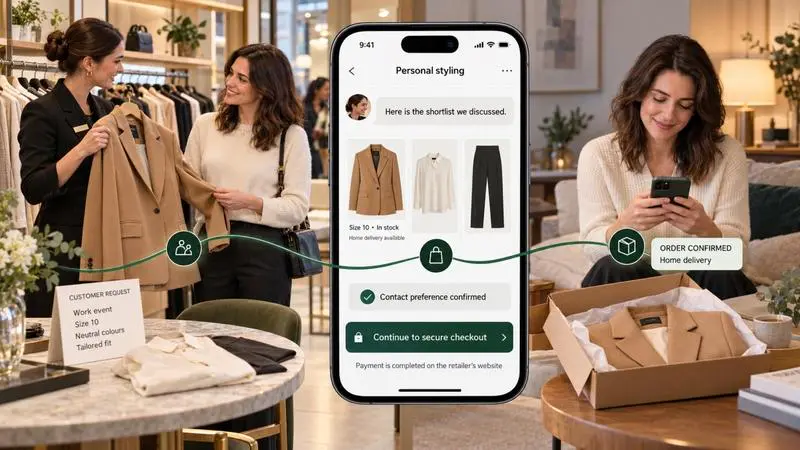
Learn how clienteling in retail turns a store conversation into a remote sale, with UK examples, the KPIS to track and the consent rules for outreach.
Fill out the form
Share your contact information to get started
Speak to an expert
A member of our sales team will get in touch with you