October 27, 2026
Best Order management system (OMS) for 2027: The buyer's guide, compared honestly
Explore Fynd OMS features, integrations and results and compare it with other order management systems for 2027. See who each OMS suits.
Garima Poddar
October 27, 2026
Explore Fynd OMS features, integrations and results and compare it with other order management systems for 2027. See who each OMS suits.
Garima Poddar
An OMS decides what happens between "order placed" and "order delivered", for every channel at once.
Quick answer. The best order management system (OMS) for 2027 is the one that makes the right fulfilment decision for every order, on every channel you sell through, at your peak volume. For brands selling through a website, marketplaces and physical stores, Fynd OMS is a strong fit because it routes orders across warehouses and stores and runs returns in the same system. Marketplace-first sellers should also test Unicommerce and EasyEcom. Fashion brands that need deep allocation planning should look at Increff. Global enterprises already on SAP or Salesforce often start with the OMS inside their suite.
An OMS in 2027 is a decision system, not just a record keeper. Its role is to decide where each order ships from, at what cost and with what delivery promise.
Judge vendors based on how well they fit your operations, not just how impressive their demos are. Have each one run your three toughest order scenarios using your own data.
Quick commerce and cash on delivery (COD) are changing the game. In India, quick commerce handles over 9 million orders daily, and COD orders return to origin roughly ten times more often than prepaid ones.
Depth of integration is more important than the number of integrations. Ask what each connector syncs, how frequently delivered" forand what happens if a sync fails.
Fynd OMS excels with omnichannel brands that have stores. It’s less critical for single-channel sellers with low daily volumes.
In this guide: What an OMS is | Why 2027 is different | The 2027 OMS scorecard | Best OMS platforms compared | Fynd OMS in detail | Case study: Joyalukkas | What RTO really costs | Mistakes to avoid | OMS vs WMS vs ERP | FAQs
An order management system (OMS) is software that captures every customer order from all sales channels, decides where and how to fulfill it, and tracks it through delivery, returns and refunds. It acts as the bridge between your sales outlets (websites, apps, marketplaces, quick commerce apps, stores) and your shipping points (warehouses, stores, dark stores, partners).
Simply put: your storefronts take orders, your warehouse management system (WMS) picks and packs them, your ERP handles the money and the OMS makes all the decisions in between.
Older order tools were systems of record. They copied orders from each channel into one list, printed invoices and labels, and logged statuses. A person still decided which warehouse should ship, what to do with failed deliveries, and whether returns could go back on sale.
A modern OMS is a system of decision. It reserves stock the moment an order arrives, picks the best fulfillment location based on stock, distance, freight cost, and promised delivery date, splits or merges shipments and pushes exceptions to a queue with suggested next steps. This difference shows up in lower costs per order, faster delivery and fewer staff needed on busy sale days.
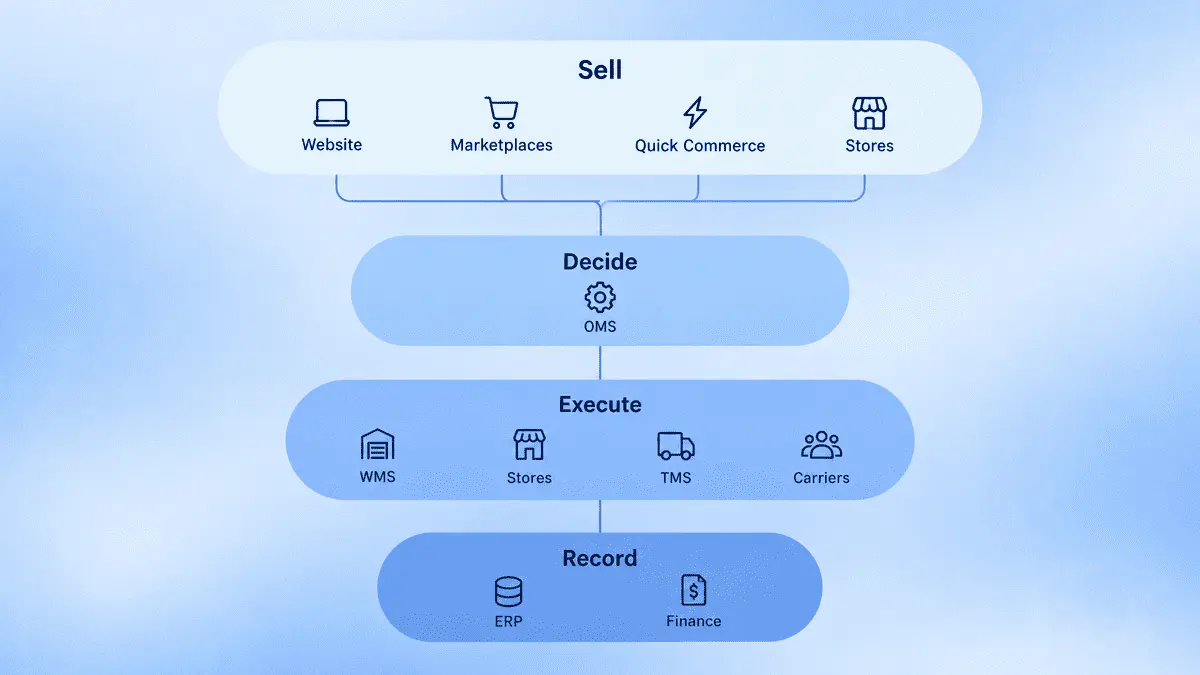
The OMS is the decide layer. When it is weak, the warehouse, carriers and ERP all inherit its mistakes.
Distributed order management (DOM) is the part of an OMS that decides which location fulfills each order when stock is spread across multiple places. Analysts like Gartner define DOM as systems that orchestrate orders across warehouses, stores, and partners. Every DOM is an OMS, but a basic OMS without multi-location routing is not a DOM.
Four shifts have changed what a good OMS in 2027 has to do. Each one is measurable.
India's e-commerce market was about US$125 billion in 2024 and is projected to reach US$345 billion by 2030, according to Infisum research reported by IBEF. The same report counts about 2,525 dark stores in 2025 and expects around 7,500 by 2030. Quick commerce platforms now handle over 9 million orders a day, based on Moneycontrol's August 2026 estimates.
Each platform works differently - some send purchase orders to your warehouse, some require delivery appointments, and each has unique service levels and penalties. An OMS that only understands "customer places order, brand ships parcel" won’t manage this complexity.
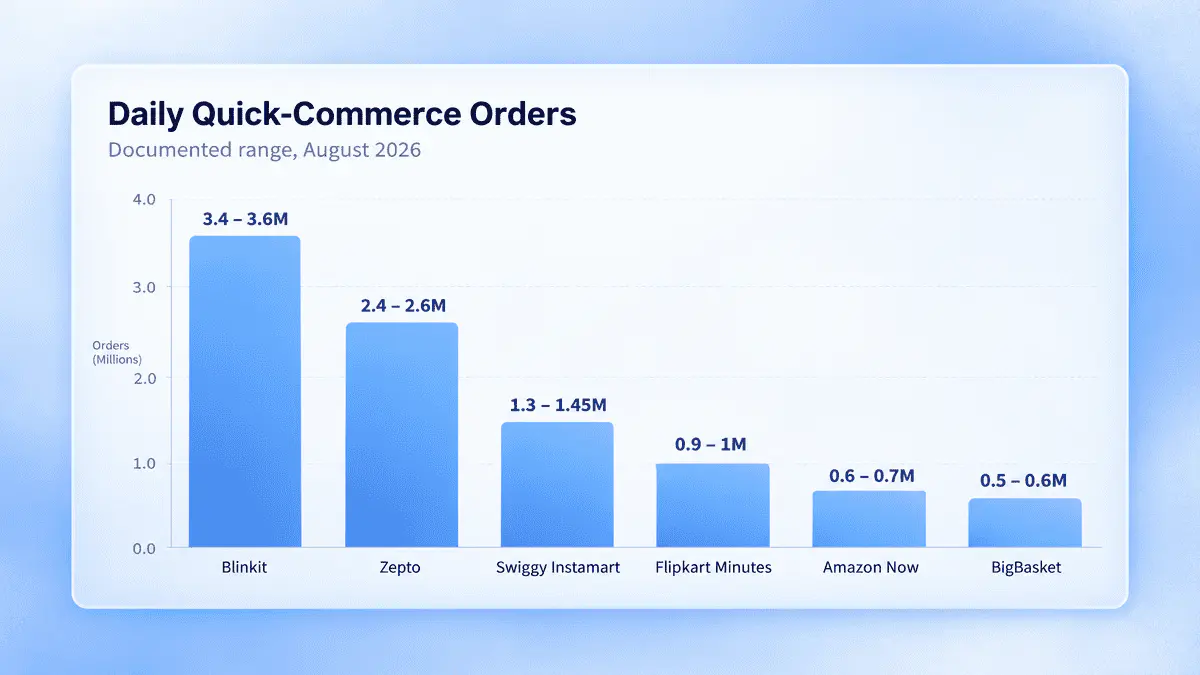
Six quick commerce platforms, each with its own order model. Your OMS has to treat them as distinct channels, not one bucket.
Between 60 and 65 percent of Indian e-commerce orders are COD, according to ET Prime Research cited by Razorpay. COD orders see a 25 to 30 percent return to origin (RTO) rate, compared to just 2 to 3 percent for prepaid orders. RTO means the parcel goes to the customer, is refused or undeliverable and returns to origin. You pay freight both ways and lose the sale.
Your OMS controls several levers affecting returns: which node ships, parcel speed, how failed deliveries are reattempted, and how returns are processed. We provide numbers on this later in the guide.
Analysts have renamed the category around AI. IDC’s 2026 report is titled Worldwide AI-Enabled Order Orchestration and Fulfillment Applications for Retail and B2C. Gartner’s 2025 Market Guide for Distributed Order Management Systems highlights rising demands for inventory visibility and AI's growing role in order management.
Orders are also starting to come from AI shopping assistants. In January 2026, Shopify and Google announced the Universal Commerce Protocol, an open standard allowing AI agents to complete purchases within conversational interfaces. OpenAI and Stripe published the Agentic Commerce Protocol in September 2025 for similar purposes. When an agent buys on behalf of a shopper, it needs accurate stock figures and reliable delivery dates—answers that come from the OMS.
Shipping from a store near the customer usually means shorter routes and faster delivery than shipping from a distant warehouse. It also turns store stock that might otherwise remain unsold into online revenue. An OMS that can’t see and reserve store stock leaves this value on the table.
Most OMS demos look good. Demo fit means the product handles a clean order in a clean demo account. Operating fit means it handles your messiest order on your biggest sale day with your real integrations. Score every shortlisted vendor on these eight tests, from 1 (weak) to 5 (strong), then multiply by the weight. Adjust weights to fit your business.
Test | Weight | Ask the vendor to show you | Red flag |
|---|---|---|---|
Routing intelligence | 20 | How the system picks a node using stock, freight zone, carrier cost and promised date, and how you change the rules yourself | Routing is "nearest warehouse" only, or rule changes need a developer |
Inventory truth | 15 | Stock sync speed across every channel, store and warehouse, and how reservations prevent overselling | Stock syncs on a fixed schedule rather than on each event |
Channel depth | 15 | Every one of your channels live, including labels, invoices, dispatch windows and penalties per marketplace | A long logo list, but key channels need "custom work" |
Returns and RTO | 15 | Pickup, quality check, restock, refund and credit note, plus failed delivery and RTO handling | Returns are tracked but stock is updated by hand |
Peak readiness | 10 | Bulk confirm, invoice and dispatch at your peak volume, and references from a brand at your scale | No load evidence beyond a slide |
Finance and compliance | 10 | GST invoices, e-invoices, e-way bills, payment tracking and reconciliation | Invoices exported to the ERP by file upload |
Integration and extensibility | 10 | APIs, webhooks, event streams and sync rules for your ERP, WMS and POS | Integration depends on the vendor's services team for every change |
Time to value and total cost | 5 | A written plan, named team, and price at today's volume and at double | Pricing jumps sharply at a volume threshold you will cross this year |
A simple test: write down your three most painful order scenarios today, such as a split order across two stores with one item out of stock. Ask each vendor to run those three scenarios live, on your data, in the demo.
Your situation | What to prioritise |
|---|---|
Mostly marketplace orders | Marketplace coverage, label and invoice rules, dispatch windows, penalty tracking |
Website, marketplaces and stores | Smart routing, ship from store, one inventory view across all locations |
Quick commerce is a growing share | Purchase order handling, appointment slots, dark store replenishment, fill rate tracking |
Many stores or franchise outlets | Store-level fulfilment, buy online pick up in store, store stock visibility |
High returns or high COD share | Pre-dispatch checks, doorstep quality checks, return rules by item value, RTO workflows |
Already on an ERP you want to keep | Real-time, two-way ERP integration with clear ownership of each data field |
Sharp festive peaks | Bulk actions and tested performance at your peak volume |
Just starting out | Quick setup, low fixed cost and a clear upgrade path |
How we assessed: we read each vendor's public website and analyst recognitions as of OMS platforms in 2026. Scale figures are the vendors' own claims, not independent audits. Check each vendor for current features and pricing.
Platform | Best for | Stated scale or recognition | Verify in your demo |
|---|---|---|---|
Fynd OMS | Omnichannel brands with stores, warehouses, marketplaces and website | 2,300+ brands on Fynd; 250+ Integrations across marketplaces, storefronts, ERPs, WMS, POS, as well as SOC2, GDPR and ISO certifications listed | Routing rules on your store network; returns rules for your categories |
Unicommerce | Marketplace-first sellers | 290+ integrations, 8,000+ live clients | Store fulfilment depth and routing beyond nearest warehouse |
EasyEcom | Growing D2C brands, marketplace sellers and 3PLs | 455+ native integrations, 1,800+ brands and 3PLs | Routing for store networks and returns grading |
Increff | Fashion and lifestyle brands that need allocation and merchandising | 700+ brands across 35+ countries | Whether you need the planning suite or only the OMS |
Vinculum (VIN OMS) | Large retailers and 3PLs that want OMS and WMS together | 1,000+ brands, 150+ ready integrations to 3PLs and POS | Marketplace and quick commerce coverage for your channel mix |
Zoho Inventory | Small teams already on Zoho | Free plan up to 50 orders; paid plans from US$29 per month | Volume ceilings and multi-location routing |
Fluent Commerce | Global enterprises wanting a cloud OMS | Leader, Forrester Wave: Order Management Systems, Q1 2025 | Indian marketplace, GST and COD coverage |
Suite OMS (SAP, Salesforce, Manhattan) | Enterprises standardised on one of these suites | SAP named a Leader in IDC MarketScape 2026 for AI-enabled order orchestration | Local marketplace connectors and total cost of ownership |
Nearly all your orders come from marketplaces? Test Unicommerce and EasyEcom alongside Fynd. Their strength lies in marketplace connector breadth.
Fashion brand with deep size and color planning? Increff offers planning tools that can complement any OMS.
Already on SAP or Salesforce? The suite OMS may suit you, though many Indian brands still add a channel-facing OMS on top to handle marketplace, GST and COD workflows needing custom work.
Just starting out? Zoho Inventory or EasyEcom are practical first steps. A shipping aggregator like Shiprocket handles shipping and COD remittance well but is not a full OMS.
If store networks, returns, and delivery promises are your main challenges, Fynd OMS shines.
If you sell on just one channel, ship from one warehouse, and handle a few dozen orders daily, a lighter tool will cost less and do the job. Fynd OMS earns its place when you have multiple channels, multiple stock locations, significant returns or RTO costs, or sharp seasonal peaks.
Fynd OMS is the order management system from Fynd, a commerce technology company (Shopsense Retail Technologies) founded in 2012 and used by over 2,300 brands. It unifies orders, inventory, pricing and returns from online and offline channels into one system, managing each order from placement through routing, fulfillment, delivery, returns, and refunds.
Fynd OMS supports B2C, B2B, D2C, franchise, and omnichannel brands, including multi-location retailers with webstores, marketplaces, warehouses and stores. It suits businesses that:
Sell on multiple channels like websites, marketplaces and stores.
Hold stock in multiple warehouses or stores that fulfill online orders.
Experience sharp peaks such as festive sales, wedding seasons or end-of-season sales.
Run ERP, WMS or POS systems they want to keep.
Lose significant margin to RTO and returns.
Term | What it means |
|---|---|
Order | The complete purchase a customer makes. One order can contain many products. |
Shipment | A group of items from an order that ship together. Items shipping from different locations or at different times become separate shipments, each with its own ID. |
Bag | A single product line within a shipment. It is the smallest unit the OMS tracks. |
Source: Fynd OMS documentation.
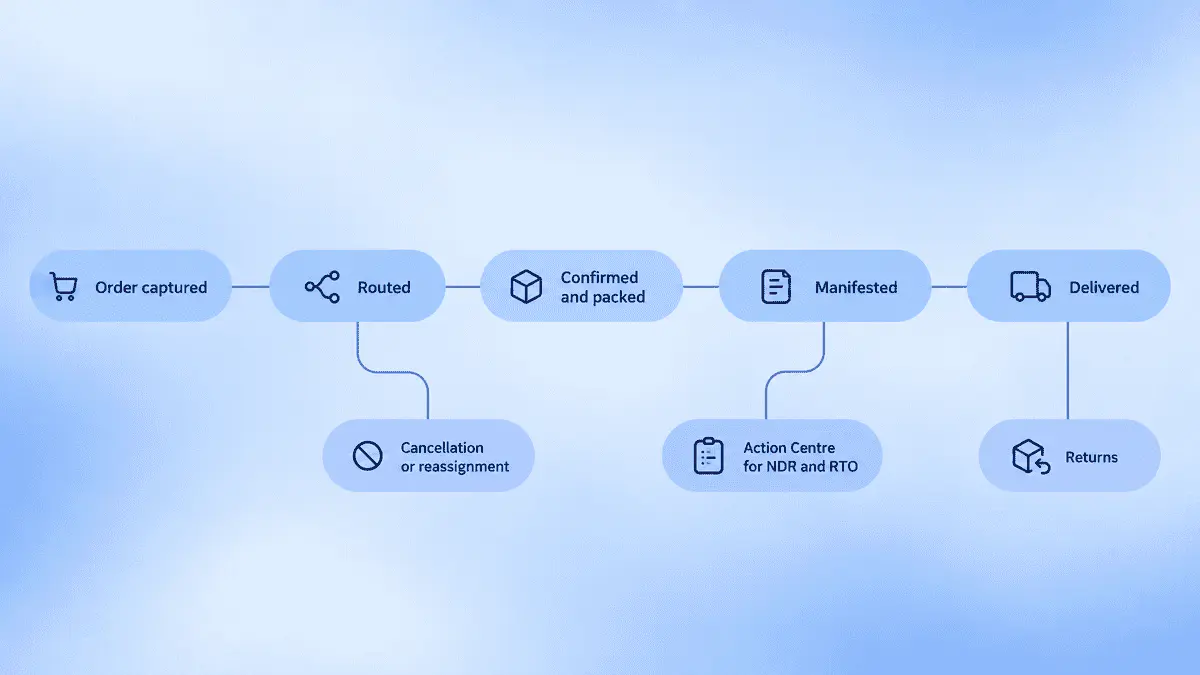
The main path runs left to right. Cancellations, failed deliveries and returns each have their own queue.
The order arrives. It lands in the Unfulfilled lane of the dashboard.
Confirm or cancel. The team confirms what can ship in full or in part. Items that cannot ship can be cancelled or reassigned to another selling location.
Invoice and pack. Invoices are generated automatically or entered manually. Tax invoices and labels download in A4, A6 or POS format and the shipment is marked packed.
Manifest and dispatch. A manifest, the handover document for the delivery partner, is generated and the shipment moves to the Processed lane.
Track delivery. Delivery partner status updates flow back into the OMS and drive customer notifications.
Handle exceptions. Failed deliveries move to the Action Centre for non-delivery report (NDR) re-attempts or RTO processing.
Process returns. Returned items enter the Returns flow for pickup, quality check, restocking and refund.
Capture every order
One dashboard for orders from websites, marketplaces and stores with real-time updates. Search by order ID, shipment ID, bag ID, or customer email; filter by date, status, channel, or delivery partner.
Automatic order sync from connected channels like Shopify, Amazon, and Trendyol, with stock updated across channels after each sale to reduce overselling.
Manual, phone, and assisted orders via the Commerce Panel, plus international orders with currency handling and customs documents.
Decide where each order ships from
Routing to the best warehouse, store, or fulfillment partner based on stock, freight zone, carrier cost, and service level—critical in India where shipping costs vary by zone.
Split one order across locations, bundle multiple orders into one shipment, or ship part of an order now and the rest later.
Delivery partner preferences and priorities set through a rule engine.
Fulfil from warehouses and stores
Ship from store, buy online pick up in store, and curbside pickup.
Bulk confirm, invoice and process shipments, including CSV uploads, for sale days.
Deliver and keep customers informed
Automatic SMS, email, and WhatsApp updates at each stage: confirmed, shipped, out for delivery, delivered, return started and refund processed.
A tracking page for customers.
Recover from exceptions and returns
The Action Centre queues delayed shipments, failed deliveries, re-attempts, and complaints so teams handle them in priority order.
Customer returns with pickup, quality check, refund and credit note, plus seller-initiated returns, RTO handling, and re-shipments.
Reconcile and stay compliant
Invoices and labels that follow tax rules and each marketplace's format, with e-invoice and e-way bill generation, custom templates, and merged PDFs for faster packing.
Payment tracking, refunds, and reconciliation across channels.
Analytics on order volume, fulfillment speed, cancellations, carrier performance, and delivery outcomes.
An activity log of every state change, user action, and admin override for stuck shipments, like marking an order delivered with proof.
Integrations run through Fynd Konnect, Fynd’s pre-built integration layer for marketplaces, storefronts, ERPs, WMS, and POS systems. Ready connectors still require configuration, data mapping, and testing for each brand.
Category | Examples |
|---|---|
ERP | SAP, Ginesys, Microsoft Dynamics |
WMS and POS | Vinculum, QuickBill |
Marketplaces | Amazon, Flipkart, Myntra, Nykaa Fashion, Tata CLiQ Luxury, Trendyol |
Storefronts | Shopify, Magento (Adobe Commerce) |
Delivery partners | Leading carriers and aggregators, through Fynd Logistics |
Vinculum appears both here and in the comparison table for a reason: many brands run Vinculum's WMS in the warehouse and a separate OMS for channel orders. A good OMS works with the systems you already run.
Yes. For technical teams:
APIs: The Platform API covers backend tasks like managing orders and inventory, including a Create Order API.
Events and webhooks: Order, shipment, refund, and return events can be delivered to Kafka, Amazon EventBridge, Amazon SQS, Google Pub/Sub, or Temporal.
Sync rules: Data translation, webhook subscriptions, and channel- or product-specific sync rules.
Controlled state changes: The OMS defines valid state transitions, so extensions check allowed next states before updating shipments.
The OMS works independently and connects to the rest of Fynd when you need more capabilities:
Product | What it adds |
|---|---|
Marketplace, ERP, WMS and POS integrations | |
Multi-warehouse inventory and fulfilment for B2C and B2B | |
Dispatch, AI route optimisation and live rider tracking | |
Shipping through leading carriers and aggregators | |
Product catalogue enrichment for every channel |
Fynd reports customers have seen delivery timelines fall by 30 percent, delivery costs drop by 27 percent, and RTO rates cut by 50 percent. These figures are from Fynd; actual results depend on category, channel mix, COD share and starting point.
Joyalukkas is a jewelry retailer with 120 showrooms in India and over 160 across 11 countries. It sells more than 10,000 SKUs through its Magento website and five marketplaces: Amazon, Flipkart, Myntra, Nykaa Fashion and Tata CLiQ Luxury. Before Fynd, store stock wasn’t visible online, orders came through separate portals and returns of high-value jewelry lacked structured quality control.
One order dashboard: Orders from every marketplace, website, and showroom flow into Fynd OMS, where the team confirms, invoices, packs, and dispatches.
Showrooms became delivery nodes: The system finds the nearest showroom with stock and routes orders there for same-day or even faster fulfillment.
Prices follow the gold rate: Updates reach every channel within minutes of a gold rate change.
Return rules by value: Pre-QC and Doorstep QC verify returned jewelry. A ₹1,00,000 diamond necklace follows stricter return processes than a ₹3,000 silver bracelet.
Stock updates automatically: Returns passing quality checks go back to sellable stock; failures move to damaged stock, with Microsoft Dynamics updated without manual entry.
Peak days run in bulk: The team confirms and invoices thousands of shipments from a single CSV upload during Dhanteras and Akshaya Tritiya.
Lesson for other brands: Joyalukkas kept its website and ERP while Fynd added a decision layer on top instead of replacing them. For most established retailers, this approach is lower risk than a full platform swap.
The formula is simple: annual RTO cost = monthly orders × RTO rate × cost per RTO × 12, weighted by COD and prepaid mix.
For example, a brand shipping 50,000 orders monthly with 60 percent COD, a 25 percent COD RTO rate, a 3 percent prepaid RTO rate, and ₹190 lost per RTO on freight and handling faces about 8,100 RTOs monthly and loses around ₹1.85 crore yearly, excluding stock locked in transit or damaged returns.
Each 5-point drop in COD RTO saves this brand about ₹34 lakh annually. OMS levers that influence the rate include:
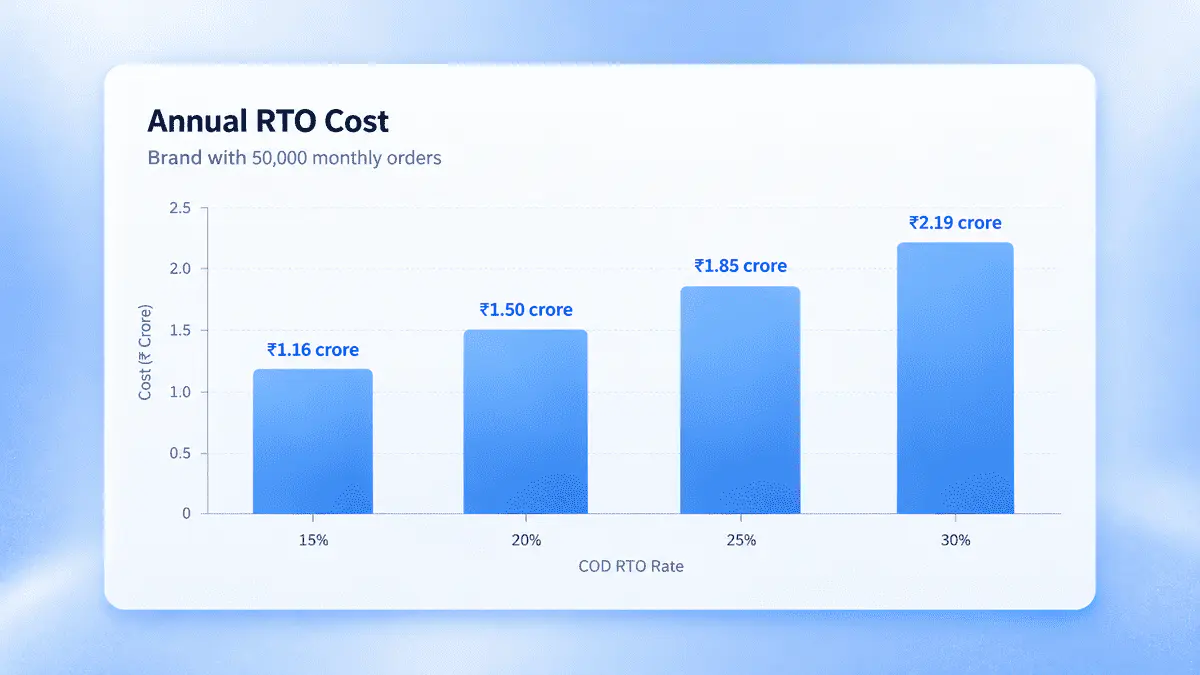
Hypothetical figures. Each 5 point change in COD RTO moves about ₹34 lakh a year for this brand.
Each five-point drop in COD RTO saves this brand about ₹34 lakh a year. The OMS levers that move the rate:
Ship from the nearest node. Shorter transit time means less time for buyers to change their minds.
Check serviceability before promising. Don’t accept COD orders to pincodes where carriers often fail.
Confirm high-risk COD orders before dispatch. A confirmation step costs little compared to two-way freight.
Work failed deliveries fast. A structured Non-Delivery Report (NDR) re-attempt queue converts some failed first attempts into deliveries.
Pick carriers by lane performance, not just price. The cheapest carrier may cost more if it returns more parcels.
Ask every vendor which of these run inside their OMS and which require external tools.
Buying the longest integration list. Symptom: the connector exists, but orders need manual fixes daily. Ask what each connector syncs and how failures appear.
Ignoring returns until after go-live. Symptom: returned stock sits unused for weeks because no one owns grading and restocking.
Treating stores as an afterthought. Symptom: online sells out while nearby stores have the same item in stock.
Testing at average volume. Symptom: the system works fine in July but falters on the first festive sale day.
Letting the vendor own every rule change. Symptom: a simple routing change requires a ticket and two weeks.
Going live during a peak. Symptom: cutover and sale compete for the same team’s attention. Plan go-live well before your biggest sale.
System | Main job | Example question it answers |
|---|---|---|
OMS | Runs the order from placement to delivery, returns and refunds | Which location should ship this order? |
WMS | Runs the warehouse: receiving, storage, picking and packing | Which shelf is this item on? |
TMS | Runs transport: dispatch, routes, riders and carriers | Which vehicle takes this route today? |
ERP | Runs the business back end: finance, purchasing, accounting | What did we earn and owe this month? |
PIM | Runs product information for every channel | Is this product's listing complete for each marketplace? |
They work best together. Fynd offers each of these and also connects to third-party systems you already run.
Timelines vary by number of channels, locations, and integrations. Ask each vendor for a written plan. Most projects follow five stages:
Discovery and mapping: List every channel, location, order type, and exception, and decide which system owns each data field.
Integrations: Connect channels, ERP, WMS, POS, and carriers; test with real order data.
Parallel run: Run new OMS alongside old processes on live orders, comparing results daily.
Cutover: Move channels in waves, with rollback plans for each wave.
Hypercare: Keep vendor support close for the first weeks and initial sale events.
Which channels and systems connect out of the box, and which need custom work?
How does routing decide where to ship from, and can my team adjust rules without a developer?
How fast does stock sync across every channel and location and what happens if a sync fails?
How are returns, quality checks, refunds and credit notes handled?
How does the system manage failed deliveries and RTO?
How do you handle quick commerce purchase orders and delivery appointments?
Can AI shopping agents get accurate stock and delivery dates through an API?
What happened to performance on your largest customer's biggest sale day?
Who supports us during implementation and after go-live, by name?
What will we pay when order volume doubles?
The best OMS for 2027 matches how you actually sell. Start with your channels, stock locations, and your three most challenging order scenarios. Score vendors on operating fit, not demo fit and ask for proof at your peak volume.
If you sell across websites, marketplaces, and stores and want one system to decide, track and recover every order, see Fynd OMS run your own scenarios.
It depends on how you sell. Fynd OMS fits brands selling across websites, marketplaces and stores, because it routes orders across warehouses and stores and manages returns. Unicommerce and EasyEcom suit marketplace-first sellers. Increff suits fashion brands needing allocation. Zoho Inventory suits small teams. Enterprises on SAP or Salesforce often use the suite OMS.
An OMS captures orders from every sales channel, reserves stock, decides which warehouse or store ships each order, and generates invoices and labels. It then tracks delivery, handles failed deliveries and returns, and processes refunds. In short, it makes every decision between an order being placed and the customer receiving it.
An ERP manages the business back end: finance, purchasing and accounting. An OMS manages the order itself: where it ships from, how it is delivered and how returns are handled. Most brands run both, with the OMS sending invoices, payments and stock movements to the ERP.
A WMS manages what happens inside a warehouse, such as receiving, storage, picking and packing. An OMS decides which warehouse or store should fulfil each order and tracks the order across all locations and channels. A brand with one warehouse may need a WMS first; a brand with many locations needs an OMS.
Fynd OMS is the order management system from Fynd, a commerce technology company founded in 2012 and used by more than 2,300 brands. It unifies orders, inventory, pricing and returns across websites, marketplaces, warehouses and stores, and manages each order from placement through fulfilment, delivery, returns and refunds.
Yes. Fynd OMS can route online orders to the nearest store that has the item in stock, so stores act as fulfilment points. It also supports buy online, pick up in store and curbside pickup. Joyalukkas uses this to fulfil online orders from its showrooms.
Fynd OMS looks at stock across warehouses and stores, freight zones, carrier costs and service levels, then picks the best fulfilment location. It can split an order across locations or bundle orders into one shipment. Teams set delivery partner preferences and priorities through a rule engine.
An OMS reduces RTO by shipping from the nearest location to shorten transit, checking serviceability before accepting COD orders, routing failed deliveries into a re-attempt queue, and choosing carriers by lane performance. Fynd reports up to 50 per cent lower RTO rates for its customers; results depend on category and COD share.
Yes. Fynd OMS generates invoices and labels that follow tax rules and each marketplace's format. E-invoice and e-way bill generation can be enabled in selling location settings, and invoice templates can be customised.
Fynd OMS integrates with systems such as SAP, Ginesys, Microsoft Dynamics, Vinculum and QuickBill through Fynd Konnect. Konnect also connects marketplaces such as Amazon, Flipkart, Myntra and Trendyol, and storefronts such as Shopify and Magento. Each connector still needs configuration and testing.
Yes. Bulk action tools let teams confirm, invoice and dispatch large numbers of shipments at once, including by CSV upload. Joyalukkas uses this during Dhanteras and Akshaya Tritiya. Ask for a load test at your own peak volume during evaluation.
Yes. Fynd OMS adds a decision layer on top of your existing systems instead of replacing them. Joyalukkas kept its Magento website and Microsoft Dynamics ERP, with returns and stock movements updating the ERP automatically.
OMS pricing usually depends on order volume, number of channels and locations, and integrations. Entry tools start with free or low monthly plans, while enterprise OMS pricing is quoted after discovery. Fynd quotes after a demo. Always ask what you will pay when volume doubles.
Not always. If you sell on one storefront from one warehouse, Shopify's built-in order tools may be enough. You need an OMS once you add marketplaces, stores, more warehouses or quick commerce, because then someone has to decide where each order ships from.
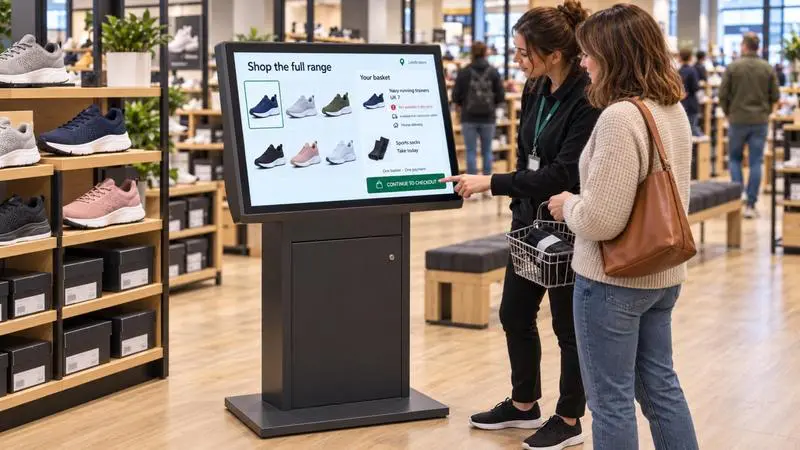
An endless aisle lets store teams sell stock held in another store or warehouse, with one checkout and a choice of home delivery or store collection.
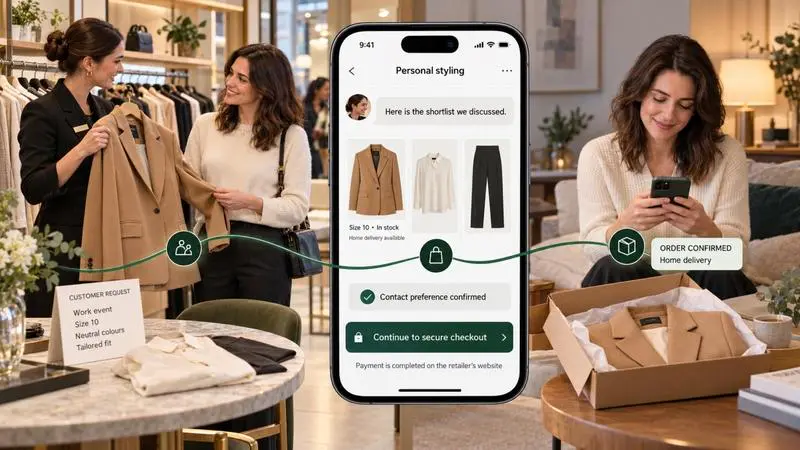
Learn how clienteling in retail turns a store conversation into a remote sale, with UK examples, the KPIS to track and the consent rules for outreach.

AI fashion photography pilots need accurate source images and checks for product fidelity before retailers can judge whether the process is worth scaling.
Fill out the form
Share your contact information to get started
Speak to an expert
A member of our sales team will get in touch with you