In 2020, retailers added store pickup and ship-from-store because they had to. Stores were closed or restricted, and any way to get a product to a customer counted as a win.
The question has changed. Customers now treat these options as normal. What matters to a retailer is whether each one makes money. A pickup order that costs more to handle than the sale earns is not a win. Neither is a store shipment that empties the shelf a walk-in customer needed.
What is omnichannel order fulfillment?

Omnichannel order fulfilment means using all your channels and locations, including stores, warehouses, your website and marketplaces, to fill a customer's order from the best place. The same stock can serve a walk-in shopper, an online order for pickup and a home delivery.
The hard part is deciding which location should serve each order, at what cost, without letting anyone down. Fynd OMS brings orders from websites, marketplaces and stores into one dashboard and routes each one to the nearest warehouse, store or fulfilment partner based on inventory availability. Our guide to how an OMS routes orders explains the logic.
How the four fulfilment models pay off

Every model has its own economics. Here is where each one pays, where it loses money, and what to watch.
Curbside pickup
The customer collects without going inside, and staff bring the order out.
Pays when: Stores are busy, the shopper wants speed, and there is a safe, easy pickup spot.
Loses money when: Staff spend long periods running orders out, space is tight, and there is little add-on selling because the shopper never enters.
Watch: Wait time at handover, and orders handled per staff member.
Curbside is supported as a delivery option alongside same-day home delivery and in-store pickup on Fynd Endless Aisle
Buy online, pick up in store (BOPIS)
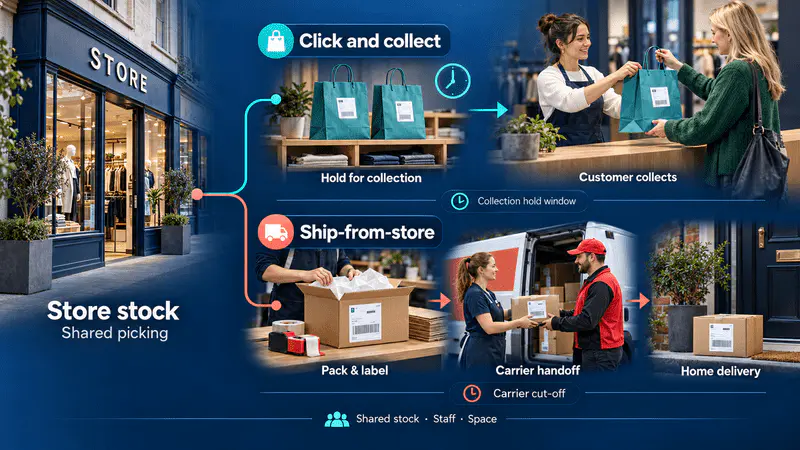
BOPIS, also called click and collect, lets the customer order online and collect from a store.
Pays when: You skip last-mile delivery, the shopper comes into the store, and bulky items are easier to hand over than to ship.
Loses money when: Staff time goes on picking, handovers are slow, stock is held for pickups that never happen, or mis-picks come from inaccurate stock.
Watch: Time to ready for collection, uncollected rate, and add-on purchases at pickup.
A good pickup experience is clear before the customer arrives. Best Buy's website, for example, shows shipping and pickup options at every step of the buyer's journey. A useful pattern to copy is showing pickup availability and timing right on the product page.

Ship from the store
A store packs and ships an online order, which turns stores into smaller fulfilment centres.
Pays when: Stock would otherwise sit and need markdowns, the store is close to the customer, and a faster delivery promise is possible.
Loses money when: Packing is slow, packaging costs add up, shelves empty for walk-ins, and cancellations follow wrong stock counts.
Watch: Rejection rate, cost per order, and stock-related cancellations.
Hyperlocal delivery
A nearby store delivers within a short radius, using its own riders or partners.
Pays when: You're in a dense city, selling urgent categories over short distances.
Loses money when: Order values are low, density is thin, and rider cost per order is high.
Watch: Delivery time, cost per delivery, and orders per rider.
Hyperlocal delivery from your own stores is not the same as quick commerce, where platforms run dedicated dark stores with very short delivery promises. Customers now compare any delivery promise with quick commerce, though, so speed expectations are rising.
Where fulfilment loses money
Most losses come from a few places, and the same ones show up in every model:
Leak | What happens | A fix |
|---|
Inaccurate store stock | The order is accepted, then cancelled or mis-picked | Count and fix stock before turning on store fulfilment. See why online and offline inventory never matches |
Unnecessary split shipments | One order leaves from two places and costs two deliveries | Prefer one shipment where you can. Fynd OMS can split an order across locations or bundle several into one shipment to cut shipping cost |
Unknown cost per order | You can't tell which store or model is profitable | Work out cost per order by location. A 2024 study of 34 European omnichannel retailers, summarised in our OMS guide, found many didn't know their actual cost to fulfil online orders |
Empty shelves for walk-ins | Online orders drain the stock in-store shoppers need | Hold back a buffer. One Fynd customer reserved store stock on its staples for walk-in demand |
Returns and failed deliveries | You pay for the trip out and the trip back | Push prepaid orders, speed up delivery and make exchanges easy |
Uncollected pickups | Stock sits reserved and unavailable | Set a hold period, then release the stock |
Rules that protect margin
You don't need dozens of rules. These do most of the work:
Check stock first. Only offer an order to a location that really has the item.
Prefer the nearest location that can ship the whole order, so there are fewer splits and shorter trips.
Set a daily limit per store, so no store is swamped.
Keep a buffer on fast sellers for walk-in shoppers.
Add a fallback. If a store rejects an order, the system should reroute it to the next best location.
Watch the cut-off times of couriers and store hours.
Where to start
If your situation is… | Start with… |
|---|
Stores are close to customers and stock counts are reliable | Ship-from-store |
You have slow-moving stock sitting in stores | Ship-from-store |
You sell bulky or heavy items | BOPIS. One Fynd customer saw a meaningful share of bulky orders move to collection, which cut fulfilment cost |
Your stores are busy and have a good pickup spot | BOPIS or curbside, in a few stores first |
You're in dense cities with urgent categories | Hyperlocal, from your best-stocked stores |
Store stock counts are unreliable | Fix the counts before any of the above |
Fynd customers
Brand | What they did | What was reported | Read this carefully |
|---|
Khadim | Assigns online orders to the store nearest the delivery pin code | 6% additional store sales. Delivery time from 10 days to 4. 25% lower logistics costs. 5% growth in prepaid orders. 30% fewer cancellations and returns-to-origin | A 2022–23 story. Khadim moved from another omnichannel provider, so this reflects a change of delivery model too |
Raymond | Rolled out from a 20-store pilot to 200+ stores | 5–7% additional store sales and 87% delivered sales (orders placed that were delivered) | Brand outlets, many in tier 2 and 3 cities. In the pilot, cancellations were high because fulfilling stores didn't know how to handle split or bundled orders |
An Indonesian pet retailer | One inventory across stores, warehouses, website and marketplaces, with orders routed from the nearest location and store stock reserved for walk-ins | 28% lower fulfilment cost per online order, with a meaningful share of bulky orders moving to collection | Unnamed retailer outside India, in a repeat-purchase category |
Adidas Kids | Used Endless Aisle to sell unavailable sizes for pickup or delivery during the 2023 Cricket World Cup season | Converted about 60% of walk-ins looking for one jersey | One product, one season |
Fynd's OMS page also reports 30% shorter delivery timelines, 27% lower delivery costs and 50% lower RTO rates. It doesn't say what these are measured against, so ask how they were calculated. All of these come from single businesses, so treat them as references.
Brands that made store fulfilment pay

Nykaa
Omnichannel fulfillment strategy used by Nykaa: Hyperlocal deliveries, shop online, and try it in Nykaa's brick-and-mortar stores.Nykaa plans to capture market share in India’s overall cosmetics and fashion market, which is expected to be valued at INR 14.1 trillion by 2025.
The company has an impactful online presence but is quickly expanding offline as it plans to strengthen its offline presence and open 300 physical stores in 2022. The retailer's omnichannel strategy is to expand to offline channels that offer a trial of products and cater to consumers who prefer to try cosmetics, beauty, and fashion products before purchasing them.
Nykaa was sitting on a large inventory during the pandemic due to closed physical stores. They utilized the hyperlocal deliveries directly from Nykaa stores, which turned them into mini-warehouses. This strategy helped sell Nykaa’s unutilized in-store inventory, countered demand suppression from tier 1, tier 2, and tier 3 cities during the pandemic, significantly reducing their supply chain costs.
Another excellent example of implementing an omnichannel strategy is Fynd, which has kickstarted hyperlocal deliveries on MaginPin, in the fashion segment with Spykar, W & Aurelia already live on the platform.
Retail brands can amaze their clients by meeting their urgent demands with lightning-fast deliveries to their doorsteps by sourcing products directly from the closest store to the customer’s location. Fynd’s StoreOS's hyperlocal delivery model also enables retailers to reduce their logistical load by minimizing cost and time and serving a greater number of customers.
Nordstrom

Nordstrom Local: pickup and returns as a service. Nordstrom Local is a service-only format. These small neighbourhood hubs have no products for sale. They offer online order pickup, returns, alterations and donation drop-off. Nordstrom launched the concept in 2017 and, with the June 2026 openings, runs six in California and three in the New York market. It says the hubs are meant to put services closer to where customers live and work.
The lesson is that pickup and returns can be worth providing as a service in their own right, with the sale happening elsewhere. In our view, that is worth testing in dense Indian neighbourhoods, but the economics are unproven here.
Rothy’s
Rothy's is a digitally native shoe brand whose customers mostly shop online. To make returns easy without owning a store nearby, it offers returns through Happy Returns, now a UPS company. Shoppers get a QR code, drop their items at a Return Bar, and get a refund after the item is verified. Happy Returns says drop-off takes no packaging or label and under 60 seconds, and the Return Bar network reached 10,000 US locations in April 2026. Returns are consolidated and shipped in bulk, which reduces cost for the merchant.
The lesson is that returns are a fulfilment cost you can design. The network is US-only. In India, the closest equivalent for a store-based retailer is accepting returns at any store, which Fynd POS supports.

Work out the cost per order
Use this for each model and each store. The aim is a contribution per order you can compare.
| Line | How to fill it in |
|---|
Value | A. Margin on the order | Your gross margin on the items |
| B. Margin on add-on purchases | Mainly for BOPIS, where the shopper is in the store |
| C. Avoided markdown | For ship-from-store, stock you would otherwise have discounted |
| D. Delivery fee collected | If you charge one |
Cost | E. Picking and packing labour | Minutes per order × staff cost per minute |
| F. Packaging | Per order |
| G. Last-mile or courier cost | Per order, for ship-from-store and hyperlocal |
| H. Payment and COD handling | Per order |
| I. Expected returns and RTO cost | Your return rate × the cost of each one |
| J. Cancellation cost | Cancellation rate × the cost of each one |
Result | Contribution per order | (A + B + C + D) − (E + F + G + H + I + J) |
Fynd's pricing is modular, based on stores, POS users and modules, so line your own software costs up on the same basis. See the Store OS pricing page.
A note on forecasts
The old version of this article quoted a 15% annual growth forecast for click and collect "until 2024." The date has passed, and the figure was US-only. Forecasts also disagree widely. Estimates for India's quick commerce market in 2026 range from about $3.65 billion to $5.58 billion to $7.46 billion, and a brokerage report puts it near ₹1.08 lakh crore, roughly $13 billion. The same report says the three largest platforms' dark-store networks grew from 3,405 to 5,026 locations in a year. The sources define the market differently, and some of these pages are secondary coverage.
So plan on your own order data. A pilot in a few stores tells you more than any market forecast.
Getting ready
Raymond's early rollout is a useful warning. Stores struggled to find products in the app, products often didn't show up, and cancellations were high until a store playbook, daily tracking and hands-on support were in place. Before you switch on store fulfilment:
Measure stock accuracy the same way in every store.
Write your routing rules down before you configure any weights.
Train the fulfilling stores, including on split and bundled orders.
Test the failures: a store rejecting an order, a missed courier cut-off, a store closure.
Pilot in a few stores, and track these weekly: acceptance and rejection rate, stock-related cancellations, split-shipment rate, rerouting rate, time to ready for collection, on-time fulfilment, cost per order and stock adjustments.
How Fynd supports each model
Model | Fynd product | Label | Source |
|---|
BOPIS | Fynd OMS reserves stock at the chosen store, and Fynd POS handles handover and returns | OMS: add-on | OMS, POS |
Curbside | Offered as a delivery option alongside same-day home delivery and in-store pickup | Native to Endless Aisle | Endless Aisle |
Ship-from-store | OMS routes orders to the nearest store or warehouse with stock, and can split or bundle shipments | Add-on | OMS |
Hyperlocal | Store-level routing, order hopping, self-ship and hyperlocal delivery models in Konnect, plus route optimisation and live rider tracking in TMS | Separate products | Konnect, TMS |
Returns | Automated pickup, QC and restocking workflows | Add-on | OMS |
Conclusion
Store-based fulfilment is no longer a reaction to a crisis. It's a set of choices, and each one should earn its place. Start with accurate stock and a written routing policy, pick the model that fits your stores and categories, and measure contribution per order before you scale.
Fynd works with 2,300+ brands. If you'd like to see how these models would work across your stores, book a free demo.