Picture this. A customer walks into a store on a busy Saturday afternoon. He has been eyeing a particular structured blazer in olive green for two weeks. he finds the rack, flips through the sizes, and his heart sinks. The blazer is there in an XS and an XL, but his size, a Medium, is nowhere to be found. A store associate checks the backroom. Nothing. The customer shrugs, walks out, and buys the blazer from a competitor that evening.
That sale was not just lost. That moment of disappointment quietly chipped away at brand loyalty.
This is the exact problem that Endless Aisle was built to solve. And for fashion brands operating across physical stores, e-commerce platforms, and warehouses, the strategy has become less of a competitive advantage and more of a survival requirement.
What Endless Aisle actually means in practice
At its core, Endless Aisle is a retail approach that allows store staff to access the brand's complete inventory across all locations and fulfilment center, and place an order on the spot for a customer who cannot find what they need on the shelf.
It is not a kiosk with a product catalog. It is not just a website terminal. Done right, it is a fully connected system that bridges the gap between physical retail limitations and the infinite shelf space of digital commerce.
The customer gets what he wants. The brand records the sale. The store associate goes from being a passive employee to an active sales driver.
You have a fashion brand with a real problem
To understand how this plays out in practice, let’s imagine your brand is a mid-premium Indian fashion label selling elevated basics, occasion wear, and workwear for women between the ages of 25 and 42. You operate 38 stores across 14 cities, a warehouse in Bhiwandi, a secondary warehouse in Delhi NCR, and a growing D2C website.
Your collections drop seasonally, but you also maintain a large year-round catalog. The problem you face is familiar to almost every multi-store fashion brand. Each store carries a curated selection of SKUs based on the city, the store size, and the season. A store in Pune might carry the core collection but skip the premium linen line. A store in Bengaluru might carry sizes XS to L but run out of M within the first two weeks.
The result? You are consistently losing a double-digit percentage of potential in-store sales to stock-outs and missing SKUs every quarter. Your store managers know it. Your area heads know it. But nobody has a clean solution that does not involve overstocking every store, which would eat into margins and create end-of-season write-offs.
So you decide to implement an Endless Aisle solution across all 38 stores.
The implementation: How you used Endless Aisle for your fashion brand
Step 1: Centralising inventory visibility
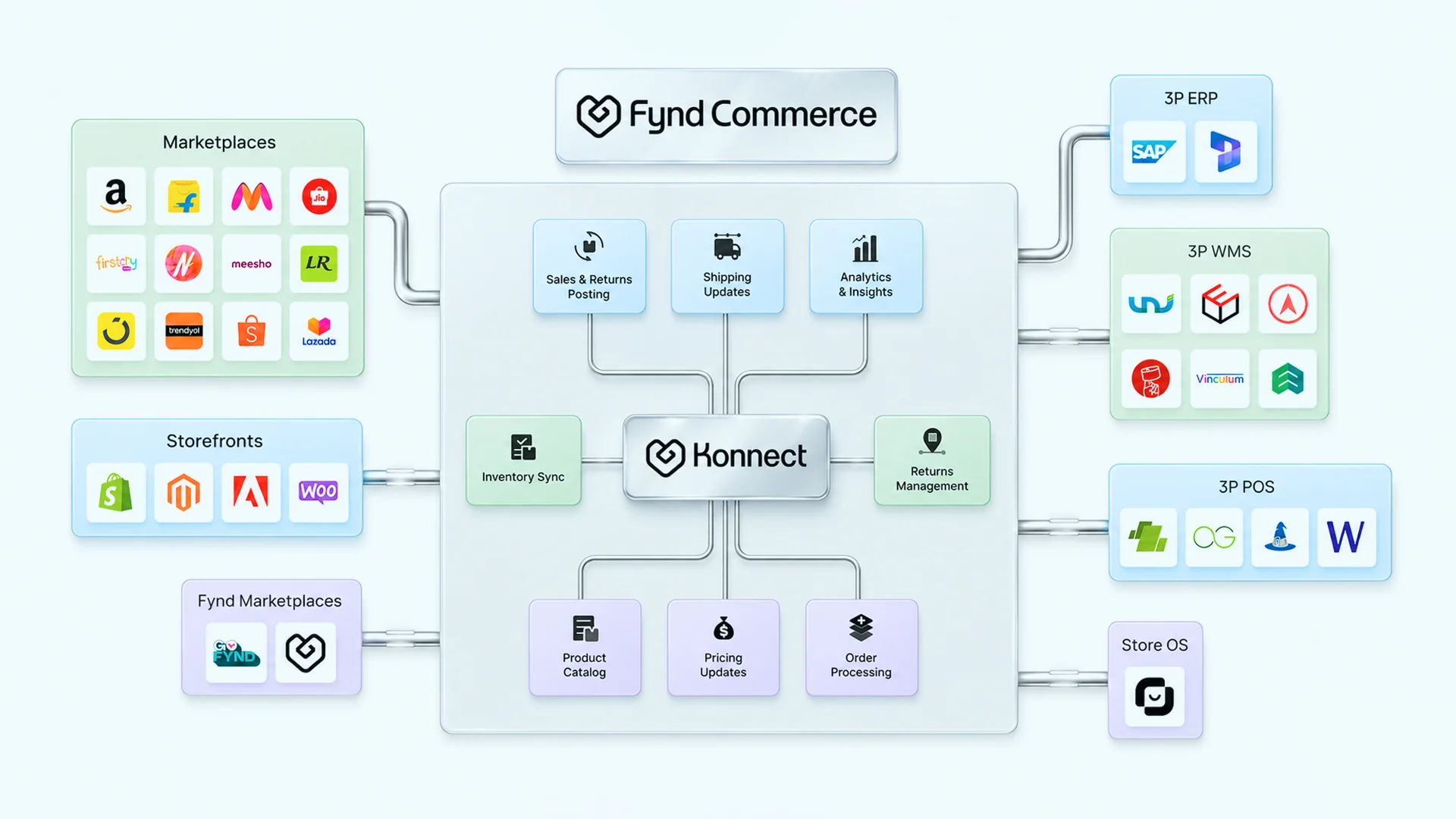
The first thing you had to do was connect your inventory data. Your Bhiwandi and Delhi warehouses were on one system. Your stores were running a separate POS. Your website had its own inventory pool. Three different buckets of stock that were never talking to each other in real time.
For the Endless Aisle system to work, you needed one unified inventory view. You worked with Fynd, an omnichannel retail platform, to integrate your POS, warehouse management system, and e-commerce backend into a single real-time inventory layer. Once that was in place, a store associate in Hyderabad could look at a product, see that the Delhi warehouse had 12 units of a size M, and place an order for the customer immediately without picking up a phone or sending an email.
This step might sound simple but it is not. It requires integration work, clean data, and buy-in from every part of the organisation. But it is non-negotiable. Endless Aisle cannot function on fragmented inventory data.
Step 2: Training store associates as sales consultants
This is the part most brands underestimate. Endless Aisle is not just a technology rollout. It is a behavioural shift for store staff.
You ran a four-week training program before going live. Store associates were trained not just on how to use the system, but on how to have the conversation with a customer when something is out of stock. Instead of saying "sorry, we do not have it," they learned to say, "We have this in your size at our warehouse and it can reach you in two days. Would you like me to place the order for you right now?"
That shift in language changed everything. The transaction that would have walked out the door now stayed in the system. And customers appreciated the effort. Several stores reported that customers who used the Endless Aisle option returned more frequently, because the trust had been built in that one moment of being helped.
Step 3: Smart fulfilment routing
When a customer places an Endless Aisle order at your Kolkata store, who fulfils it? The closest store with stock? The warehouse? The store in the next city?
This is where order routing logic becomes critical. You configured your system to prioritise fulfilment from the nearest location with available stock, to minimize shipping time and cost. If a nearby store had the product and could ship it, the order was routed there. If not, the warehouse took over.
You also set up a ship-from-store model in your top 12 stores, where those locations could act as mini fulfilment center for Endless Aisle orders coming from other cities. This kept inventory moving across the network instead of sitting idle in one location.
Step 4: Mixed cart checkout
One insight that came out of the pilot was that customers wanted to combine their in-store purchases with their Endless Aisle orders in a single transaction.
A customer might pick up two items physically available in the store, and then add a third item via Endless Aisle that would be delivered to his home. Making him pay separately for these two baskets was a friction point. Once you enabled mixed cart checkout where a single bill covered both the walk-out items and the home-delivered items, the drop-off rate on those split orders came down significantly.
This capability, which Fynd supports natively, turned out to be one of the highest-impact changes in the entire rollout. It sounds like a small UX detail. In practice, it removed the most common reason customers said no at the last step.
This Isn't Just TheoryThe value of Endless Aisle has already been proven at scale by some of India's largest retail brands. After Khadim, one of the country's leading footwear retailers with a large offline store network implemented Fynd Store OS and connecting stores into a unified omnichannel fulfilment network, Khadim transformed stores from isolated inventory points into active sales and fulfilment hubs. The results were tangible: 6% additional store sales, a reduction in average delivery timelines from 10 days to 4 days, 25% lower logistics costs, 5% growth in prepaid orders, and a 30% reduction in cancellations and RTOs. What's particularly important is that these gains did not come from opening more stores or increasing inventory levels. They came from making existing inventory more discoverable, more accessible, and more sellable across the retail network. That's the core promise of Endless Aisle: helping customers buy what they want, regardless of where that inventory sits, while helping retailers unlock revenue that would otherwise be lost to stock-outs and fragmented inventory visibility. |
Key strategies worth taking away
If you are a fashion brand looking to build your own Endless Aisle practice then you need take care of a few things that will help you make the biggest difference:
1. Unify your inventory first
No Endless Aisle strategy works without a real-time, unified view of stock across stores and warehouses. That infrastructure investment is the foundation of everything else.
2. Train for the conversation, not just the tool
Technology alone will not close lost sales. Your store associates need to feel confident selling something that is not physically in front of them. Role-play the conversation. Build the language before the system goes live.
3. Start with your highest-traffic stores
The impact is most visible and measurable in stores where footfall is high and stock-outs are frequent. Use those wins to build internal momentum for the broader rollout.
4. Enable home delivery and pick-from-store both
Different customers want different things. Some want the product shipped to their door. Others want to come back and collect it. Offering both options removes the most common reason to say no.
5. Track it as its own channel
Create a specific attribution model for Endless Aisle sales so you can see what the system is actually generating. Without clear attribution, the impact gets buried in aggregate numbers and leadership never fully appreciates what the program is producing.
The bigger picture
Endless Aisle is one of those strategies that sounds like a feature until you see what it does to the customer relationship at scale. It is really a statement from a brand that says: we will not let a logistics limitation become your problem.
For fashion brands in particular, where impulse and emotion drive a significant portion of purchase decisions, the moment of wanting something is a narrow window. If a store associate can capture that moment even when the product is not physically present, the brand wins. Not just the transaction, but a piece of the customer's trust that compounds over time.
Ready to take your in-store experience beyond the shelf? The first step is always inventory visibility. Platforms like Fynd are helping Indian retail brands get there faster than most expect.
Talk to us
~t.compress(q:75)/cms_uploads/How-Omnichannel-brands-in-India-can-use-Endless-Aisle.webp)