October 21, 2026
Clienteling in retail: from store conversation to remote sale
Learn how clienteling in retail turns a store conversation into a remote sale, with UK examples, the KPIS to track and the consent rules for outreach.
Amrita Bhambhani
October 21, 2026
Learn how clienteling in retail turns a store conversation into a remote sale, with UK examples, the KPIS to track and the consent rules for outreach.
Amrita Bhambhani
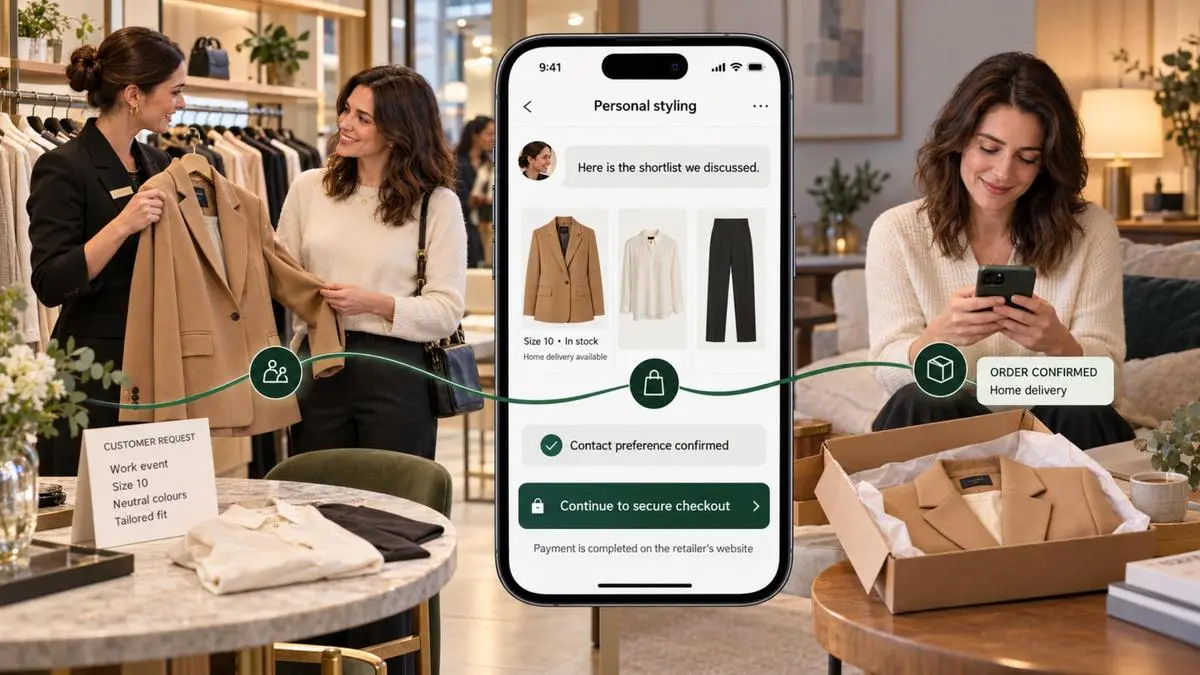
Clienteling in retail is the practice of using an associate’s judgement and the customer context a retailer holds, with the customer’s agreement, to give relevant one-to-one service before, during and after a purchase. An associate might draw on purchase history, saved preferences, a wishlist or notes from an earlier conversation to advise a customer in the store, then continue the conversation by message or by phone once the customer has left.
The practice suits purchases where advice matters and customers return, such as fashion, beauty, furniture and electronics, and it applies well beyond luxury retail.
This article follows the associate’s side of the work: how a store conversation becomes a curated selection, a remote sale and a follow-up the customer welcomes. It also explains how clienteling differs from CRM, which UK examples show the practice in use, which measures to track and which consent rules apply to outreach.
Clienteling in retail means a store associate builds a relationship with individual customers over time. The associate uses what the customer has agreed to share, such as past purchases and preferences, to give advice that fits that person, and keeps a record of each conversation so the next one can continue from it.
Three things turn ordinary service into clienteling:
One person owns the conversation: An associate, stylist or adviser takes responsibility for the customer and uses their judgement.
The retailer holds useful memory: Purchases, preferences, notes and earlier conversations stay with the customer’s profile, so any associate can pick up where the last one ended.
Every conversation ends with a practical next step: such as a shortlist, appointment, saved selection, basket, delivery or agreed follow-up.
Take a customer who returns to a Manchester clothing store to exchange trousers. The associate brings the right size and, because the profile shows which fits she has kept, suggests two other styles in that fit. With her permission, the associate saves the fit, so the next conversation, in the store or by message, starts from what the store already knows.
The table shows how clienteling relates to similar practices.
Practice | Main job | How it relates to clienteling |
Customer service | Resolve a question or problem | Can be personal and usually closes with the case |
Assisted selling | Help a customer choose and buy during one visit | One transaction-focused part of clienteling |
Personal shopping | Curate a selection around a customer’s goals | A high-touch form of clienteling |
Loyalty | Recognise and reward repeat purchases | Supplies status and purchase history an associate can use |
Remote selling | Complete a sale away from the store | Carries the clienteling conversation into a purchase |
A customer relationship management (CRM) system stores customer information, including purchase history, preferences, previous interactions and communication permissions. Marketing, sales and customer service teams use it to manage customer relationships. Clienteling lets store associates refer to the same information when helping an individual customer and add anything useful they learn during the conversation.
Consider the earlier example of a customer exchanging a pair of trousers. The CRM holds her purchase history, loyalty details and contact preferences. The marketing team might use that information to plan a seasonal campaign. The store associate uses it to see which styles and sizes she has bought before, recommends suitable alternatives after discussing what she is looking for and records any new preference, such as a trouser length.
The table compares how retailers use each.
Area | CRM | Clienteling |
Main users | Marketing, customer service and sales teams | Store associates, stylists and remote advisers |
Common uses | Customer segmentation, marketing campaigns, service requests and account history | Individual conversations, product recommendations and follow-ups |
Outcome | A central customer record that supports different business functions | Recommendations, appointments, prepared baskets or agreed next steps |
Success measure | Data quality and process performance | Quality of service, relevance of recommendations, sales and repeat purchases |
For clienteling to work consistently across stores, associates need access to accurate customer records. Retailers must also control who can view and update this information based on their responsibilities and the customer's permissions.
As associates record new preferences and details from customer conversations, the CRM stays up to date and provides useful information for future interactions.
Turning a clienteling conversation into a sale requires understanding the customer's requirements, recommending suitable products and helping them complete the purchase. Associates can use previous interactions, purchase history and product information to make their recommendations relevant to each customer.
The process does not always end with an immediate purchase. Some customers may need time to decide, request an item that is currently unavailable or prefer to complete their purchase later. In these situations, the associate should agree on a suitable next step and make sure the conversation can continue without the customer having to start again.
The following seven steps explain how to manage a clienteling conversation, from the initial interaction to recording the outcome.
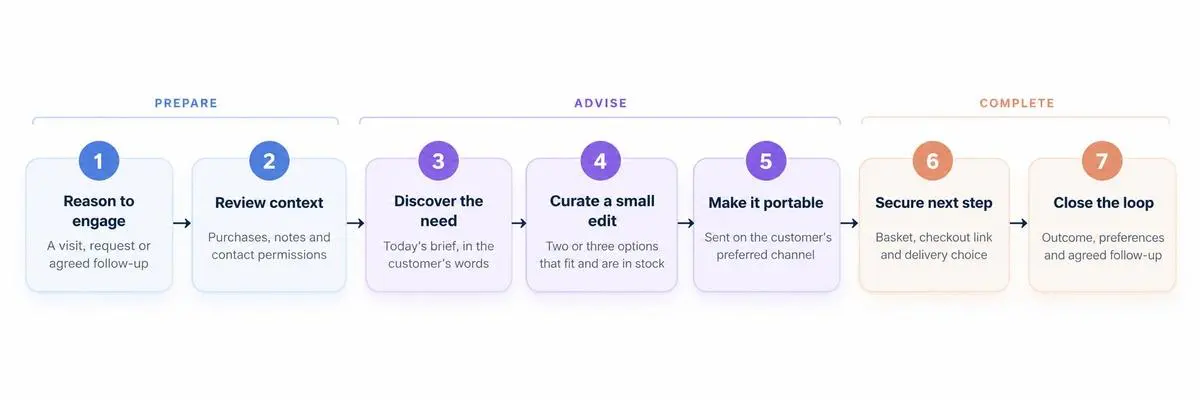
Start with a reason to engage
Identify why the customer needs assistance before starting the conversation. This could be a product enquiry, a scheduled appointment, a request for styling advice or a follow-up the customer previously agreed to.
If the customer is visiting the store, begin by understanding what brought them in. For follow-up conversations, check the original request and make sure the information you are sharing is still relevant.
Avoid contacting customers simply because they appear in a list of previous buyers. Every interaction should have a clear purpose and respect the customer's communication preferences.
Review previous interactions
Check the customer's profile before making recommendations. Look at recent purchases, returns, saved products, preferred sizes and notes from earlier conversations.
Focus on information that helps with the current request. For example, if a customer previously returned trousers because they were too long, check whether the retailer offers a shorter length before suggesting another pair.
Also check whether another associate is already handling the request. This prevents duplicate follow-ups and helps maintain continuity.
Use the information to prepare for the conversation, but confirm that the customer's preferences and requirements are still accurate.
Understand the customer’s current requirements
Ask questions to establish what the customer is looking for and what matters to their purchase. Start with the product or occasion, then clarify details such as budget, size, fit, preferred colours and when the item is needed.
Keep the questions relevant to the request. Someone looking for a replacement pair of trousers may need help finding the right fit, while a customer buying a gift may need recommendations based on another person's preferences.
Check whether anything has changed since the customer's previous visit. Purchase history can provide useful context, but it should not determine what you recommend without understanding their current needs.
Before suggesting products, confirm the main requirements so that both the associate and customer are working towards the same outcome.
Narrow down the product selection
Use the customer's requirements to select a small number of suitable products. Prioritise options that meet their stated preferences and explain the differences that could influence their decision.
For example, when recommending trousers, explain how the available styles differ in fit, length, fabric or care requirements. Help the customer understand which option is likely to suit their needs.
Check product availability before making a recommendation. Confirm that the required size, colour or variant is in stock, verify the current price and check whether the item can be delivered or collected within the customer's preferred timeframe.
If a suitable product is unavailable, check stock at other locations or suggest an alternative that meets the same requirements.
Agree on the next step
Once the customer has reviewed the recommendations, ask how they would like to proceed.
If they are ready to purchase, confirm their selection and proceed to checkout. If they need additional time, offer to save the products they are considering so they can review them later.
Depending on the request, the next step could involve reserving an item, arranging another appointment, checking availability at a different store or sharing a shortlist of products.
Use the clienteling platform to save the selected products in a wishlist, digital lookbook or basket. If the customer wants the information sent to them, confirm their preferred communication channel and check that the necessary permissions are in place.
Before ending the interaction, agree on any follow-up required, including who will contact the customer and when.
Help the customer complete the purchase
Once the customer has made a decision, confirm the selected products, including the correct sizes, colours, quantities and prices.
For purchases completed in the store, assist with checkout and arrange any requested delivery or collection services.
If the customer prefers to purchase later, prepare a digital basket containing the agreed products and share a secure checkout link through their approved communication channel.
Make sure the customer can review their order, select an available fulfilment option and complete payment through the retailer's checkout. Payment information should never be collected or stored through personal messages or phone conversations.
If the customer encounters a problem during checkout, provide assistance through the retailer's approved support process.
Record the outcome and any follow-up
Update the customer's profile after the conversation. Record the products purchased, recommendations considered, preferences expressed and any actions that still need to be completed.
Be specific when recording feedback. If a customer decides against a product because the fit is unsuitable, note the fit issue rather than making a general assumption about their style preferences.
For conversations that do not result in a purchase, record the reason the customer provided. This could include price, availability, uncertainty about sizing or a decision to wait.
If a follow-up was agreed, record the action, responsible associate and expected date. This helps ensure that requests are completed and prevents customers from receiving repeated or unnecessary messages.
Keep the notes factual and relevant to future interactions. Accurate records allow another associate to understand the customer's requirements and continue assisting them without repeating the entire conversation.
Remote clienteling is the same one-to-one service delivered away from the shop floor, by message, phone or video. The associate advises from the customer’s profile and live stock, sends a saved selection and shares a secure checkout link, so the customer can complete the purchase wherever they are.
Remote selling in retail starts in one of two places. In the store, a visit, exchange or appointment ends before the customer is ready to buy and the customer agrees to be contacted, so the associate saves the selection and continues the conversation on the agreed channel. Remotely, the customer messages the store, books a virtual appointment or replies to an agreed follow-up, and the associate opens the customer’s profile, advises by message, phone or video and shares a basket.
Route | What triggers it | What the associate does |
In the store | A visit, exchange or appointment ends before the customer is ready to buy, and the customer agrees to be contacted | Saves the selection, sends it on the agreed channel and continues the conversation there |
Remotely | The customer messages the store, books a virtual appointment or replies to an agreed follow-up | Opens the customer’s profile, advises by message, phone or video and shares a basket |
The associate should ask the customer how they would prefer to stay in touch. Email is useful for sharing product selections and digital lookbooks, which customers can open and review in their own time. WhatsApp and SMS work well for quick questions, updates and product photos. Phone and video calls are better suited to appointments where the customer wants to discuss options or see products in greater detail. Before contacting the customer, the associate should check their communication preferences and permissions. The section below covers the relevant UK consent requirements.
Three things need to be in place before an associate can sell remotely: a customer record that every store and channel can read, live stock and delivery options for each product, and a checkout link that takes payment in the retailer’s own checkout. Clienteling software brings the three together, and Fynd Clienteling gives store staff customer profiles, shoppable catalogues with real-time inventory, and carts or product links to share by WhatsApp, SMS or email. With all three in place, a conversation that starts in the store can continue by message and finish as a sale at home.
Clienteling examples in UK retail include John Lewis’s complimentary personal styling, Liberty’s expert appointments, Harrods’ personal shoppers who work by WhatsApp, WeChat or phone, and Fortnum & Mason’s Fortnum’s Connect platform. It also reaches the high street, where FatFace is trialling one-to-one styling appointments in six stores.
Clothing
John Lewis offers complimentary styling appointments through more than 180 stylists across 31 shop locations. The first conversation can take place by phone, email or in person, and the stylist sends an online wishlist of any items the customer wants to think over, which is the saved selection from the workflow above, sent after the appointment. FatFace announced a trial of free one-to-one styling in six stores in April 2026 and plans to extend it to more stores over the coming year.
Luxury
Harrods offers personal shopping to its Platinum and Black Tier Rewards members as a complimentary service. After a member makes contact, a shopper replies within 48 hours by WhatsApp, WeChat or phone, can assist remotely and arranges home delivery, and the member can go back to the same shopper about purchases and returns. The service is open to members of the top Rewards tiers, which shows how selectively clienteling is offered. Selfridges at Manchester Exchange Square runs personal shopping in private suites or by video or phone call, with fashion styling appointments booked online.
Beauty
Liberty’s expert appointments cover beauty advice as well as styling and interiors. The customer books online and receives a confirmation email with the meeting details, and a customer who wants to buy something the expert has shown tells the expert, who helps with the transaction. To book the same expert again, the customer calls or emails the personal shopping team, and Liberty also offers virtual appointments from home.
Food and gifting
Fortnum & Mason announced Fortnum’s Connect with Proximity in May 2026. The platform gives store teams a live view of customer details, including tastes, past purchases and suggested products, and lets them message customers one to one by email, text and WhatsApp, manage preferences and recommendations, book appointments, run in-store events and review reports. It brings the shared record, the channels and the follow-up described in the workflow into one tool for a store team.
Retailers need to measure how often clienteling conversations lead to purchases, how much customers spend and whether they return to buy again. It is also worth tracking how customers respond to follow-up messages and how many have agreed to receive them.
Five clienteling KPIs cover these measures:
KPI | How to calculate it | What it measures |
Conversation-to-sale rate | Number of recorded conversations that lead to a sale ÷ total recorded conversations × 100 | How often clienteling conversations result in purchases |
Average order value (AOV) | Total revenue from clienteling sales ÷ number of those sales | The average amount customers spend on purchases assisted by an associate |
Repeat purchase rate | Customers who make another purchase within a defined period ÷ customers served in the eligible group × 100 | How often customers return to purchase again |
Follow-up response rate | Follow-up messages that receive a reply ÷ follow-up messages delivered × 100 | How often customers respond to associate outreach |
Contactable client share | Customers with valid permission to receive the relevant communications ÷ total customers served × 100 | The proportion of customers associates can contact for follow-ups |
To measure these accurately, associates need to record each conversation and its outcome. Set a consistent period for attributing purchases to clienteling interactions. For example, a 14-day window allows a sale completed online several days after an in-store conversation to count towards that interaction.
For repeat purchases, use the same measurement period across customer groups and compare customers who received clienteling assistance with those who bought unassisted. This can show whether assisted customers return more frequently, although the difference may also reflect which customers choose to take up assistance.
Start by establishing a baseline during the pilot. Published clienteling benchmarks often come from software providers and may reflect different customer groups, retail categories and measurement methods. Tracking the five KPIs consistently over the first few months gives retailers a sounder basis for setting targets as the programme expands.
UK retailers must follow the Privacy and Electronic Communications Regulations (PECR) and UK GDPR when contacting customers through clienteling. Marketing messages sent by email, SMS or social media direct messages generally require consent, unless the retailer qualifies for the soft opt-in.
The soft opt-in covers marketing messages to existing customers when the retailer collects the contact details directly during a sale or negotiations for a sale, promotes its own similar products or services, and gives the customer a clear opportunity to opt out when collecting their details and in every subsequent message.
Messages that customers have specifically requested, such as a product selection sent after an appointment, are generally treated as solicited communications. Retailers should keep these messages relevant to the original request and avoid adding unrelated promotions.
Where consent is required, associates should record when and how the customer gave it, what they agreed to receive and which communication channels they approved. These preferences should be stored in the customer’s profile and checked before sending messages. The ICO applies electronic marketing rules to social media direct messages and similar stored communications, so WhatsApp outreach should be managed with the same care as email and SMS.
Notes about size, fit and style preferences may be useful for future recommendations. Information revealing a medical condition, such as a skin condition, can qualify as special category health data under UK GDPR, which requires a lawful basis under Article 6 and an additional condition under Article 9. Retailers should therefore limit profile notes to information genuinely needed to assist the customer, and any use of website browsing behaviour to personalise outreach must also comply with the applicable rules on cookies and similar tracking technologies.
If retailers use website browsing behaviour to personalise outreach, they must also comply with the applicable rules on cookies and similar tracking technologies.
Customer communications should take place through retailer-approved systems, and customer records, contact permissions and conversation histories should remain accessible to authorised colleagues when the associate who handled the relationship leaves the business.
Start a clienteling pilot with a small group of stores where associates already help customers with appointments, product recommendations or personal requests. Select a few associates, limit the communication channels and agree on the five clienteling KPIs before launching the pilot, so the results can be compared with a baseline.
For example, FatFace launched its first in-store styling service, Face to Face, across six stores in April 2026. Customers could book free, one-to-one styling appointments online or in store, with plans to introduce the service at additional locations over the following year.
Select the stores and associates: Choose stores with consistent footfall and associates who regularly help customers with product selection, styling or individual requests. Make sure participating associates know how to access customer information, record conversations and manage follow-ups.
Establish a baseline: Before launching, record average order value, repeat purchase rate and other relevant sales measures. Collect the same information from comparable stores outside the pilot.
Set up consent and customer records: Decide how associates will record customer preferences, conversation outcomes and permission to receive messages. Consent can be collected through appointment booking forms or during in-store conversations, and associates check the customer’s communication preferences before sending any follow-up.
Choose the communication channels: Start with email and one messaging channel, such as WhatsApp or SMS, and establish a consistent process for sharing recommendations, sending checkout links and recording responses.
Review the results before expanding: Set a review date before the pilot begins, such as 90 days after launch. Compare the five KPIs against the baseline and the comparable stores. Speak to participating associates about the time spent recording interactions, managing follow-ups and completing sales, and use their findings to improve the process before introducing clienteling to additional stores.
A practical place to start with clienteling is the conversations your associates already have, whether that's helping a customer during an appointment, finding an out-of-stock item or following up on a product enquiry. Choose a few stores to run a pilot, give associates access to customer records and establish how they'll manage follow-ups and communication permissions. Review the results against your existing sales figures to understand what's working and where improvements are needed before expanding to other stores.
Fynd Clienteling brings customer profiles, real-time inventory and shoppable links into one platform. Your associates can continue previous conversations, share relevant product recommendations and help customers complete purchases after they've left the store. Notes and conversation history stay on the customer profile when the assigned associate changes.
Ready to introduce clienteling in your stores? We can help you plan a pilot that works for your business.
Personal shopping is a service in which a stylist helps a customer choose products, usually during an appointment. Clienteling covers the wider relationship, including the customer record the stylist works from, the follow-up after the appointment and the remote sale that can complete the purchase.
Associates use purchase history, returns, saved products, preferred sizes and notes from earlier conversations to prepare recommendations. They record the details that help the customer, keep notes factual and relevant to future conversations, and send follow-up messages through the channels the customer has agreed to.
Yes. A pilot can start with a few stores and associates, one or two communication channels and the five KPIs measured against comparable stores. The retailer can extend the practice once the results are clear, using the same customer record and process.
A loyalty programme rewards repeat purchases with points, tiers or offers. Clienteling is one-to-one service from an associate who uses the customer record to advise, follow up and complete a sale. The two can connect, as at Harrods, where personal shopping is open to Platinum and Black Tier Rewards members.
AI fashion photography pilots need accurate source images and checks for product fidelity before retailers can judge whether the process is worth scaling.
Prepare product data for a PIM migration by defining the data model, assigning field ownership, cleaning records and testing each wave before launch.
Compare 8 loyalty program software platforms for retail brands, including features for rewards, tiers, referrals, omnichannel loyalty and reporting.
Isi formulir
Bagikan informasi kontak Anda untuk memulai
Bicara dengan pakar
Anggota tim sales kami akan menghubungi Anda