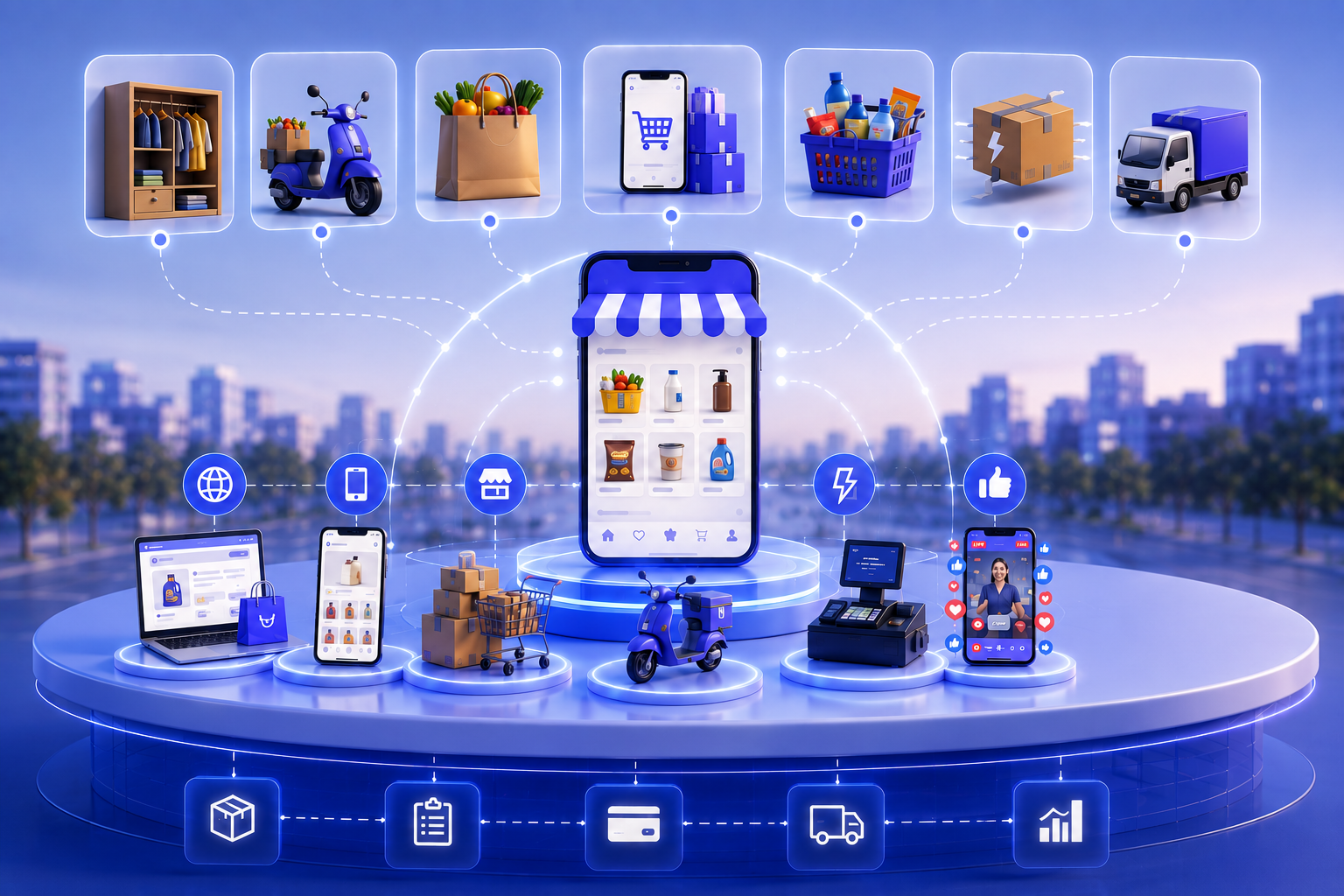
The sale was not lost because the product was out of stock. It was lost because the inventory was invisible.
A customer walks into a footwear store looking for a specific size and color. The store associate checks the shelves, searches the backroom, and eventually delivers the disappointing answer: "Sorry, we are out of stock."
The customer leaves and buys from a competitor online.
The product may have been available elsewhere in the retailer's network. It could have been sitting in another store just a few kilometers away or waiting in a warehouse ready to ship from store. The customer never knew. Neither did the store associate.
That sale was not just lost. The customer experience suffered as well.
Why inventory visibility becomes harder as retailers grow
Managing inventory is relatively simple when a brand operates a single store.
The challenge grows as retailers expand into multiple stores, warehouses, online marketplaces, mobile apps and their own e-commerce websites. Inventory becomes distributed across locations, while customers continue to expect a seamless shopping experience.
This creates a common problem:
Products remain available somewhere: Inventory exists within the network, but not where the customer is currently shopping.
Store teams lack visibility: Associates can only access local stock information.
Customers experience stockouts unnecessarily: They assume the retailer is out of stock when inventory actually exists elsewhere.
Sales opportunities are lost: Revenue disappears even though products remain available within the business.
As retail operations scale, these gaps become more expensive.
What is an Endless Aisle?
An Endless Aisle retail strategy that allows customers to purchase products beyond the inventory physically available in a store.
Instead of limiting sales to what's on local shelves, store associates gain access to inventory across the retailer's entire network, including other stores, warehouses and fulfillment centers.
If an item is unavailable at the current location, the associate can still place the order and arrange delivery to the customer's preferred address.
The aisle effectively becomes "endless" because customers can access the brand's broader inventory, not just what they see in front of them.
How does Endless Aisles work?
To understand the concept, consider a growing fashion retailer operating 35 stores across India.
A customer visits a Mumbai store looking for a particular jacket in size XL. The local store has sold out.
Without an endless aisle strategy, the interaction ends there. With endless aisle capabilities, the experience looks very different.
Step 1: Centralizing inventory visibility
The retailer connects inventory data from stores and warehouses into a single system.
Store associates can instantly see where inventory is available across the network.
The jacket may not exist in Mumbai, but it might be available in Pune, Bengaluru, or a central warehouse.
Step 2: Finding the nearest available stock
The associate searches the product and identifies available inventory elsewhere.
Instead of saying "out of stock," they can offer immediate alternatives.
The customer remains engaged because the purchase is still possible.
Step 3: Creating the order
The associate places the order directly from the store.
The order is linked to the location that currently holds inventory.
From the customer's perspective, the purchase process remains simple and uninterrupted.
Step 4: Fulfilling from the best location
The retailer determines the most suitable fulfillment source.
Who fulfills the order?
The nearest store with stock? A warehouse? Another regional fulfillment center?
The answer depends on inventory availability, delivery timelines, and operational rules.
Step 5: Delivering to the customer
The product is shipped directly to the customer's preferred location.
The customer receives the item without needing to visit another store or search alternative websites.
The sale stays within the brand's ecosystem.
Proof point
Example Result |
|---|
A retail brand implemented endless aisle capabilities and increased inventory utilization, reduced lost sales from stockouts and improved customer satisfaction scores. Replace with a verified customer reference before publication. |
The business benefits of Endless Aisle
Higher sales conversion
Customers can buy products even when the local store is out of stock.
Retailers convert demand that would otherwise disappear.
Better inventory utilization
Inventory across the network becomes available for sale.
Products no longer remain hidden within isolated locations.
Improved customer experience
Customers gain access to a wider assortment without visiting multiple stores.
The shopping journey becomes more convenient.
Reduced markdown pressure
Slow-moving inventory in one location can help fulfill demand elsewhere.
This reduces the need for aggressive discounting to clear stock.
Stronger omnichannel retail strategy operations
Endless Aisle solutions help unify physical and digital retail experiences.
Customers interact with one brand rather than separate sales channels.
How technology enables endless aisle
Retail endless aisle platforms depend on accurate, real-time inventory visibility.
Retailers need systems that can:
Track inventory centrally: Maintain a single view of stock across stores and warehouses.
Route orders intelligently: Identify the best fulfillment location automatically.
Enable store-assisted selling: Give associates access to network-wide inventory.
Support omnichannel fulfillment: Connect physical stores and digital channels through shared inventory data.
This is where platforms such as Fynd help retailers create a connected inventory ecosystem, allowing products to remain sellable regardless of where they are physically located.
Why endless aisle matters now
Customer expectations continue to evolve.
Shoppers no longer think in terms of stores, warehouses, or channels. They simply expect products to be available whenever they want to buy them.
For retailers, the challenge is no longer carrying more inventory. It is making existing inventory visible and accessible across the network.
The brands that solve this problem create better customer experiences while improving operational efficiency. The ones that don't risk losing sales they could have fulfilled all along.
Want to explore how Endless Aisle can help unlock inventory across your retail network?
[Talk to Us]
~t.compress(q:75)/cms_uploads/111.webp)