November 5, 2026
How much does a self-checkout kiosk cost in the UK?
Self-checkout kiosk costs in the UK range from about £4,400 for compact hardware to £40,000 for a full grocery lane, before software and installation.
Amrita Bhambhani
November 5, 2026
Self-checkout kiosk costs in the UK range from about £4,400 for compact hardware to £40,000 for a full grocery lane, before software and installation.
Amrita Bhambhani
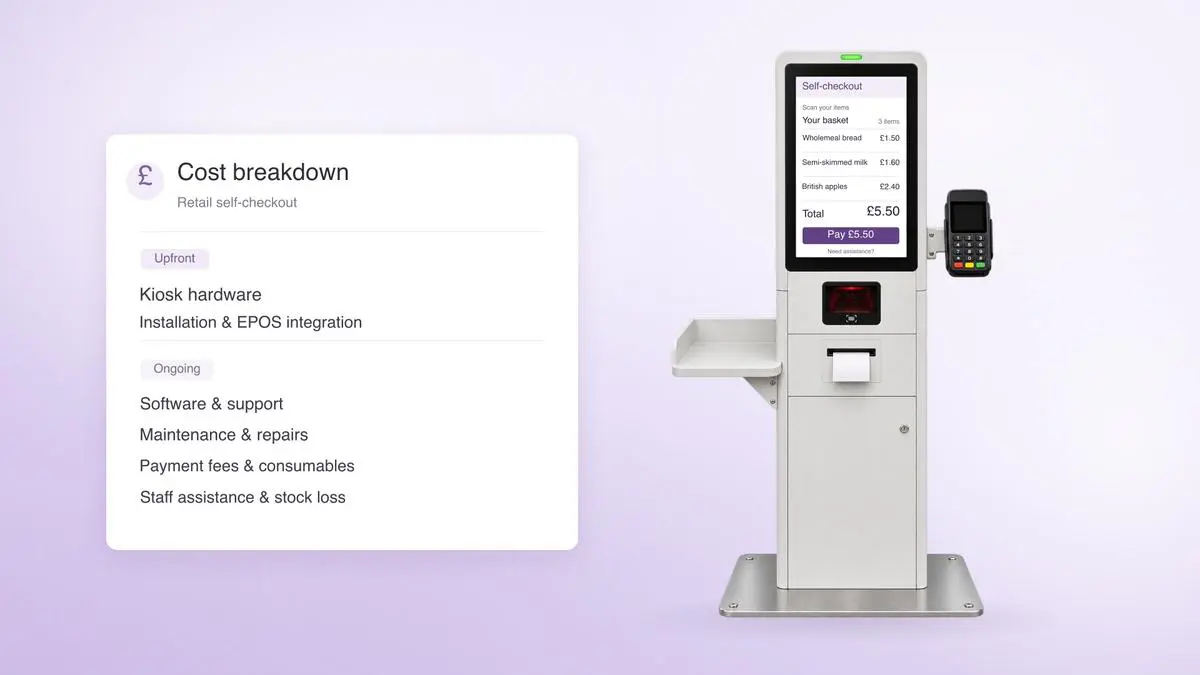
A self-checkout kiosk in the UK can cost between £4,400 and £6,600 before VAT for compact retail hardware, while a fully equipped grocery checkout lane can cost £20,000 to £40,000. These figures cover the equipment, and the total investment also depends on software, EPOS integration, installation, maintenance and ongoing operating costs.
Retailers also need to account for stock loss. The 2026 ECR Retail Loss study found that store losses rose by an average of 22% in the first year after retailers introduced self-checkouts.
This guide covers what to look for in a supplier quote, the running costs to budget for, how to calculate payback and how self-checkout compares with staffed tills. Payment terminals, weighing scales, cash handling and security features each change the price, so the published UK prices below serve as a starting point for a store's own quotes.
Here is what published UK listings show about self-service checkout cost for different types of self-checkout equipment.
Self-checkout system | Published price | What the listing says |
£4,376.57 excluding VAT | 23.8-inch touchscreen, barcode scanner and receipt printer. Compatible with payment terminals, with optional cash management | |
£5,835.42–£6,582.60 excluding VAT | Compact self-checkout units with 27 or 32-inch screens. Cash rack and security scale available as optional expansions | |
£20,000-£40,000 | Estimated cost of a fully equipped grocery lane with cash recycling and weighing scales |
Note: Prices are based on listings checked in the 1st week of November 2026 and may change. Jarltech's published prices are intended for resellers, exclude VAT and are non-binding. The Lendus range is an indicative estimate rather than a supplier quotation.
Kiosks with similar screens can differ widely in cost because of their configuration.
A basic card-only unit may require a touchscreen, scanner, payment terminal and receipt printer. A grocery retailer may also need weighing scales, cash recycling, bagging areas and additional security features.
Manufacturers offer different configurations to accommodate these requirements. For instance, Diebold Nixdorf's EASY ONE includes a touchscreen, scanner, thermal printer, basket shelf and security scale, with a cash rack available as an add-on. NCR Voyix offers card-only, card-and-cash and convertible self-checkout systems.
When comparing suppliers, ask for an itemised quote covering hardware, software, installation, EPOS integration and ongoing support. This will help you understand the total cost and identify expenses that may arise after installation.
Retail self-checkout kiosks and restaurant self-ordering kiosks serve different purposes, so their prices should be compared separately.
In a retail store, customers scan products and complete payment themselves. The kiosk needs to work with the retailer's product catalogue, inventory, pricing and EPOS system.
Restaurant self-ordering kiosks, meanwhile, allow customers to browse a menu, customise their order and pay without placing it through a cashier.
For example, Square UK lists its restaurant kiosk software at £35 per device per month, plus standard in-person transaction fees. Hardware is sold separately, and businesses need a compatible iPad.
This pricing is relevant to restaurant self-ordering systems and should be considered separately when budgeting for retail self-checkout equipment.
The price of a self-checkout kiosk depends on what comes with it. Suppliers such as NCR Voyix and Diebold Nixdorf offer configurable systems, allowing retailers to choose the hardware and features they need. Software, installation, integration and support may be charged separately.
Before comparing prices, ask each supplier for an itemised quote that covers the following:
Cost component | What to check with the supplier |
Hardware | Does the price include the screen, scanner, payment terminal, receipt printer, weighing scales, bagging area, cash handling and security equipment? |
Software | How is the software licensed? Which checkout features, updates and support services are included? |
EPOS and other integrations | Can the kiosk connect to existing EPOS, payment, inventory, pricing, promotions, loyalty and reporting systems? Are there additional integration fees? |
Configuration | Which store settings and checkout rules are included in the initial setup? Will future changes cost extra? |
Installation | Does the quote cover delivery, assembly, cabling, network setup, testing and handover? What must the retailer arrange separately? |
Staff training | Who receives training, how is it delivered and will technical support be available during launch? |
Maintenance and warranty | How long does the warranty last? What are the support hours, response times and charges for repairs or replacement parts? |
These details let retailers compare the full cost of a project against the equipment price alone. According to Lendus, software and service support are frequently covered by separate contracts and are generally excluded from equipment financing.
Installation covers delivery, assembly, cabling, network configuration, testing and handover. UK suppliers generally price this per site, so quotations should show installation as a separate line item and clearly distinguish between the supplier’s responsibilities and the retailer’s. Stores may need to arrange power and network points, building work or layout changes before installation begins. For example, a 2019 Fidelity Systems listing advertised its self-service till price as excluding installation.
Self-checkout software powers the customer interface, product search, promotions, receipts and integration with the store’s EPOS system. Suppliers may charge a licence fee per kiosk, per store or across the entire retail estate, while others use a recurring subscription model. Software, maintenance and technical support may also be covered by separate contracts.
Published prices are more common for restaurant-ordering kiosks than for retail self-checkout systems. Square, for example, charges £35 per device per month. Retailers should therefore ask suppliers to specify the licensing model, integration fees, included updates, support terms and any additional recurring charges in their quotations.
Ongoing costs include software licences and support, maintenance, payment processing, connectivity and consumables, and staff supervision, alongside the stock loss a store measures in its own pilot. The amount depends on the supplier's pricing model, the equipment installed and how the store manages its self-checkout area.
Here are the main costs to account for:
Software and technical support: Monthly or annual licence fees, software updates and support contracts. Check whether pricing is per kiosk, per store or across the entire retail estate.
Maintenance and repairs: Preventive maintenance, remote monitoring, engineer visits and replacement parts, particularly once the warranty expires.
Payment processing: Card transaction fees, payment terminal rental and any additional charges from the payment provider.
Connectivity and consumables: Network services, receipt paper and other supplies needed to operate the kiosks.
Integration and upgrades: Charges for connecting new systems, adding features or updating existing integrations.
Contract renewal and exit: Price increases, renewal terms and any costs associated with changing suppliers or ending a contract.
Ask suppliers to separate fixed annual charges from transaction-based or occasional expenses. This will make it easier to estimate operating costs over three to five years.
Self-checkout kiosks still require staff to help customers with scanning problems, age-restricted products, payment issues and other interruptions. Retailers should account for the time employees spend supervising kiosks and assisting shoppers.
Stock loss is another important consideration. The 2026 ECR Retail Loss study examined self-checkout losses across a sample of 39 retailers and reported the following findings:
Store losses increased by an average of 22% in the first year after self-checkouts were introduced in before-and-after comparisons.
Stores with self-checkout recorded 33% higher losses than stores without it in comparative studies.
Missed scans occurred in 1% to 4.8% of transactions, with an average value of €2.50 per incident.
The research links losses to both deliberate theft and accidental scanning errors. Difficult barcodes, unfamiliar checkout interfaces and awkwardly shaped products can all contribute to missed scans.
Results depend on the store with product range, checkout design, supervision and security measures, so these findings serve as a useful reference for a pilot.
When testing self-checkout in your stores, track how often customers need assistance, the time staff spend resolving issues and changes in stock loss. Including these figures alongside software and maintenance expenses will give you a more complete picture of the ongoing cost of self-checkout.
To calculate the return on investment (ROI) of self-checkout, retailers need to compare the upfront investment with the savings and other measurable benefits generated each year. The calculation should include equipment, installation, software, maintenance, staff involvement and any increase in stock loss.
The 2026 ECR Retail Loss report recommends considering labour and capital savings alongside stock loss and other operational effects when assessing the financial return from self-checkout.
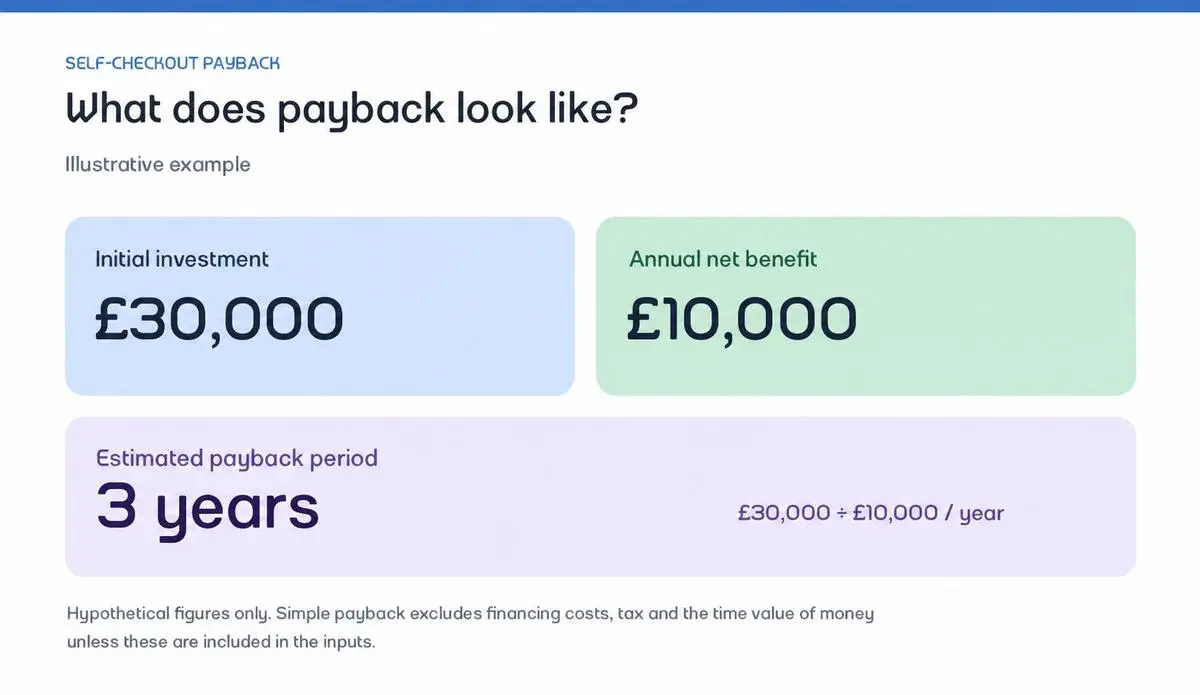
A simple way to estimate how long it will take to recover the investment is to calculate the payback period.
Payback period (years) = Initial investment ➗Annual net benefit
Annual net benefit is calculated as:
Labour savings + other measurable financial benefits − recurring operating costs − additional stock loss and exception costs
For example, suppose a retailer spends £30,000 installing self-checkout kiosks and estimates an annual net benefit of £10,000 after accounting for maintenance, staff assistance and stock loss. Simple payback is therefore three years (£30,000 ÷ £10,000). These figures are illustrative.
A reliable estimate starts with the store's existing checkout activity. Before introducing self-checkout, collect the figures needed to establish a baseline.
Measure checkout demand: Record transactions by hour, queue lengths and peak trading periods to understand current checkout capacity.
Calculate potential labour savings: Identify how many staffed checkout hours could realistically be reduced or reassigned. Use your actual employment costs, including relevant employer contributions.
Track performance during a pilot: Measure kiosk usage, completed transactions, customer assistance, downtime and time spent resolving checkout problems.
Monitor stock loss: Compare refunds, voids, missed scans and other relevant losses with the baseline, ideally using comparable stores or trading periods.
Include all supplier costs: Add equipment, installation, software licences, maintenance, technical support and other charges over the evaluation period.
Test different scenarios: Calculate payback using conservative, expected and optimistic assumptions for customer adoption, labour savings and stock loss.
One important difference is how staff time is counted. If introducing self-checkout reduces paid checkout hours, the savings can be included in the financial calculation. If employees are moved to replenishment, customer service or other tasks, that benefit should be measured separately unless it produces a demonstrable financial return.
The ECR Retail Loss study also highlights the need for retailer-specific evidence. Its before-and-after findings are drawn from 11 grocery retailers, and the report notes differences in how businesses measure and report losses. A store's own pilot results will therefore provide a more relevant basis for forecasting payback.
Self-checkout can reduce the number of employees needed to process transactions, and it also introduces equipment, software, maintenance, supervision and potential stock-loss costs, so whether it works out cheaper depends on the store's transaction volumes, operating hours and checkout setup.
A practical way to compare the two is to calculate the total cost per completed transaction over the same period.
Cost factor | Staffed checkout | Self-checkout |
Equipment | Till, scanner, payment terminal and other POS hardware | Kiosk hardware, scanner, payment terminal and optional security equipment |
Labour | Staff hours spent operating tills | Staff hours spent supervising kiosks and assisting customers |
Software and maintenance | EPOS licences, support and equipment maintenance | Self-checkout software, integration, support and equipment maintenance |
Stock loss | Existing checkout-related losses | Checkout-related losses, including missed scans and other exceptions |
Transaction capacity | Transactions completed by staffed tills | Transactions completed by kiosks, accounting for assistance and downtime |
To compare, use the same store hours, customer volumes and product mix. Account for the number of completed transactions and the total cost of processing them, including any changes in staffing and stock loss.
A pilot can help retailers understand whether self-checkout improves checkout capacity, reduces operating costs or delivers other measurable benefits before committing to a wider rollout.
For UK retailers calculating labour costs, the National Living Wage is £12.71 per hour for employees aged 21 and over from 1 April 2026. The actual employer cost is higher once applicable National Insurance, pension contributions and other employment expenses are included. For a 35-hour week, a minimum-wage employer pays about £14.48 for each staffed checkout hour once the £12.71 wage, 15% employer National Insurance above £96 a week and the 3% minimum employer pension contribution are included, before holiday pay and sickness cover. Use your own payroll figures for the store's actual cost.
The 2026 ECR Retail Loss report is also a useful reference when setting assumptions for stock loss and customer assistance. Its findings show that losses can increase after self-checkout is introduced, making these costs important to measure during a pilot.
Before choosing a supplier, confirm exactly what you are paying for and what it will cost to operate the kiosks once installed.
Is the system designed for retail self-checkout or restaurant self-ordering?
Which hardware components are included, and which are optional?
Is the price for outright purchase, leasing or financing? Does it include VAT?
What additional charges apply to installation, configuration, EPOS integration and staff training?
How are software, maintenance, payment processing and technical support charged?
Does the store need any electrical, network or layout changes before installation?
What does the warranty cover, and how quickly can the supplier respond to technical issues?
Can the system be piloted in a small number of stores before a wider rollout?
The cost of self-checkout extends beyond the equipment. Software, installation, maintenance, staff supervision and stock loss all contribute to the overall investment. A pilot in one store can help retailers measure these costs alongside transaction volumes, checkout times and potential labour savings before deciding on a wider rollout.
Fynd offers two approaches to self-checkout, depending on your store's requirements. Fynd SwiftScan provides dedicated self-checkout kiosks in countertop, floor-standing and wall-mounted formats, with options for RFID-enabled checkout, security controls and integration with existing POS, ERP and inventory systems.
For retailers looking to introduce self-checkout without installing dedicated kiosks, Fynd Scan & Go lets customers scan products and pay directly from their mobile browsers. It supports automatic promotions, digital receipts and QR-based purchase validation at store exits.
Both solutions work with Fynd Store OS, which connects checkout with inventory and other store operations. Retailers can assess which approach suits their floor space, customer traffic, basket sizes and existing technology.
Explore our self-checkout solutions and book a free demo with us to find the right setup for your stores.
Amrita Bhambhani
UK suppliers price installation per site, covering delivery, assembly, cabling, network set-up, testing and handover. A 2019 Fidelity Systems listing priced its self-serve till "plus installation" as a separate line. Ask each supplier to itemise installation and to state what the store arranges itself, such as power points, network points and layout changes.
Retail self-checkout software is quoted to specification and charged as a licence per kiosk, store or estate, often alongside a separate support contract. Published prices exist mainly for restaurant ordering kiosks, such as Square at £35 per device per month, which is a menu-ordering product and sits outside the budget for retail self-checkout lanes.
A retail self-checkout kiosk lets shoppers scan products and pay, and it connects to the retailer's product catalogue, pricing, inventory and EPOS system. A restaurant self-ordering kiosk lets customers browse a menu, customise an order and pay. The two product types carry separate price lists, so each needs its own comparison.
Yes. Mobile scan-and-go lets shoppers scan products and pay in their own phone browser after scanning a store QR code. Fynd Scan & Go works this way, with QR-based purchase validation at the store exit, so the store needs no additional devices. Fynd SwiftScan covers stores that prefer dedicated kiosks.
Compare the best TMS software for delivery-first businesses in India in 2027. Explore tools for route planning, dispatch, rider tracking and carrier management.
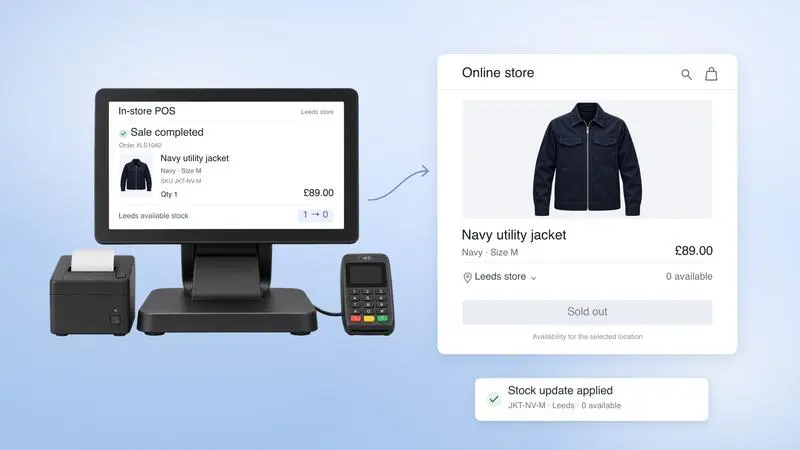
How POS ecommerce integration works, how stock syncs between stores and online, which system should hold master data, and what happens when a sync fails.
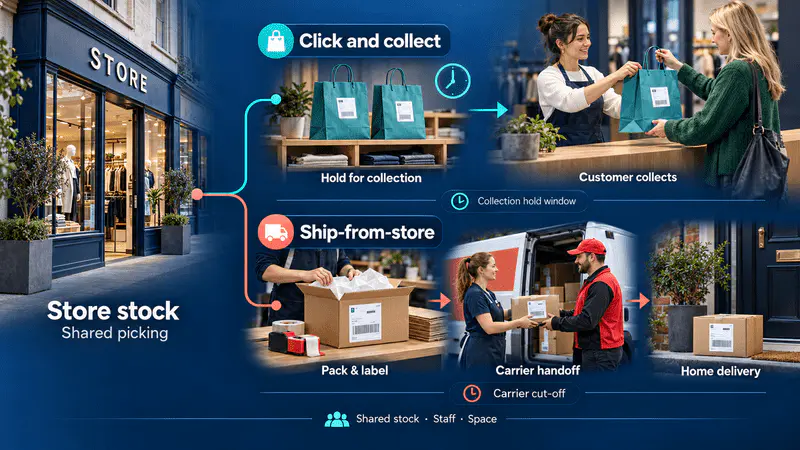
Compare click and collect with ship-from-store to understand the staffing, inventory, space and cost considerations of each model.
Isi formulir
Bagikan informasi kontak Anda untuk memulai
Bicara dengan pakar
Anggota tim sales kami akan menghubungi Anda